TL;DR: Kimi K3 scores 57.1 and ranks #4 of 189 in its current Artificial Analysis comparison class, just 1.8 points behind GPT-5.6 Sol and 2.7 points behind Claude Fable 5.[2] Its measured $0.94 cost per Intelligence Index task is 9.4% below Sol and 65.8% below Fable, while Moonshot's 2.8-trillion-parameter, 1-million-token model is scheduled to release full weights by July 27, 2026.[1][2] K3 is not the overall intelligence champion. It is the open-model champion in waiting, and that distinction is the real story.
Moonshot AI released Kimi K3 on July 16, then punctured its own launch hype with a rare admission: the model's overall performance still trails Claude Fable 5 and GPT-5.6 Sol.[1] That does not kill the champion argument. It tells us which crown K3 is actually chasing.
Artificial Analysis independently measured K3 at 57.1123, versus 59.8606 for the routed Fable configuration and 58.8898 for Sol at max reasoning. The same evaluation measured K3 at 62.0 output tokens per second, 1.99 seconds to first token, and $0.9398 per weighted benchmark task.[2][4] Those numbers place K3 inside the frontier, not above it.
The real story isn't that Moonshot won every test. It is that a model promised for open-weight release has reached within 3.02% of Sol's independent intelligence score, leads one current independent automation benchmark, offers a 1-million-token context window, and undercuts the premium leaders on measured task cost.[2][5]
Why This Matters Now
The frontier premium depends on scarcity. Kimi K3 challenges that scarcity by combining near-leading intelligence, broad agent performance, million-token context, and a promised weight release in one system. If Moonshot ships usable weights and a workable license, proprietary labs will have to defend not just better scores, but why buyers should accept permanent API dependence.
The Independent Verdict: Fourth Place Is Not A Defeat
Let's be clear: Kimi K3 is not number one on the broadest independent scoreboard available at launch.
Artificial Analysis' Intelligence Index v4.1 weights agent tasks at 34%, coding at 24%, scientific reasoning at 24%, and general capability at 18%. It combines nine evaluations and is text-only and English-only, so it is useful without being universal.[3] K3 ranks fourth because the live class includes Fable 5, Sol at max reasoning, and a second Sol configuration above it.
Kimi K3's Independent Launch Snapshot
Artificial Analysis measurements captured on July 17, 2026.
#4 of 189 in the current comparison class
#1 on guardrail-adjusted objective completion
Below the 72.7 t/s comparable-model median
Better than the 2.60 s comparable-model median
9.4% below Sol max and 65.8% below Fable with fallback
More than twice the 63M comparable-model median
The independent category win matters. On AutomationBench-AA, K3 reaches 52.7% guardrail-adjusted objective completion, ahead of Grok 4.5 at 51.4% and Sol at 51.2%. On the benchmark's separate raw completion measure, Grok leads at 80% and K3 scores 75%, which is why the metric name and methodology cannot be dropped from the claim.[5]
The Frontier Leaders: Intelligence, Speed And Task Cost
| Feature | Kimi K3 | Claude Fable 5* | GPT-5.6 Sol |
|---|---|---|---|
| AA Intelligence Index | 57.1 | 59.9 | 58.9 |
| Output speed | 62.0 t/s | 65.6 t/s | 53.1 t/s |
| Cost per AA task | $0.94 | $2.75 | $1.04 |
| Distance from leader | 2.7 points | Leader | 1.0 point |
Fable 5 is the max-effort routed configuration with Opus 4.8 fallback. Values are a July 17 live snapshot and can change as providers and measurements update.[2][4]
Fourth place looks different when the gap is 2.7 points and the measured task cost is 65.8% lower. K3 did not take the intelligence crown. It made the crown look expensive.
The Radar: Breadth Is K3's Strongest Claim
A radar chart is useful only when every axis speaks the same mathematical language. Mixing Intelligence Index points, tokens per second, dollars, Elo, and context length would create a dramatic shape with no defensible meaning. The comparison below uses seven 0-to-100 scores from Moonshot's own launch table instead.[1]
Moonshot-reported launch results. K3 was run at max effort. Several agentic rows use different native harnesses, so the chart compares deployed model-agent systems rather than base models under one standardized harness. Fable includes fallback behavior. The polygon is a capability profile, not an independent composite score.[1][12][13]
The shape tells a more useful story than its area. K3 leads Program Bench, BrowseComp, and Moonshot's Automation Bench row. Fable leads MCP Atlas. Sol leads Terminal-Bench 2.1, GPQA Diamond, and MMMU-Pro. K3 is competitive everywhere, but it does not dominate everywhere.
Here is the trap. The unweighted average across these seven selected axes gives K3 78.2000 and Sol 78.1714, a meaningless 0.0286-point K3 lead. Add the equally reasonable HLE-Full result and Sol moves ahead, 73.9625 to 73.8625. A champion claim that flips when one valid axis is added is not a champion claim. It is chart selection.
Kimi K3's radar is evidence of breadth. It is not a mathematical crown.
The Architecture: Moonshot Attacked Sequence And Depth
K3's 2.8 trillion parameters are the headline. The architecture is the strategy.
Moonshot combines Kimi Delta Attention, or KDA, with Attention Residuals and Stable LatentMoE. The router activates 16 of 896 experts for a token. Moonshot has not disclosed the model's total active parameter count, so dividing 2.8 trillion by the expert ratio would be fake precision.[1]
KDA changes information flow across sequence length. The earlier Kimi Linear research reported up to 75% lower KV-cache use and as much as 6x decoding throughput at 1-million-token context in its own comparison. Those are Kimi Linear paper results, not measured K3 production gains.[9] Attention Residuals changes information flow across depth by learning which earlier representations should be retrieved instead of accumulating every layer uniformly.[10]
Moonshot's disclosed Stable LatentMoE routing pattern. Total active parameters remain undisclosed, and the technical report is still pending.
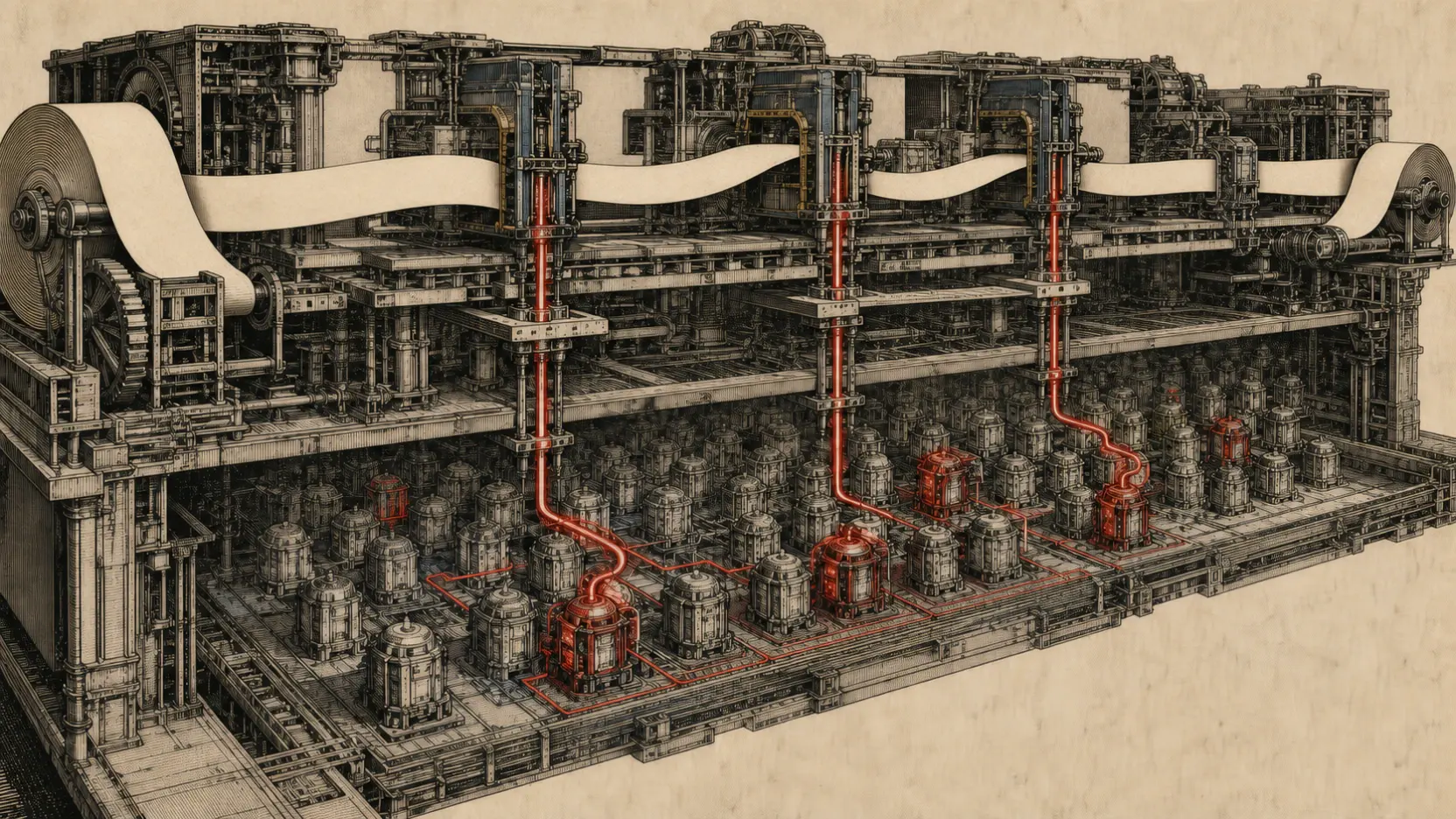
Here's the genius: Moonshot attacked the two places where giant models become economically awkward. KDA targets the memory burden across long sequences. Attention Residuals targets the information and communication burden across deep stacks. Stable LatentMoE limits how much of the expert pool is used for a token.
Moonshot claims the combined system delivers an approximate 2.5x improvement in overall scaling efficiency over Kimi K2. It also uses quantization-aware training with MXFP4 weights and MXFP8 activations, and recommends supernodes with 64 or more accelerators for deployment.[1] Those are first-party disclosures awaiting the promised technical report and weights.
The serving layer matters too. Moonshot's Mooncake research separates prefill from decoding and makes KV-cache movement a scheduling problem. The company says K3's official API achieves a cache-hit rate above 90% in coding workloads.[1][11] Architecture and infrastructure are being designed as one commercial system.
The Economics: Cheap Per Result, Expensive Per Token
K3 is not a bargain-bin model. The official API charges $0.30 per million cache-hit input tokens, $3.00 per million cache-miss input tokens, and $15.00 per million output tokens.[7] Artificial Analysis calls the $3 and $15 list prices somewhat expensive relative to comparable-model medians of $1.75 and $8.40.[2]
The real story isn't token price. It is cost per completed high-end task. K3's $0.94 weighted Intelligence Index task cost sits below Sol's $1.04 and far below Fable's $2.75, even though cheaper and lower-scoring systems beat K3 on pure cost.[2]
That advantage comes with a verbosity tax. K3 generated 130 million output tokens during the Intelligence Index run, versus a 63 million comparable-model median, and the full evaluation cost $2,690.80.[2] Max-only reasoning helps capability, but a $15 output rate turns every unnecessary reasoning token into a line item.

Cost Per Task Is Not Cost Per Accepted Result
Artificial Analysis' $0.94 figure is a weighted benchmark cost, not a universal production bill. Teams still need to price retries, tool calls, verification, long reasoning traces, cache-hit rates, and failures. K3's economics look strongest when a workload reuses large prefixes and accepts the model's first completed artifact.
The uncomfortable truth is that open models no longer have to be cheap to disrupt the market. They only need to be good enough that control, inspectability, and deployment choice become worth paying for.
The Open Bet: The Weights Are Still A Promise
Moonshot calls K3 the first open 3T-class model and says the full weights will be released by July 27, 2026. As of July 17, those weights are not on Moonshot's public Hugging Face model list, no K3 license has been published, and Artificial Analysis still classifies the model as proprietary.[1][2][14]
That is why "champion in waiting" is not wordplay. It is a release-state description.
The hosted product is real today. K3 is available through Kimi.com, Kimi Work, Kimi Code, and the kimi-k3 API. The API exposes max reasoning at launch, supports text and image input, and documents a default maximum completion of 131,072 tokens that can be raised within the 1,048,576-token total context limit.[1][6][8]
What's often overlooked is the operational coupling. Moonshot warns that multi-turn and tool workflows must return the assistant's earlier thinking and tool state unchanged. Dropping that history or switching models mid-session can destabilize quality.[6] K3 may be open later, but its best behavior could still depend on a carefully matched harness and serving stack.
What Must Happen Before The Crown Sticks
Moonshot must publish the complete K3 weights by July 27 with a clear license and reproducible inference guidance.
Independent evaluators must rerun K3's strongest coding and workflow claims under matched agent harnesses.
The technical report must disclose active parameters, training details, architecture ablations, and the evidence behind the 2.5x scaling-efficiency claim.
Production teams must test accepted-result cost because max reasoning and high verbosity can erase list-price advantages.
Open-source serving projects must prove that K3 can be deployed outside Moonshot's 64-accelerator supernode recommendation without destroying throughput.
The Verdict: K3 Targets The Frontier Moat
Kimi K3 did not beat Fable 5 or GPT-5.6 Sol on Artificial Analysis. It did not sweep Moonshot's own benchmark table. It is not downloadable today. Those are not footnotes. They define the limits of the claim.
They also reveal why the launch matters. K3 is 1.8 index points behind Sol, costs 9.4% less per measured task, runs 16.8% faster in the current provider snapshot, supports a 1-million-token context window, and has a credible independent win on AutomationBench-AA. Against Fable, it gives up 2.7 index points while cutting measured task cost by 65.8%.
While competitors protect proprietary margins, Moonshot was building a credible exit ramp from the closed frontier. Axios captured the launch-day industry reaction, but even the excitement came with the correct warning: K3 was only hours old, and early benchmarks could overstate real-world reliability.[15]
Call K3 the overall champion and the data says no. Call it open source today and the missing weights say no. Call it the open-model champion in waiting, and every important number points to the same conclusion.
The crown belongs to Fable and Sol for now. The moat is what Kimi K3 just put on trial.
Sources & References
Key sources and references used in this article
| # | Source | Outlet | Date | Key Takeaway |
|---|---|---|---|---|
| 1 | Moonshot AI / Kimi Kimi Team | July 16, 2026 | Official launch source for model size, architecture, benchmark table, pricing, availability, limitations, and the July 27 weight-release commitment. | |
| 2 | Artificial Analysis Artificial Analysis | July 17, 2026 snapshot | Independent source for the 57.1123 Intelligence Index, #4 ranking, $0.9398 task cost, 130M-token evaluation usage, pricing, context, and current proprietary classification. | |
| 3 | Artificial Analysis Artificial Analysis | 2026 | Defines the nine-evaluation Intelligence Index, category weights, English-only scope, testing parameters, and confidence-interval guidance. | |
| 4 | Artificial Analysis Artificial Analysis | July 17, 2026 snapshot | Provider-level source for output throughput, time to first token, end-to-end response time, and current first-party API measurements. | |
| 5 | Artificial Analysis Artificial Analysis | July 2026 | Independent benchmark where K3 leads guardrail-adjusted objective completion at 52.7%. | |
| 6 | Kimi API Docs Kimi Team | July 2026 | Official API behavior, reasoning settings, output limits, multimodal input, tool support, context caching, and thinking-history caveats. | |
| 7 | Kimi API Docs Kimi Team | July 2026 | Official $0.30 cache-hit input, $3 cache-miss input, and $15 output price per million tokens. | |
| 8 | Kimi Code Docs Kimi Team | July 2026 | Confirms K3 availability in Kimi Code, max reasoning at launch, and plan-dependent access to 256K or 1M context. | |
| 9 | arXiv Moonshot AI Researchers | October 2025 | Primary research source for Kimi Delta Attention and the earlier long-context cache and throughput results that inform K3's architecture. | |
| 10 | arXiv Moonshot AI Researchers | March 2026 | Primary research source for learned retrieval across model depth and the Block AttnRes efficiency design. | |
| 11 | arXiv Moonshot AI Researchers | July 2024 | Primary infrastructure research behind Moonshot's disaggregated prefill, decode, and cache-aware serving strategy. | |
| 12 | DataCurve DataCurve | July 2026 | Public coding leaderboard that exposes why KimiCode, Codex, Claude Code, and mini-SWE-agent results should not be merged without harness labels. | |
| 13 | Vals AI Vals AI | July 2026 | Independent benchmark source cited by Moonshot for comparator Program Bench results. | |
| 14 | Hugging Face Moonshot AI | July 17, 2026 snapshot | Public model repository used to verify that K3 weights had not appeared by the article cutoff. | |
| 15 | Axios Ina Fried | July 16, 2026 | Launch-day industry context, including the model's geopolitical significance and the warning that first-day results may overstate reliability. |
Last updated: July 17, 2026