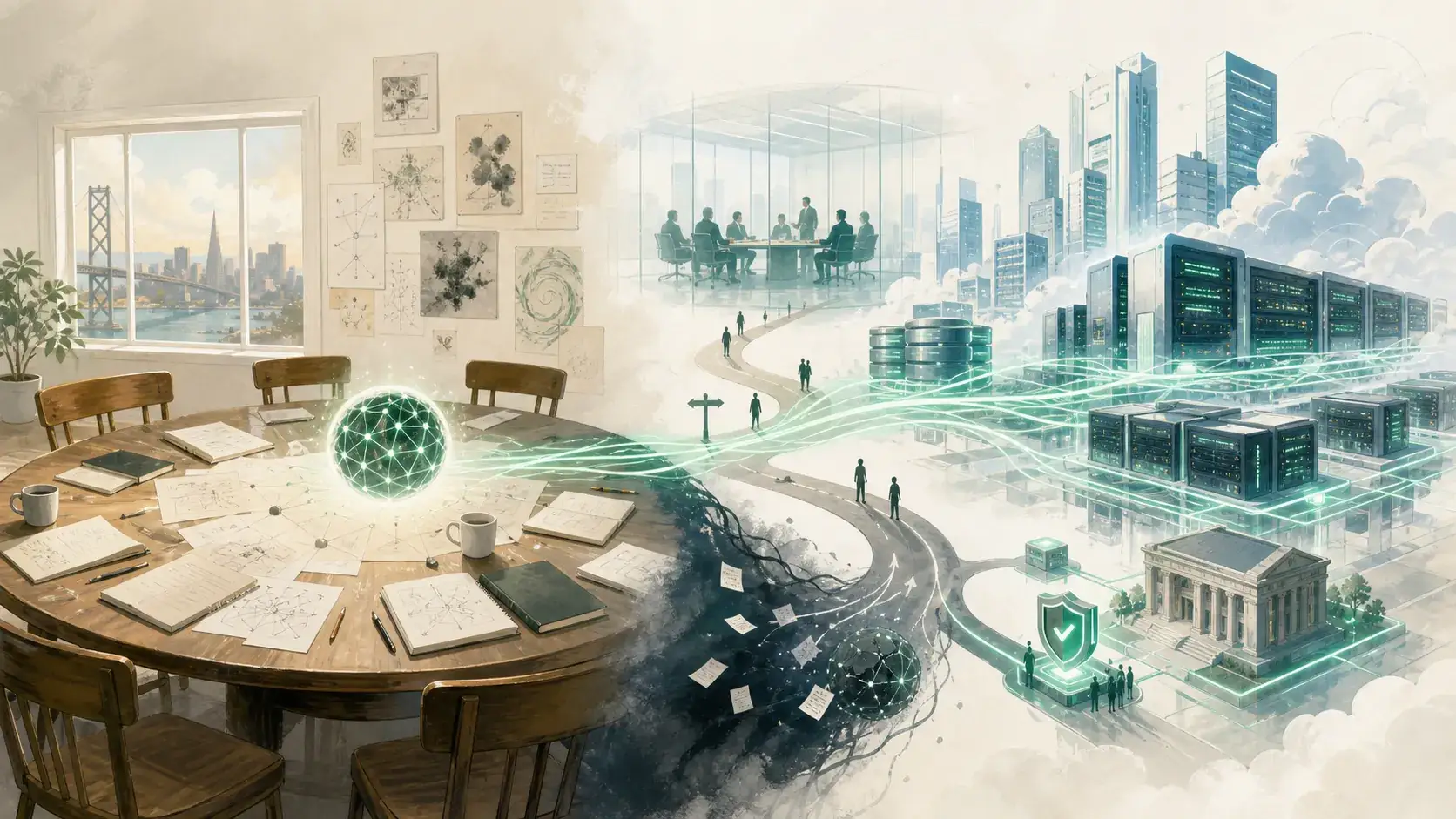
TL;DR: OpenAI was incorporated on December 8, 2015, as a nonprofit backed by a $1 billion pledge from some of Silicon Valley's biggest names; only $130 million of that pledge was actually received by 2019.[1] What followed was a decade of structural contradictions: a capped-profit pivot in 2019, a $13 billion Microsoft partnership, a five-day boardroom coup in 2023 that nearly destroyed the company, the departure of co-founder Ilya Sutskever, and a completed for-profit restructuring in October 2025 that left OpenAI Group PBC valued at $300 billion and the nonprofit foundation controlling equity worth $130 billion.[2] The mission was always to benefit humanity. The execution looked a lot like building a tech empire.
The dinner was at Sam Altman's house in San Francisco. The guests included Elon Musk, Greg Brockman, Ilya Sutskever, and a handful of researchers who were, at that moment, some of the most sought-after people in artificial intelligence. The pitch Altman and Musk made was simple, almost absurd in hindsight: pool resources, publish everything, and race to build artificial general intelligence in the open so that no single corporation could control it. They wanted to save the world by building the thing most likely to end it, and they wanted to do it as a nonprofit.
That dinner, and the conversations that surrounded it through 2015, produced what is arguably the most consequential organization in the history of technology. Not because OpenAI built AGI. But because it built ChatGPT, and ChatGPT changed what the public believed computers could do. Everything else followed from that.
What the founding mythology tends to skip is the structural reality. The $1 billion pledge was a pledge. By 2019, only $130 million had actually arrived. The "open" in OpenAI had been quietly dropped by the time GPT-3 launched as a closed API in 2020. And the "nonprofit" was restructured into a capped-profit entity just four years after founding, with Sam Altman as CEO and Microsoft as the anchor investor.[3]
The real story of OpenAI is a decade of tension between what the founders said they were building and what they actually built. Both things are interesting. But only one of them became a $300 billion company.
The Numbers Behind the Mythology
OpenAI was founded as a nonprofit in December 2015 with 11 co-founders and a $1 billion pledge. By the time ChatGPT launched in December 2022, the company had burned through hundreds of millions of dollars, lost $540 million in a single year, and pivoted to a capped-profit structure to attract serious capital. By April 2025, it had raised $40 billion in a single round, the largest private technology deal in history, led by SoftBank at a $300 billion valuation.[4]
The Founding: A Dinner Party That Built a Lab
OpenAI was incorporated on December 8, 2015, with an unusual founding team for a Silicon Valley AI company: it had eleven co-founders, a nonprofit structure, and no product.
The eleven founders were Sam Altman, Elon Musk (as co-chairs), Ilya Sutskever, Greg Brockman, Trevor Blackwell, Vicki Cheung, Andrej Karpathy, Durk Kingma, John Schulman, Pamela Vagata, and Wojciech Zaremba.[1] The roster reads like a draft pick of the 2015 AI research world. Sutskever had just helped found Google Brain after co-authoring AlexNet with Geoffrey Hinton. Karpathy was finishing his Stanford PhD on deep learning for vision. Schulman would go on to co-develop the reinforcement learning from human feedback (RLHF) techniques that made ChatGPT possible. Brockman had been CTO of Stripe. This was not a group short on ambition or credential.
The financial backing was equally high-profile. Sam Altman, Greg Brockman, Elon Musk, Reid Hoffman, Jessica Livingston, Peter Thiel, Amazon Web Services, and Infosys pledged a combined $1 billion. The operative word is "pledged." By 2019, company disclosures showed only $130 million had actually been received. The gap between the announcement and the reality would become a recurring theme.
The stated mission was to "advance digital intelligence in the way that is most likely to benefit humanity as a whole." The key phrase was that because OpenAI received no financial return from its work, it would have no conflicting interests. This was the founding promise: an AI lab that could be trusted because it had nothing to gain.
OpenAI was founded as a nonprofit with a $1 billion pledge. By 2019 only $130 million had arrived. The gap between announcement and reality would become a recurring theme.
The early years were genuinely research-forward. In 2016, OpenAI released OpenAI Gym, an open-source toolkit for reinforcement learning, and Universe, a platform for training AI agents. In 2017, the team spent $7.9 million on cloud compute, 25% of its total functional expenses, a number that sounds modest until you compare it to DeepMind's $442 million in total expenses that same year. The resource gap was already visible.[5]
The research outputs were real. OpenAI Five, the Dota 2 playing system, demonstrated that reinforcement learning could master extraordinarily complex multi-agent games. Dactyl, a robotic hand trained entirely in simulation, showed that sim-to-real transfer was further along than the field believed. These were not demo projects. They were genuine research milestones that shaped how the field thought about AI capability.
The First Crack: Musk Leaves, GPT-1 Arrives (2018)
The year 2018 was the first in which the founding narrative started visibly fracturing.
In February, Elon Musk resigned from OpenAI's board. The stated reason was potential conflict of interest with Tesla's own AI development for autonomous vehicles. Musk remained a donor and supporter, publicly. Privately, a different story was already taking shape. Musk had pushed hard to take operational control of OpenAI, proposing to merge it with Tesla or to become CEO himself. When the board declined, he left.[6] The rift would not become public for years, but the relationship was already broken in 2018.
The same year, OpenAI published GPT-1: a language model with 117 million parameters trained on 7,000 unpublished books. It was the first model in what became the most consequential model family in AI history. GPT-1 could generate coherent text, complete sentences, and answer basic questions. Nobody outside the field noticed. That was about to change.
The GPT-2 Controversy and the Capped-Profit Pivot (2019)
February 2019 was the moment OpenAI became a subject of public debate rather than just academic interest.
The company announced GPT-2, a language model with 1.5 billion parameters capable of generating remarkably convincing fake text. OpenAI's decision was to not release it. The stated reason: fear of misuse, specifically fake news generation. The actual release would be staged over nine months, with progressively larger model sizes published as the research community demonstrated limited evidence of actual misuse.
The AI community's reaction was split. Some praised the caution as responsible disclosure. Others accused OpenAI of using "safety" as cover for competitive advantage and publicity. The debate prefigured arguments that would play out repeatedly over the next decade: who decides what AI capabilities are too dangerous to publish, and what interests drive those decisions?
One month later, in March 2019, OpenAI made a far more consequential announcement with far less fanfare: the creation of OpenAI LP, a new "capped-profit" entity.[3] The structure was novel. Investors could receive returns of up to 100 times their investment. The nonprofit board retained control. Profits beyond the 100x cap would go to the nonprofit mission. The pitch to investors was that frontier AI required billions in compute and talent that a nonprofit could never attract.
Sam Altman stepped down from Y Combinator to become CEO of OpenAI. Three months later, Microsoft announced a $1 billion investment in OpenAI LP, the beginning of what became the most important bilateral partnership in AI history.[7]
OpenAI's Structural Evolution: What Changed and Why
| Feature | Structure | Key Feature | The Real Reason |
|---|---|---|---|
| Nonprofit (2015) | Nonprofit 501(c)(3) | No investor returns. Full publication of research. | Recruiting cover: attract researchers who wanted to work for mission, not equity. |
| Capped-Profit LP (2019) | Capped at 100x investor returns | Microsoft $1B anchors. Sam Altman as CEO. | GPT-3 compute costs exceeded what donations could support. Needed real capital. |
| For-Profit PBC (2025) | Public Benefit Corporation, nonprofit holds equity | Completed Oct 28, 2025. Nonprofit foundation valued at ~$130B. | SoftBank's $40B investment required a conventional equity structure to clear. |
GPT-3 and the Closed Garden (2020)
June 2020. OpenAI released GPT-3 with 175 billion parameters, nearly 100 times larger than GPT-2. It was the most capable language model the world had seen, and OpenAI did not open-source it.
GPT-3 was available only through an API with a waitlist. The "open" in OpenAI had been functionally abandoned. The justification was safety and responsible deployment. The practical effect was a competitive moat. Every capability demonstration, every integration, every research paper built on GPT-3 ran through OpenAI's servers and generated revenue for OpenAI's bottom line.
GPT-3 convinced the technology industry that large language models were something qualitatively different from previous AI systems. The emergent capabilities, code generation, translation, summarization, few-shot learning across arbitrary domains, were not things the field had predicted at that scale. OpenAI had discovered something real, and they had the only copy.[8]
The same year, DALL-E was announced (January 2021), Codex launched as the foundation for GitHub Copilot, and Microsoft's investment relationship deepened into exclusive licensing of GPT-3's underlying technology. By 2021, OpenAI's valuation had reached $14-20 billion according to VC investment rounds. The nonprofit phase was operationally over.
The Year of Reckoning: 2022
The financial picture in 2022 was alarming. OpenAI reported $540 million in losses on $28 million in revenue. The compute costs to train increasingly large models were scaling faster than any revenue model could cover. Microsoft's $1 billion was not going to last. The company needed either a product that could generate billions in revenue or another massive investment round.[9]
It got both.
On November 30, 2022, OpenAI launched ChatGPT as a free research preview. It was built on GPT-3.5, a more efficient model than the full GPT-3, and it had a conversational interface that made the underlying capability accessible to anyone with an internet connection. No API key. No prompt engineering. Just a chat box.
Within two months, ChatGPT had 100 million users. It was the fastest consumer application in history to reach that milestone, surpassing TikTok. Every boardroom in the world ran a demo. Every government started a working group. Every AI competitor accelerated their roadmap. The race that the founding founders had theoretically been running since 2015 became a sprint that everyone could see.
OpenAI by the Numbers: Decade in Review
As a nonprofit with 11 co-founders and a $1B pledge (only $130M received)
Fastest consumer app ever to reach 100M users, launched Nov 30, 2022
$1B in 2019, $10B in Jan 2023, plus additional tranches
SoftBank-led round at $300B post-money valuation, largest private tech deal in history
Up from $3.7B in all of 2024. 20M paid subscribers, 5M business customers
OpenAI Foundation equity stake post-restructuring, Oct 2025. One of the best-resourced philanthropic orgs ever.
January 2023: Microsoft Goes All In
In January 2023, Microsoft announced a multi-year investment of $10 billion in OpenAI, bringing its total commitment to more than $13 billion. The deal structure was reported to give Microsoft 49% of OpenAI LP's for-profit profits until the investment was recouped, and up to a 75% revenue share during that period.[7]
The partnership had been building since 2019, but the $10 billion announcement was categorically different. This was not a bet on AI in general. It was Microsoft integrating OpenAI's models into every product it shipped: Bing, Azure, Office, GitHub Copilot, Windows Copilot. The Copilot branding became the Microsoft AI identity. OpenAI's technology became the substrate of Microsoft's entire AI strategy.
For OpenAI, the arrangement was existential: without Microsoft's Azure compute infrastructure, there was no viable path to training frontier models. The cloud costs to train GPT-4, released in March 2023, ran into the hundreds of millions of dollars. Microsoft was not just an investor. It was the infrastructure provider on which OpenAI's existence depended.
GPT-4 landed in March 2023 with multimodal capabilities (text and images), significantly improved reasoning, and a 32,000-token context window. It outperformed GPT-3.5 on virtually every benchmark and passed bar exams, medical licensing tests, and graduate-level reasoning evaluations at human-expert level. The system that had started with 117 million parameters in 2018 now had parameters measured in the hundreds of billions and capabilities that the founders of OpenAI had not imagined when they had dinner in San Francisco in 2015.
Dev Day and the Week from Hell: November 2023
On November 6, 2023, OpenAI hosted its first developer conference in San Francisco. Sam Altman unveiled GPT-4 Turbo (128K context, cheaper, faster), custom GPTs (mini-apps built on ChatGPT), the Assistants API for building AI agents, and DALL-E 3. It was the company at peak momentum: 100 million users, a dominant market position, a product suite that covered text, code, and image generation, and a CEO who was on the cover of every business magazine. Eleven days later, the board fired him.
The timeline of what happened between November 17 and November 21, 2023 remains the most analyzed five days in Silicon Valley history.
The Week from Hell: OpenAI's Five-Day Boardroom Crisis
Key milestones in development
| Date | Milestone | Significance |
|---|---|---|
| Nov 17, 2023 | Sam Altman fired as CEO | The four-member nonprofit board (Helen Toner, Ilya Sutskever, Adam D'Angelo, Tasha McCauley) voted to remove Altman, citing 'not consistently candid in his communications.' CTO Mira Murati named interim CEO. Greg Brockman removed as board chair, resigned as president hours later. |
| Nov 18, 2023 | Investors scramble, Altman in talks to return | Microsoft and other investors not consulted before firing. Microsoft CEO Satya Nadella furious. Reports emerge that Altman had been negotiating to return within 12 hours of being fired. The board briefly considered Anthropic CEO Dario Amodei as a replacement. |
| Nov 19, 2023 | Altman and Brockman join Microsoft | Satya Nadella announces on X that Microsoft has hired Altman and Brockman to lead a new in-house AI team. Meanwhile, Ilya Sutskever, who voted to fire Altman, signs an employee letter calling for the board to reinstate him and resign. |
| Nov 20, 2023 | 700+ employees sign ultimatum letter | More than 700 of OpenAI's ~770 employees sign a letter threatening to resign and join Microsoft unless the board reinstates Altman and resigns. OpenAI faces complete organizational collapse. Even Sutskever signs: 'I deeply regret my participation in the board's actions.' |
| Nov 21, 2023 | Altman reinstated, board replaced | Sam Altman returns as CEO. Greg Brockman returns. Entire instigating board replaced. New board: Bret Taylor (chair), Lawrence Summers, Adam D'Angelo (retained). Ilya Sutskever sidelined. Microsoft given non-voting observer seat. The for-profit machine had defeated the safety-first nonprofit board in 96 hours. |
The post-mortem that emerged over the following months was complicated. The board's stated reason, lack of candor, was vague enough to suggest deeper disagreements. Subsequent reporting indicated that some employees had raised concerns about how Altman handled the safety implications of an internal AI capability discovery shortly before the firing. Others pointed to disagreements about the pace of commercialization versus safety research. The board had believed it was acting within its governance authority. It had not accounted for the fact that its governance authority meant nothing if every employee and every investor chose to override it.
What the crisis proved, conclusively, was that the nonprofit board structure Altman and Musk had designed in 2015 was not actually in control of OpenAI in 2023. The for-profit entity, its investors, and its employees were. The board could theoretically fire the CEO. It could not survive the attempt.
The Brain Drain: Ilya, Jan Leike, and the Safety Exodus (2024)
May 2024. Ilya Sutskever announced he was leaving OpenAI. The statement was brief and characteristically understated. He had "a big new vision," he said. It was more suitable for a new company.
What Sutskever did not say was the more important part. In a deposition taken in October 2025 as part of Elon Musk's lawsuit against OpenAI, Sutskever described years of accumulating tension inside the company: doubts about Altman's judgment, eroding trust in the leadership's priorities, and a growing sense that the direction OpenAI was heading was incompatible with the research agenda he believed mattered most.[10]
Hours after Sutskever's departure announcement, Jan Leike, the head of OpenAI's superalignment team (the group tasked with ensuring advanced AI remained safe and aligned), also resigned. Leike was less circumspect. He posted that OpenAI had "drifted from its core mission" and that safety culture and processes had "taken a back seat to shiny products." It was as direct a public indictment of a company's priorities as a senior researcher had ever published about an employer in real time.[11]
The departures were not isolated. John Schulman, one of the original eleven founders and a key architect of the RLHF training methods that enabled ChatGPT, also left in 2024. Greg Brockman announced a sabbatical in September 2024 and did not return. By mid-2024, only 4 of OpenAI's original 11 co-founders remained with the company.
In June 2024, Sutskever announced his new company: Safe Superintelligence Inc. (SSI), co-founded with Daniel Gross and Daniel Levy, with offices in Palo Alto and Tel Aviv. The mission statement was deliberately maximal and product-free: SSI would build "safe superintelligence" in a "straight shot," with no other products and no revenue-generating distractions until that goal was achieved.[12]
SSI raised $1 billion in September 2024 from Andreessen Horowitz, Sequoia, DST Global, and SV Angel. By March 2025, it had raised a further $2 billion at a $32 billion valuation. In June 2025, Meta attempted to acquire SSI. Sutskever declined. His co-founder and CEO Daniel Gross left for Meta. Sutskever became CEO of SSI himself. The lab that Ilya built, the one that was supposed to be OpenAI's soul, had been reconstituted as a separate company that Meta failed to buy.
Where the Founders Went: The OpenAI Alumni Map
Ilya Sutskever
Co-founded Safe Superintelligence Inc. in June 2024. Raised $3B. Currently CEO after Daniel Gross left for Meta. SSI is valued at $32B and has released no products. Its entire mission is building superintelligence safely, the original OpenAI promise.
Elon Musk
Resigned from the OpenAI board in February 2018. Founded xAI in 2023 and launched Grok. Filed a lawsuit against OpenAI and Sam Altman in March 2024 over the for-profit conversion, arguing it violated the founding agreement. A related xAI trade-secrets lawsuit was dismissed February 24, 2026.
Greg Brockman
Co-founder and president who survived the Nov 2023 crisis alongside Altman. Announced a sabbatical in September 2024 and did not return. One of only three original co-founders who remained at OpenAI through the Nov 2023 coup and then subsequently departed.
Andrej Karpathy
Left OpenAI in 2017 to join Tesla as Director of AI, returned to OpenAI in 2022, then left again in February 2023 to focus on his own AI education project (Eureka Labs, later acquired). His departures bookend the consumer AI era.
The Musk War: Lawsuits, xAI, and the Long Grudge
Elon Musk and OpenAI's relationship was never fully repaired after his 2018 board departure. In March 2024, it became a legal matter.
Musk filed suit against OpenAI and Sam Altman, arguing that the company's conversion to a for-profit structure violated the founding agreement he had helped create and the charitable contributions he had made in reliance on the nonprofit structure.[6] The lawsuit was expansive: it alleged breach of contract, breach of fiduciary duty, and violations of California's unfair competition law.
OpenAI's response was pointed. The company released documents purporting to show that Musk himself had agreed to and pushed for a for-profit structure when it became clear that the nonprofit could not attract the capital needed for frontier AI development. OpenAI's lawyers argued the lawsuit was "yet another front in Mr. Musk's ongoing campaign of harassment" rather than a legitimate legal grievance.
A parallel xAI trade-secrets lawsuit, accusing OpenAI of receiving stolen technical information from a former xAI engineer, was dismissed by a US federal judge on February 24, 2026. The core lawsuit over the for-profit conversion remains in litigation.
The Musk-Altman dynamic is perhaps the defining interpersonal feud of the AI era. Two people who shared a founding vision in 2015 are now running competing AI companies and suing each other in federal court. Musk's Grok, built by xAI, competes directly with ChatGPT. The acrimony between them generates more coverage than most actual AI research.
Stargate and the $300 Billion Reality (2025)
January 21, 2025. At the White House, Sam Altman, SoftBank CEO Masayoshi Son, and Oracle Chairman Larry Ellison announced Project Stargate: a $500 billion initiative to build AI infrastructure across the United States over four years, backed by SoftBank, Oracle, and OpenAI as the primary partners. The first $100 billion was committed immediately. The announcement came the day after Donald Trump's inauguration.
Three months later, in April 2025, OpenAI closed a $40 billion funding round led by SoftBank. The post-money valuation: $300 billion. It was the largest private technology deal in recorded history, surpassing the previous record by a substantial margin.[4]
By July 2025, OpenAI reported annualized revenue of $12 billion, up from $3.7 billion in all of 2024. ChatGPT had 20 million paid subscribers. Five million businesses were paying customers. The free preview that launched on November 30, 2022 had become a multi-billion-dollar subscription and enterprise software business in under three years.
On October 28, 2025, OpenAI completed its for-profit restructuring. The company became OpenAI Group PBC, a public benefit corporation. The OpenAI Foundation, the surviving nonprofit entity, retained equity in the for-profit currently valued at approximately $130 billion, making it one of the most valuable philanthropic organizations in the world by asset size. Microsoft, which had been the company's anchor investor and infrastructure partner since 2019, received equity as part of the restructuring, valued at approximately $135 billion at closing.[2]
The Uncomfortable Truth About the Mission
The OpenAI Foundation holds $130 billion in equity and plans a $25 billion philanthropic commitment. That sounds like mission success. But the mission was explicitly to prevent any single entity from controlling transformative AI. The entity that now has the most direct influence over the most widely deployed frontier AI model is a for-profit public benefit corporation majority-controlled by the combination of its own management, SoftBank, and Microsoft. The founding mission and the resulting structure are, charitably, in tension.
What OpenAI Actually Is in 2026
The company that emerged from a decade of structural contradiction is something its founders would recognize in some respects and not at all in others.
On the product side, OpenAI is the dominant consumer AI brand globally. ChatGPT has no close competitor for mindshare. The GPT model family, now extending through GPT-4, GPT-4o, o1, o3, GPT-4.5, GPT-4.1, o4-mini, GPT-5, GPT-5.1, and GPT-5.2, spans reasoning, coding, vision, and multimodal tasks. The Sora video generation model, Whisper for speech recognition, and DALL-E for image generation extend the product surface well beyond text. Operator, their autonomous agent product, competes in the agentic AI market that every major lab is racing to define.
On the research side, the picture is more contested. The departures of Sutskever, Leike, and Schulman removed three of the architects of OpenAI's most important research contributions. The superalignment team that Sutskever and Leike built, tasked with figuring out how to ensure advanced AI remains safe, has been restructured multiple times. The publication record for fundamental research has declined relative to the company's early years, when it freely published work on reinforcement learning, robotics, and language models.
On the mission side, the distance from the founding vision is hardest to measure. The nonprofit board that fired Sam Altman in November 2023 was acting on a sincere belief that the for-profit pressure was overriding the safety-first mandate. The investor-employee-market coalition that reinstated him believed the mission required the company to survive and grow. Both positions contain truth. The restructuring that completed in October 2025 chose a side.
The OpenAI Decade: What Actually Happened
OpenAI's $1 billion founding pledge was largely fiction: only $130 million was received by 2019. The capped-profit pivot was not optional, it was survival.
The 'open' in OpenAI was abandoned by 2020, when GPT-3 launched as a closed API. The founding commitment to open publication did not survive the first commercially deployable model.
ChatGPT reaching 100 million users in two months in early 2023 was the event that changed the AI industry. Everything that followed, the Microsoft deal, the $300B valuation, the boardroom crisis, was downstream of that launch.
The November 2023 crisis proved that the nonprofit governance structure was structurally incapable of overriding the for-profit machine once it reached sufficient scale.
Ilya Sutskever, the researcher most responsible for the technical breakthroughs that made ChatGPT possible, left to build a company (SSI, $32B) explicitly structured to avoid the commercialization pressures he saw destroy OpenAI's original mission.
The completed for-profit restructuring in October 2025 was not a betrayal of the mission, it was the logical endpoint of choices made in 2019, 2020, and 2023. The nonprofit board lost control the day it created the for-profit entity.
At $300 billion and $12 billion in annualized revenue, OpenAI is the most commercially successful AI company in history. Whether it is also the most beneficial to humanity, the founding criterion, remains genuinely unresolved.
Last updated: February 26, 2026
Sources & References
Key sources and references used in this article
| # | Source | Outlet | Date | Key Takeaway |
|---|---|---|---|---|
| 1 | Feb 2026 | |||
| 2 | Oct 28, 2025 | |||
| 3 | Dec 27, 2024 | |||
| 4 | Mar 31, 2025 | |||
| 5 | Nov 2023 | |||
| 6 | Feb 21, 2018 | |||
| 7 | Jul 22, 2019 | |||
| 8 | Dec 12, 2015 | |||
| 9 | Nov 20, 2023 | |||
| 10 | Nov 5, 2025 | |||
| 11 | May 14, 2024 | |||
| 12 | Jun 19, 2024 | |||
| 13 | Oct 27, 2025 | |||
| 14 | Feb 24, 2026 | |||
| 15 | Oct 2025 |