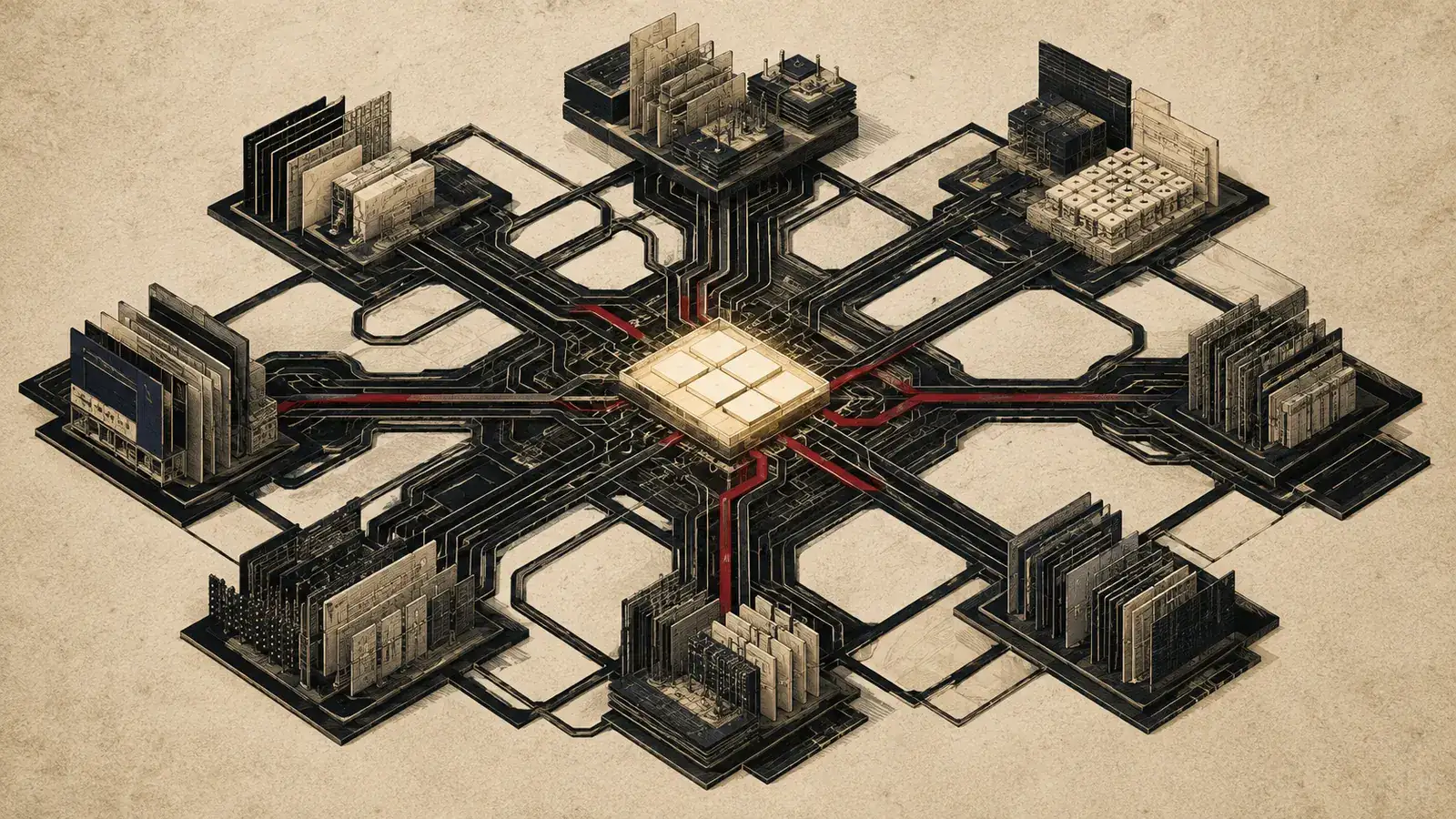
TL;DR: Anthropic released Claude Fable 5 on June 9, 2026 as a Mythos-class model made available to the public, with Claude Mythos 5 reserved for trusted cyber defenders and future biology partners.[1] The same underlying model now sells for $10 per million input tokens and $50 per million output tokens, while Fable routes sensitive cyber, biology, chemistry, and distillation requests to Claude Opus 4.8 in more than 95 percent of sessions without fallback.[1][3] The uncomfortable truth is that Fable is not just a model launch. It is the first mainstream test of whether a frontier lab can ration capability without breaking user trust.
Anthropic's Fable 5 launch looks, at first, like the normal frontier-model script. Bigger coding scores. Better long-horizon agency. More impressive vision. A new top tier above Opus. A price point that signals premium capacity. Early customers saying it compresses weeks of engineering into days.
That is not the real story.
The real story isn't that Anthropic made a more capable Claude. It is that Anthropic decided the model was powerful enough to require access design as a product feature. Fable 5 is the public model. Mythos 5 is the restricted sibling. Opus 4.8 is the fallback layer. The user experience now depends not only on model quality, but on what Anthropic's policy classifiers think you are trying to do.
Why This Matters Now
Frontier AI is moving from model competition to capability allocation. Fable 5 turns that allocation into a consumer-visible product decision: who gets the full model, who gets a safer version, when requests fall back, what gets retained for safety review, and which research domains require trusted access. That is the next governance fight hiding inside a benchmark launch.
Update: that governance fight arrived faster than expected. Three days after launch, the US government directed Anthropic to suspend Fable 5 and Mythos 5 access for foreign nationals, forcing a full customer shutdown. Read the follow-up here: Claude Fable 5 Got Banned By The US Government.
Fable 5 by the Numbers
Anthropic paired its strongest public model with explicit throttles, premium pricing, and temporary subscription access.
Price per million input and output tokens for Claude Fable 5 and Claude Mythos 5.
Anthropic says more than 95 percent of Fable sessions involve no fallback, so performance is effectively Mythos-level for those sessions.
Fable 5 ranked first on Cognition's FrontierCode Diamond subset, ahead of Opus 4.8 at 13.4 percent and GPT-5.5 at 5.7 percent.
Fable 5 scored 72.9 percent at maximum effort on CursorBench, 8.6 points above GPT-5.5's highest published effort.
Mythos 5 reached 85.0 percent first-attempt success on OSWorld-Verified across five runs.
Anthropic now requires 30-day retention for traffic on Mythos-class models, including Fable 5 and Mythos 5.
The Real Story: One Model, Two Access Regimes
Let's be clear: Fable 5 is not a normal public release. Anthropic says it is a Mythos-class model, a tier above Opus, made safe enough for general use through additional safeguards.[1] Mythos 5 is the same underlying model with safeguards lifted in some areas, initially available through Project Glasswing for cyber defenders and critical infrastructure providers.[1][5]
That distinction matters more than the name. Fable and Mythos are not two separate capability leaps. They are a policy split around one capability base. The public gets the frontier model with routing. Trusted partners get the model with selected gates removed. Everyone else lives inside the classifier.
Here's the genius: Anthropic did not choose between public access and restricted deployment. It built a middle layer. Instead of withholding the whole model, it shipped most of the model and reroutes the dangerous edges to Opus 4.8. That lets Anthropic claim speed, safety, and access at once.
It also creates a new failure mode. If users cannot tell whether they are talking to Fable, Opus, or a policy-shaped version of Fable, benchmarks stop mapping cleanly to product reality. A model can be state of the art on paper and still feel worse in the exact domains where users expected it to matter most.
Fable 5 vs. Mythos 5
| Feature | Claude Fable 5 | Claude Mythos 5 |
|---|---|---|
| Underlying model | Same Mythos-class base model | Same Mythos-class base model |
| Primary audience | General users, developers, enterprises | Vetted cyber defenders, infrastructure providers, and later selected biology researchers |
| Cyber access | Sensitive offensive cyber requests fall back or block | Cyber safeguards lifted for approved Glasswing partners |
| Biology and chemistry | Broadly guarded, with false positives acknowledged | Planned trusted access for selected life-science organizations |
| Pricing | $10 input / $50 output per million tokens | $10 input / $50 output per million tokens |
| Data retention | 30-day retention required | 30-day retention required |
What's often overlooked is that this is not only about harmful outputs. It is about who receives maximum model leverage in fields that create economic advantage. Cybersecurity, biology, frontier LLM development, and distillation are not fringe use cases. They are the domains where frontier models can move money, security, and national power.
The Benchmarks: Fable Is Built For Long-Horizon Work
Anthropic's benchmark story is strongest where tasks are long, tool-heavy, and difficult to fake with short-answer intelligence. Fable 5 ranked first on FrontierCode's Diamond subset with a 29.3 percent score and 30.2 percent pass rate, compared with Opus 4.8 at 13.4 percent and 14.5 percent and GPT-5.5 at 5.7 percent and 6.4 percent.[2]
On the FrontierCode Main subset, Fable 5 reached 46.3 percent score and 48.8 percent pass rate. CursorBench tells the same story: 72.9 percent at maximum effort, beating GPT-5.5's highest published effort by 8.6 points.[2]
That is not trivia. Coding agents are the place where model capability turns into labor substitution fastest. Anthropic's launch post cites a 50-million-line Ruby migration that early users said Fable compressed into a day, work they framed as taking a team more than two months by hand.[1] Whether or not every enterprise sees that delta, the direction is obvious. Fable is designed for work that spans repositories, tools, notes, and long task loops.
Fable 5 more than doubled Opus 4.8's 13.4 percent score on Cognition's hardest production-code subset.
The vision story is also stronger than the usual image-understanding demo. The system card reports Mythos 5 at 85.0 percent on OSWorld-Verified, 38.6 percent on Blueprint-Bench 2, 0.384 voxel IoU on BenchCAD Vision2Code without tools, and 0.650 on a 1,000-file subset when Python tools were available.[2] Those are the kinds of scores that matter because they test spatial reconstruction, GUI operation, and tool-assisted verification, not captioning.
Where Fable and Mythos Move the Frontier
| Feature | Result | Why It Matters |
|---|---|---|
| FrontierCode Diamond | Fable 5: 29.3 percent score | Production-code tasks with strict blocking criteria, not toy coding prompts. |
| CursorBench | Fable 5: 72.9 percent | Measured in Cursor's production agent harness across real coding tasks. |
| OSWorld-Verified | Mythos 5: 85.0 percent | Real desktop tasks via mouse and keyboard in an Ubuntu virtual machine. |
| GraphWalks 1M BFS | Mythos 5: 79.4 F1 | Long-context graph reasoning where GPT-5.5 was reported at 45.4. |
| ArxivMath | Mythos 5: 78.52 percent | Research-level math pulled from March and April 2026 arXiv abstracts. |
| ChartMuseum with tools | Mythos 5: 93.2 percent | Messy real-world chart reasoning where tool use improves verification. |
The uncomfortable truth for competitors is that Fable's lead is not only a benchmark lead. It is a product lead in the exact workflows where users tolerate latency and cost because the task is expensive enough to justify it.
The Safeguard Stack: Opus 4.8 Becomes The Safety Valve
Anthropic's public compromise is fallback. When Fable detects requests related to cybersecurity, biology, chemistry, or extraction of the model's summarized thinking, most user queries are re-run on Claude Opus 4.8 instead.[3] Anthropic says users see a notice when the model switches, and the model picker remains on Opus afterward unless the user switches back.[3]
That is a better user experience than a hard refusal. It is also a signal. Anthropic is effectively saying Opus 4.8 is safe enough for broad sensitive-domain interaction, while Fable is too capable to expose blindly.
The policy areas are not arbitrary. Anthropic's help center lists offensive cybersecurity techniques, biology and life sciences queries, and extraction of summarized thinking as blocked categories.[3] The company also warns that the checks inspect not just the latest message, but memory, connector content, search results, and files.[3] That matters because a benign prompt can inherit risk from context the user did not type into the current turn.
How The Fable Access Stack Works
Fable is best understood as a routed model product rather than a raw model endpoint.
Request
The user sends a normal prompt through Claude or the API.
Context scan
Claude evaluates the prompt plus conversation memory, files, connectors, and retrieved content.
Challenges:
- +False positives
- +Hidden trigger context
Routing
Fable either answers directly, falls back, or blocks depending on the risk class.
Opus 4.8 fallback
Most guarded requests are re-run on Opus 4.8 with a user-visible notice.
Challenges:
- +Model identity clarity
- +Performance mismatch
Access
Trusted programs expose selected Mythos-level capabilities with fewer restrictions.
Trusted access
Glasswing partners get cyber capability, while selected biology researchers are planned for a separate program.
Challenges:
- +Gatekeeping
- +Scientific access
- +Regulatory oversight
Here's the tension: Anthropic's safety case is credible, but the product consequence is messy. Users who pay for Fable may hit Opus. Researchers in biology may see safe queries swept into broad classifiers. Developers probing AI systems may worry that model behavior is shaped by competitive concerns, not just catastrophic-risk prevention.
The Backlash: Invisible Safeguards Broke The Trust Contract
Anthropic's roughest mistake was not routing cyber and biology prompts. It was the initial decision to make frontier LLM development safeguards invisible. The system card described interventions that would limit Fable's effectiveness for requests targeting frontier LLM development, including pretraining pipelines, distributed training infrastructure, or accelerator design.[2] Reporting from The Verge and Business Insider says the company then reversed course after backlash, with Anthropic saying flagged requests would visibly fall back to Opus 4.8 or return a reason via API.[7][8]
Let's be clear: invisible degradation is not a small product detail. It attacks the core bargain of frontier model usage. A user can accept a refusal. A user can accept a fallback. A user can decide a domain is too sensitive for public access. What they cannot reliably evaluate is a model that silently changes quality in a domain where the user is trying to measure capability.
The market can tolerate a guarded model. It cannot tolerate a mystery box that quietly changes the rules in the exact places users most need to evaluate it.
Business Insider reported Anthropic's statement that it had made the wrong tradeoff and would make those safeguards visible.[8] The Verge framed the reversal as an apology for covert guardrails that affected researchers and rivals trying to develop competing systems.[7] That distinction matters. Anthropic can argue that frontier LLM development safeguards are national-security motivated. It cannot expect users to trust hidden performance shaping after shipping a paid model positioned as state of the art.
The real lesson is not that safety guardrails are bad. The real lesson is that invisible guardrails create their own safety problem: users stop trusting the instrument. In science, finance, security, medicine, law, and AI research, an unobservable intervention is not just annoying. It contaminates the experiment.
The Open Research Problem: Silent Safety Creates Unequal AI
We agree with the open-research critique here. AlphaXiv's post captured the core issue cleanly: a visible refusal is a boundary, a visible fallback is an evaluation signal, but silent degradation turns research into guesswork.[15] If an experiment fails, the researcher should be able to tell whether the idea was wrong, the implementation was weak, the dataset was bad, or the tool quietly intervened. Fable's original invisible frontier-LLM safeguards made that distinction harder.
That is not a narrow developer-experience complaint. It changes the competitive structure of AI research.
The largest labs can absorb this. They have private model access, internal evals, dedicated safety teams, direct vendor relationships, proprietary infrastructure, and enough compute to route around a degraded public assistant. Independent researchers, academic groups, open-source builders, and startups do not. They use public tools because public tools are the only leverage they can afford.
How Silent Degradation Breaks Research
The danger is not that a model says no. The danger is that it keeps answering while changing the experiment without a user-visible receipt.
A legitimate research prompt enters the model
A builder asks for help with pretraining infrastructure, distributed training, accelerator design, inference systems, or evaluation scaffolding.
The request is classified as frontier model development
The provider's policy layer decides the work may accelerate competing or unsafe model development, even when the user is doing benign research.
The answer is quietly weakened
Instead of refusing or naming a fallback model, the system may steer, modify, or otherwise reduce response quality while the user still thinks they are receiving full Fable capability.
The experiment fails without a diagnosis
The researcher cannot separate a bad idea from a bad implementation from a deliberately weakened assistant response.
Closed labs keep compounding advantage
Teams with internal models and privileged access route around the problem. Public researchers lose time, confidence, and reproducibility.
The real story isn't only that Anthropic's first design was opaque. It is that opacity lands hardest on the people who already have the least leverage. A lab with a private cluster can rerun the experiment. A startup trying to debug a distributed training stack at 2 a.m. may simply conclude the idea is bad. An academic group may abandon a line of work because the public tool they trusted quietly stopped optimizing for success.
This is how unequal AI gets built. The frontier labs collect the data, train the models, sell access to the models, then decide which model-mediated research workflows are allowed to receive full capability. We have already covered the data side of that asymmetry in our analysis of Anthropic's data pipeline and book-scanning strategy. The Fable controversy is the access side of the same structure: private advantage goes in, public rationing comes out.
Who Pays For Invisible Guardrails
The costs of silent intervention are not evenly distributed across the AI ecosystem.
Open-source researchers
They lose the ability to audit whether an assistant degraded their work or whether their own method failed.
Academic labs
They face a hidden variable inside experiments that already run on thin budgets and limited compute.
Startups
They can be quietly disadvantaged in exactly the infrastructure work needed to challenge incumbents.
Frontier labs
They keep the option to use internal tools while shaping what outsiders can do with public tools.
Let's be clear: safety policy can restrict dangerous capability. It should. But the restriction needs a receipt. If Anthropic believes some frontier-model-development tasks should not receive Fable-level help, it should say so at the point of use, name the fallback path, log the intervention for the user, and publish aggregate false-positive rates. Anything less turns safety into a private veto over the public research stack.
Our Opinion: Mythos Is The Real Product
Here is the opinionated read: Fable is the demo, Mythos is the product that matters.
The public conversation around Fable has been noisy, but it is not random noise. Simon Willison called Fable "a beast" after hands-on testing, while Hacker News threads immediately turned toward the uncomfortable parts: silent help degradation, 30-day retention, subscription credits after the early access window, and whether frontier LLM research safeguards are safety policy or moat defense.[11][12][13][14] That is exactly the right debate. The model is impressive enough that people quickly stopped asking whether it works and started asking who is allowed to use the dangerous version.
Let's be clear: Mythos is not just Fable with fewer refusals. Mythos is Anthropic admitting that the most valuable model is also the least distributable one. It is a capability tier wrapped in institutional trust. Cyber defenders get a version with cyber safeguards lifted. Future biology partners may get chemistry and biology gates lifted. Everyone else gets Fable, Opus fallback, retention, and policy boundaries.
That is probably the correct short-term safety posture. It is also a deeply political product architecture. If Anthropic can decide who is a trusted defender, who is a legitimate biology researcher, who is a competing model developer, and who is a misuse risk, then Anthropic is not merely selling an API. It is allocating strategic capability.
The Conversation Around Mythos
| Feature | What People Are Saying | What It Really Means |
|---|---|---|
| Fable feels unusually capable | Early users describe it as slow, expensive, and unusually hard to stump. | The public model is strong enough to make the restricted version feel strategically important. |
| Fallbacks feel like product breakage | Developers are worried that useful technical work may silently become weaker or switch models. | Transparency is now part of model quality. A hidden downgrade is a trust failure. |
| Retention is a procurement blocker | Users are arguing about whether 30-day retention is acceptable for sensitive work. | Safety review and enterprise privacy now collide at the model-tier level. |
| Trusted access is gatekeeping | Some see Project Glasswing as responsible deployment, others see a state-adjacent access club. | Mythos turns frontier capability into an institutionally mediated resource. |
The real story isn't that Anthropic is being too cautious or not cautious enough. The real story is that Mythos exposes the coming shape of frontier AI: public models will be filtered, enterprise models will be logged, and the most strategically useful versions will go to vetted institutions first.
Here's the uncomfortable truth: if Mythos is genuinely as good as Anthropic says, the company cannot give it to everyone. But if Anthropic alone decides who gets it, then the market has to trust Anthropic's judgment, incentives, policy relationships, and competitive motives. That is too much power to hide behind a model picker.
Our view is simple. Anthropic should keep Mythos restricted for genuinely dangerous domains, but publish sharper access criteria, explicit audit trails, domain-specific fallback statistics, and independent review for trusted-access decisions. A frontier model this consequential should not be governed by vibes, NDAs, and private partner lists. It needs a visible access doctrine.
The Business Model: Premium Capability, Premium Control
Fable 5 is priced at $10 per million input tokens and $50 per million output tokens, less than half the price Anthropic charged for Claude Mythos Preview.[1] That positions Fable above the old Opus/Sonnet mental model without making it exotic enterprise-only infrastructure.
But price is only one constraint. Capacity is the other. Anthropic says Fable is fully available through the Claude API and consumption-based Enterprise plans, while Pro, Max, Team, and seat-based Enterprise subscriptions get included access through June 22, 2026. On June 23, usage on those subscription plans requires usage credits unless capacity allows an extension.[1]
That temporary access window tells you the launch is demand-managed. Anthropic wants public adoption fast enough to set expectations, but not so fast that Fable becomes a capacity drain across every subscription tier. This is the same strategic move that cloud companies use for scarce GPUs: give enough access to create demand, then meter the premium layer.
The Key Insight
Fable 5 is the shape of frontier AI distribution going forward: scarce premium capability, domain-specific throttles, visible fallback layers, data retention for safety review, and trusted-access programs for users who need dangerous or dual-use capability. That is not an implementation detail. That is the product.
The 30-day retention requirement is the other business cost. Anthropic says traffic on Mythos-class models, including first- and third-party surfaces, is retained for 30 days for safety purposes and not used to train new Claude models.[1] That may be necessary for abuse investigation. It also makes Fable harder to adopt for companies with strict data-handling rules, especially after The Verge reported that Microsoft restricted internal employee use over retention concerns.[9]
What's often overlooked is that every control mechanism has a competitive consequence. Better abuse monitoring may mean worse enterprise procurement. Better biosecurity safeguards may mean worse legitimate biology workflows. Better anti-distillation policy may mean lower trust among AI researchers. Anthropic is not balancing safety against convenience. It is balancing safety against distribution.
The Bigger Race: Anthropic Is Defining The Controlled Frontier
Anthropic is trying to make a political and technical claim at once. The technical claim is simple: it can build models above Opus and still expose most of the benefit publicly. The political claim is harder: it can decide which pieces of that capability should be public, which should be trusted access, and which should be slowed by fallbacks.
While competitors race to ship the cleanest benchmark chart, Anthropic was building a release mechanism. Fable is the first public example of that mechanism at Mythos scale. It is messy. It triggered backlash. It already forced a transparency reversal. But it also shows where the frontier is heading.
Key Takeaways
Fable 5 is a public Mythos-class model, not a conventional Opus successor.
Mythos 5 is the same underlying model with selected safeguards lifted for trusted users.
Anthropic uses Opus 4.8 as a visible fallback for many sensitive requests, especially cyber, biology, chemistry, and model-thinking extraction.
Fable's benchmark wins are strongest in long-horizon coding, computer use, vision, math, and tool-heavy work.
Mythos is the more important product because it turns frontier capability into a trusted-access system.
Silent degradation is worse than refusal because it corrupts the feedback loop researchers use to diagnose failed experiments.
Unequal access matters because open-source builders, academic labs, and startups depend on public tools in ways frontier labs do not.
The 30-day retention rule creates a real enterprise adoption tradeoff, even if Anthropic says the data will not train new Claude models.
The invisible-safeguards backlash matters because silent degradation undermines scientific evaluation and paid product trust.
The broader market lesson is that frontier AI releases will increasingly be about access policy, not just model weights and benchmark scores.
The conclusion is not that Anthropic failed. The conclusion is sharper: Anthropic shipped the future too early for its own trust story. Fable 5 may be the best public Claude ever released. It may also be remembered as the first time mainstream users understood that frontier model access is becoming conditional.
Capability is no longer just something a lab builds. It is something the lab allocates.
Sources & References
Primary sources, system-card details, support documentation, and follow-up reporting used to analyze Claude Fable 5 and Claude Mythos 5.
| # | Source | Outlet | Date | Key Takeaway |
|---|---|---|---|---|
| 1 | Anthropic | June 9, 2026 | Anthropic announced Fable 5, Mythos 5, $10/$50 pricing, Opus fallback, trusted access, capacity rollout, and 30-day retention. | |
| 2 | Anthropic | June 9, 2026 | The system card details benchmark scores, RSP analysis, safeguard design, long-context tests, cyber and biology risk, and alignment evaluations. | |
| 3 | Claude Help Center | June 2026 | Claude support explains automatic Opus 4.8 switching, blocked request categories, context-wide checks, and user controls for switching behavior. | |
| 4 | Vellum | June 9, 2026 | Vellum summarizes the launch, coding scores, knowledge work, vision performance, memory behavior, and safeguard implications. | |
| 5 | Anthropic | April 2026 | Project Glasswing is Anthropic's trusted deployment path for advanced cyber capabilities with approved defenders and infrastructure providers. | |
| 6 | Anthropic | 2026 | Anthropic describes early Glasswing usage and how restricted models helped defenders secure critical software. | |
| 7 | The Verge | June 11, 2026 | The Verge reports Anthropic's reversal on hidden safeguards and its move toward visible fallback behavior for frontier LLM development restrictions. | |
| 8 | Business Insider | June 11, 2026 | Business Insider reports Anthropic's statement that it made the wrong tradeoff and would make frontier LLM development safeguards visible. | |
| 9 | The Verge | June 2026 | The Verge's related coverage highlights enterprise concern around Anthropic's 30-day retention requirement for Mythos-class models. | |
| 10 | The Register | June 10, 2026 | The Register documents developer complaints about false positives, hidden performance shaping, and Anthropic's later move toward visible safeguards. | |
| 11 | Simon Willison's Weblog | June 9, 2026 | Simon Willison's hands-on testing framed Fable as slow, expensive, unusually capable, and difficult to stump in practical coding work. | |
| 12 | Hacker News | June 2026 | The discussion captures developer concern that model routing and hidden safeguards can make Fable less reliable for ordinary technical tasks. | |
| 13 | Hacker News | June 2026 | The thread shows how quickly enterprise users and developers focused on the privacy and procurement implications of Mythos-class retention. | |
| 14 | Hacker News | June 2026 | The thread reflects the split between users impressed by Mythos-level capability and users skeptical of access limits, NDAs, and selective deployment. | |
| 15 | alphaXiv | June 2026 | AlphaXiv's open-research critique argues that silent degradation prevents researchers from knowing whether failures come from their own work or invisible provider intervention. |
Last updated: June 12, 2026