TL;DR: Anthropic's July 6, 2026 global-workspace research identifies internal representations that researchers could manipulate to change selected Claude answers, including intermediate steps the model never wrote down.[1] A preliminary replication on Qwen 3.6 27B supports several core effects but misses others, making this a promising instrument for investigating model behavior rather than a dependable safety control.[5]
A model's final answer leaves out much of the computation that produced it. Anthropic's global-workspace research offers a way to inspect some of that missing middle. The company published the work on July 6; this is our September analysis of what the method means for teams evaluating and deploying agents.
The strategic question is concrete: can an auditor identify an intermediate representation, change it, and see a predicted change in behavior? That would give investigators something stronger than a persuasive explanation supplied after the fact. It would also raise a harder question: how reliably does the instrument measure what its operator thinks it measures?
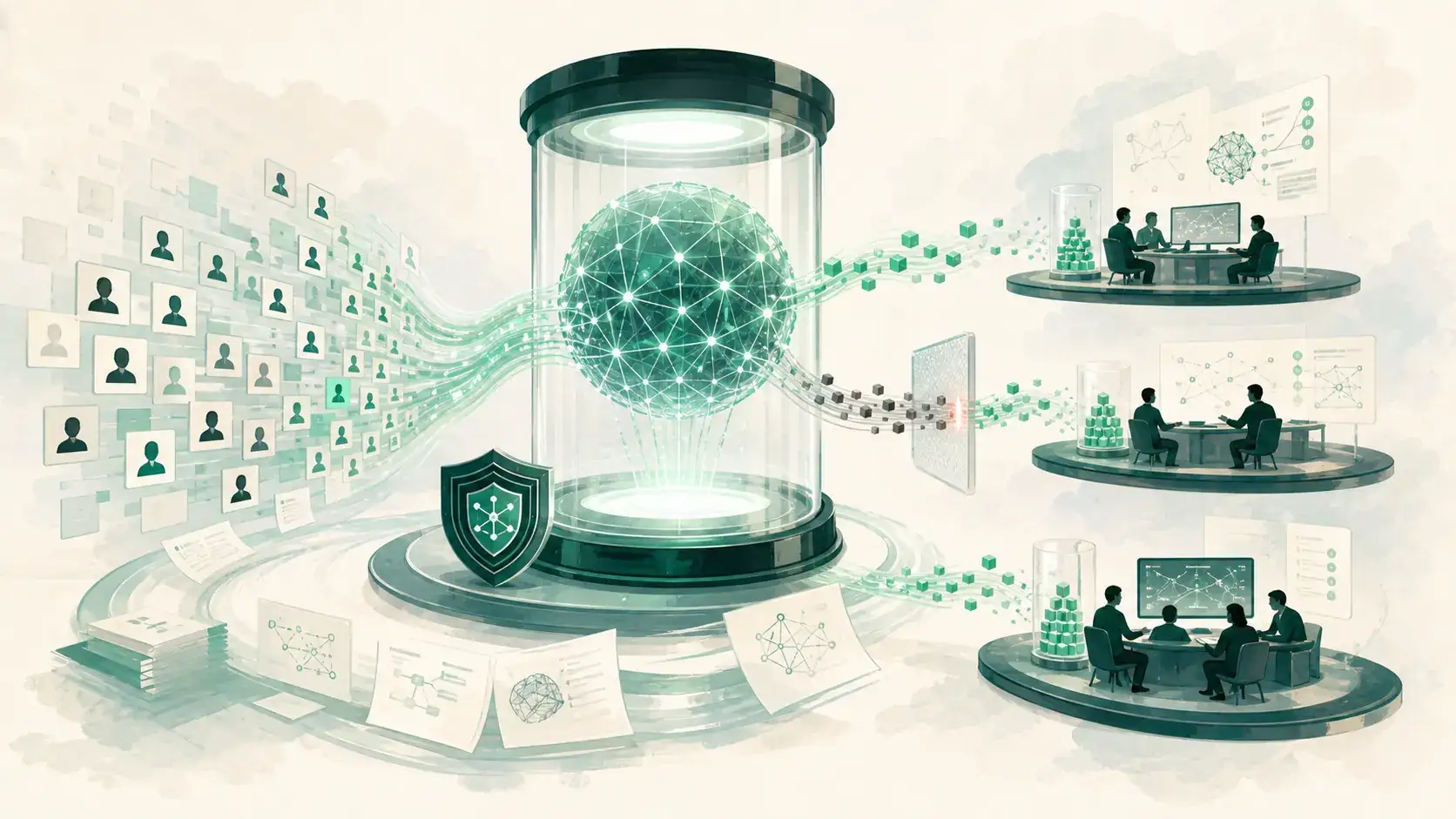
Cover: an original conceptual illustration of selective information sharing. It is not a diagram of Claude's architecture.
Why This Matters Now
The released reference implementation says Anthropic's paper lenses were fitted on 1,000 sequences of 128 tokens, and the code is Apache-2.0 licensed for open-weight decoder transformers.[3] Neuronpedia subsequently made J-lens exploration available across 12 models, with pre-fitted lenses for 36 models.[4] That turns an inside-lab interpretability claim into an external testing agenda, even though it does not expose Claude's own internal states.
The Method: A Readout for What the Model Could Say
The Jacobian lens, or J-lens, starts with an unglamorous question: which internal activation directions would make a model more likely to produce a vocabulary token later? The released implementation transports an activation through an average input-output Jacobian and decodes the result with the model's own unembedding.[3] Anthropic calls the collection of these token-linked directions the J-space.
That is not a transcript of a secret chain of thought. It is a constrained readout of representations that are poised to influence language. The distinction is the entire story. J-lens can miss concepts that do not correspond to a single token, and an average Jacobian can introduce noisy or false-positive directions.[5]
Anthropic's evidence becomes more interesting when it moves beyond observation. In its experiments, swapping a J-space representation for a different one changed a requested report and redirected selected multi-step answers. The paper also reports that the same representation could influence different downstream tasks, a property the authors interpret as broadcast-style availability rather than a one-purpose feature.[2]
Consider Anthropic's spider example. The model answers a question about the legs of a web-spinning animal. Replacing its intermediate spider representation with ant changes the answer from eight to six in the reported intervention. The altered answer is evidence that this internal representation matters to that computation.[2]
An auditor still has to rule out simpler explanations and check collateral effects. A successful intervention on one problem does not establish that the instrument has located every step of reasoning.
The Workspace Claim: Useful Analogy, Strict Limits
Global workspace theory describes a limited channel that lets specialist brain systems share information for flexible control. Dehaene and Naccache developed this account in human neuroscience, which makes it a source of hypotheses rather than direct evidence about a transformer.[10] Anthropic reports an analogous division in Claude: a small, intermediate-depth space tied to reportability, flexible reasoning, and broad downstream access, while routine work can bypass it.[1]
The comparison has real explanatory value. It predicts why a model might use a compact shared representation for a non-routine intermediate such as “spider,” then hand that representation to another computation that retrieves “eight.” It also predicts why fluent continuation can survive when a task requiring explicit manipulation fails.
But a useful analogy is not an identity claim. Transformers evolve through a forward pass over depth; human global-workspace accounts rely on recurrent neural dynamics over time. Claude's proposed workspace is mostly word-like, whereas human conscious contents are multimodal. Anthropic itself says J-lens only approximately captures a true workspace and only identifies single-token concepts.[2]
Anthropic's invited external commentators make the conceptual gap clearer. A privileged set of cognitively accessible representations is weaker than a unified stream, which is weaker again than the full global-workspace architecture proposed in neuroscience.[6] None of those functional claims decides whether a system has subjective experience. Butlin and colleagues' earlier survey likewise treats AI consciousness through multiple theory-derived indicators, rather than one decisive behavioral or architectural test.[9] The real story isn't whether a catchy neuroscience metaphor wins a philosophical argument. It is whether the metaphor produces experiments that separate causal mechanisms from post-hoc stories.
The Safety Angle: A Lead for Investigators, Not a Lie Detector
Anthropic showed J-lens readouts surfacing markers such as test awareness, fabricated data, and covert malicious goals. Those examples deserve attention, but their experimental setting is non-negotiable. The hidden-goal case used deliberately misaligned "model organisms" whose training histories the researchers controlled.[1] Anthropic's earlier hidden-objectives audit used deliberately trained models to give investigators a target whose origin was known.[8] Such test cases help evaluate investigative methods, but do not establish their reliability on unknown problems in deployed models.
A Responsible J-lens Audit Loop
The method should create testable evidence, not replace ordinary evaluations.
Observe Anomaly
A behavioral evaluation, red-team result, or model-organism task raises a specific concern.
Read Candidate Representations
Use J-lens readouts to form a hypothesis about a hidden intermediate, with token and noise limits recorded.
Test Causal Relevance
Ablate or steer only in a controlled evaluation, then compare behavior against matched baselines.
Replicate And Escalate
Re-run across prompts, models, and independent teams before treating a signal as operationally useful.
What’s often overlooked is that steering is evidence of influence, not evidence of control. A vector can alter behavior while also damaging unrelated computations. A useful audit technique still needs false-positive studies, sensitivity tests across prompts and model versions, and independent replications before anyone builds a policy decision on top of it.
The Replication Test: Promising, Incomplete, Necessary
In an invited review, Neel Nanda and his MATS collaborators Camila Blank and Agam Bhatia reported a preliminary replication on open-weight Qwen 3.6 27B. Anthropic supplied an advance draft; this was external testing, not independent peer review. Their main lens used 25 prompts of 128 tokens. That differs from Anthropic's fitting corpus, so the results are not a controlled comparison of the models. They found weak but positive verbal-report effects, somewhat similar layer structure, moderate directed modulation, and successful multilingual and typo evaluations. Poetry and arithmetic did not replicate in their attempts.[5]
The missed cases belong in the evaluation report alongside the successes. Portability across architectures and tasks remains an empirical question, not a property established by publishing a repository.
The harder opportunity is to connect an internal signal to behavior under intervention. Anthropic's older circuit-tracing work studied shared conceptual representations and advance planning in Claude 3.5 Haiku. J-lens belongs to the same broader research program, using a different method; the earlier results do not independently validate this one.[7]
The Business Value: Better Evidence for Deployment Decisions
The uncomfortable truth is that a capable system can still be difficult to investigate when something goes wrong. If J-lens-like methods mature, the commercial advantage is not that a company can announce an AI mind. It is that it can investigate a troubling behavior faster, train against a measured intermediate, and produce stronger evidence to customers, auditors, and regulators.
That is still a research thesis. Anthropic has released reference code, not a customer safety endpoint; Neuronpedia has a demo, not a certification service; and no published result establishes a universal monitor. The winning implementation will be the team that measures reliability under distribution shift and shows that a readout improves an audit decision relative to behavioral baselines.
Do Not Turn A Probe Into A Guarantee
The fabricated-data example comes from Anthropic's pre-release Opus 4.6 audit; the hidden-goal examples involve deliberately trained model organisms.[1] Those are different evidence settings. A J-lens result can be a reason to investigate. It is not proof of intent, a complete view of internal computation, or a substitute for red teaming, behavior evaluation, and independent replication.
Our sandbox security analysis separates what an agent computes from what its surrounding services authorize. J-lens addresses another part of that stack: evidence about internal computation. Even a useful warning signal needs a system that can deny an operation, revoke access, and preserve the record. Interpreting a model and limiting its authority remain separate engineering responsibilities.
Anthropic's July paper matters because it moves the conversation from "what did the model say?" toward "which internal variable helped make it say that?" The answer will often be partial, noisy, and model-specific. That is not a reason to dismiss it. It is the price of turning interpretability from a demo into an evidence discipline.
Sources & References
Primary research, released tooling, external and invited commentary, and foundational context.
| # | Source | Outlet | Date | Key Takeaway |
|---|---|---|---|---|
| 1 | Anthropic | Jul 6, 2026 | Anthropic's account of J-space experiments, limits, and controlled safety demonstrations. | |
| 2 | Transformer Circuits | Jul 6, 2026 | Technical paper on J-lens, intermediate layers, limited capacity, and broadcast-style composition. | |
| 3 | GitHub | Accessed Sep 8, 2026 | Apache-2.0 reference implementation and stated fitting setup for the paper lenses. | |
| 4 | Neuronpedia | Jul 10, 2026 | Independent platform's rollout of J-lens demos and pre-fitted lenses for open-weight models. | |
| 5 | LessWrong Neel Nanda | Jul 6, 2026 | Preliminary Qwen 3.6 27B replication found substantive but mixed results and detailed method limits. | |
| 6 | Anthropic CDN | Jul 2026 | Invited experts distinguish a privileged representation set from a full global-workspace claim. | |
| 7 | Anthropic | Mar 27, 2025 | Earlier circuit-tracing work on shared concepts, planning, and model explanations. | |
| 8 | Anthropic | Mar 13, 2025 | Context for model-organism evaluations used to test alignment-audit methods. | |
| 9 | arXiv | Aug 16, 2023 | Survey showing that consciousness in AI is theory-dependent and cannot be inferred from one functional analogy. | |
| 10 | Trends in Cognitive Sciences Stanislas Dehaene and Lionel Naccache | Jan 2001 | Foundational global neuronal workspace account used as neuroscience background. |
Last updated: September 8, 2026