TL;DR: On November 23, Amazon announced an agreement to buy technology behind the Decart Optimization Stack and bring over Decart's 3 co-founders and their team. The deal still requires regulatory clearance.[1] Bloomberg put the deal at about $7.5 billion, as reported by Reuters. Amazon did not announce a price.[1][2]
Amazon has worked with Decart since 2025. In May 2026, Decart said it was already running its Lucy 2 real-time video model on AWS Trainium3. The proposed purchase takes that relationship further by bringing the optimization technology and the people who built it into Amazon if the transaction closes.[1][3]
The hard part of selling custom AI chips is getting other people's models to run well on them. Amazon can develop more Trainium capacity. It gets more value from those chips when customers can bring an existing workload over and keep it in production without a separate engineering effort for every model release.
Why This Matters Now
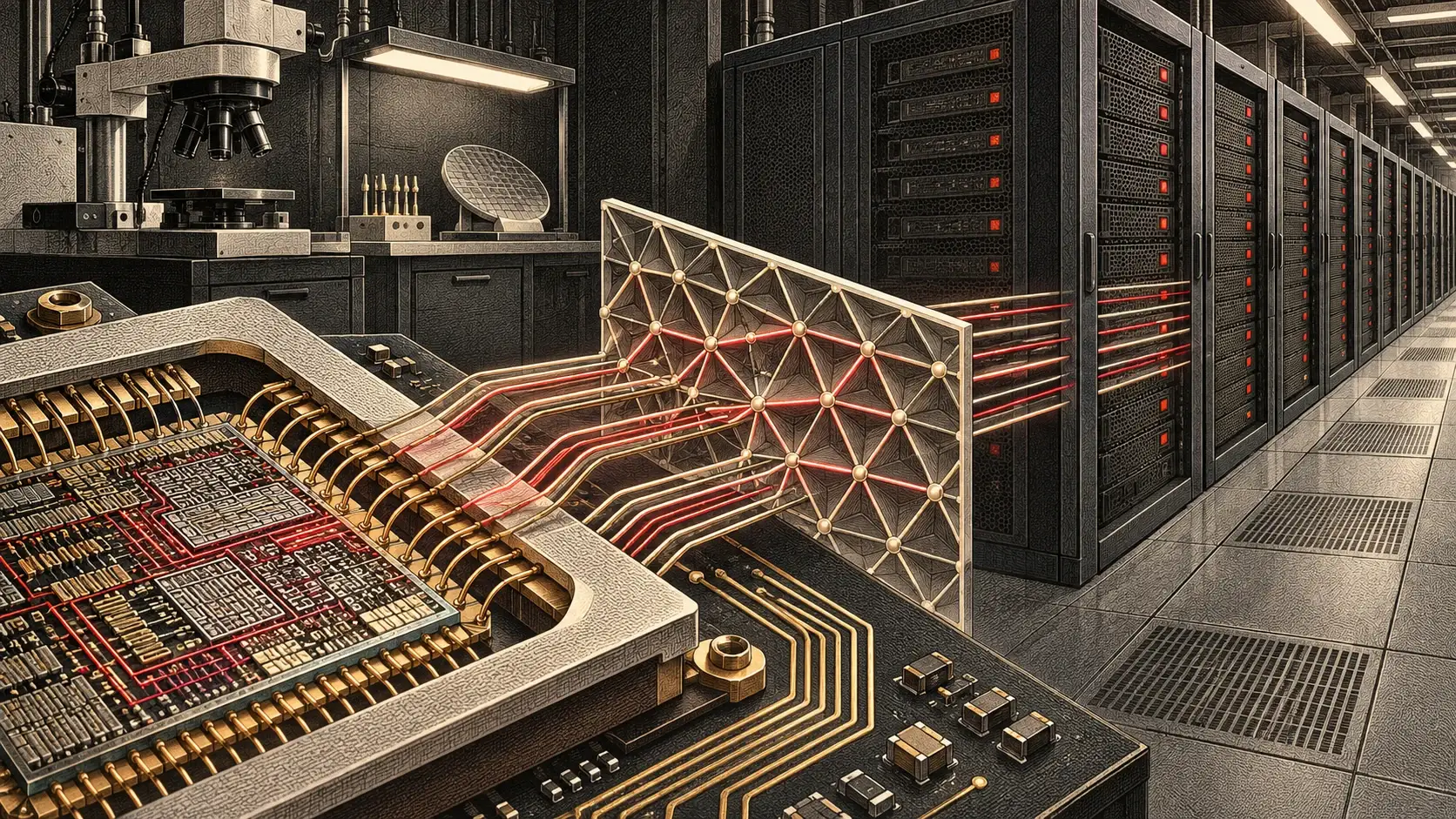
Cover: editorial illustration of circuit traces connecting a chip to server racks.
The Deal: What Amazon Has Agreed to Buy
Amazon named the proprietary technology behind the Decart Optimization Stack and said founders Dean Leitersdorf, Moshe Shalev and Orian Leitersdorf would join with their team of researchers and engineers. Decart markets Lucy and Oasis as separate products that use the stack. Axios reported that the world models fall outside the purchase. Amazon's announcement describes the transaction as subject to customary conditions, including regulatory clearance.[1][3][8]
That scope explains how the deal could serve different AWS customers. Lucy is a real-time video model. The technology behind the stack spans hardware-aware model design, compilers, kernels and inference optimization, according to Decart. Those capabilities can also matter to teams serving language models, where the requests and latency requirements look very different.[3][6]
Trainium: The Software Has to Land Beyond One Model
AWS made Trn3 UltraServers generally available in December 2025. Decart's disclosure about Lucy 2 provides a named example of an existing model deployment on Trainium3. Its broader DOS 2.0 announcement also named NVIDIA GPUs and Google TPUs alongside Trainium. Amazon's announcement leaves the future availability of those cross-platform capabilities open.[1][3][4]
AWS already provides a way to deploy supported workloads through the Neuron SDK and its vLLM integration for Trn2 and Trn3. The operational question is how much of Decart's work will reach that kind of documented, supported path. A specialist team can tune a single workload with direct access to chip engineers. A customer who upgrades a checkpoint or needs to roll back a release needs tooling that behaves predictably each time.[5]
Economics: Compare the Cost of Serving the Same Work
AWS offers both Trainium and NVIDIA-based EC2 instances. For a customer choosing between them, the useful comparison starts with the same workload and service targets. Measure input and output lengths, precision, decoding settings, time to first token and tail latency under realistic concurrency, alongside the cost of capacity and engineering. For a video model, test the frame rate and interaction delay at the same resolution and quality. The hardware that looks best in a short benchmark can lose its advantage once those constraints are applied.[7]
The Customer Test: What Can a Team Deploy?
Watch for a named model and a supported integration that a customer can run without working directly with the team that optimized it. Documentation for model compatibility, deployment and upgrades would show whether the integration is becoming a repeatable option. Results under sustained load would show whether it changes the economics of production inference.
What the Announcement Establishes
The deal gives Amazon a chance to make Trainium easier to choose. It pays off when engineers can keep more of their existing workflow and deliver the same service at a lower cost.
Sources & References
Key sources and references used in this article
| # | Source | Outlet | Date | Key Takeaway |
|---|---|---|---|---|
| 1 | Amazon | Nov 23, 2026 | Defines the announced technology and hiring scope and the closing conditions. | |
| 2 | Reuters | Nov 23, 2026 | Attributes the reported $7.5 billion figure to Bloomberg. | |
| 3 | Decart | May 18, 2026 | Describes the stack, hardware coverage and Lucy 2 deployment on Trainium3. | |
| 4 | AWS | Dec 2, 2025 | Documents when Trainium3 systems became generally available. | |
| 5 | AWS | Accessed Nov 25, 2026 | Documents the existing vLLM serving integration for Trn2 and Trn3. | |
| 6 | Decart | Accessed Nov 25, 2026 | Describes Lucy’s application and its use of DOS. | |
| 7 | AWS | Accessed Nov 25, 2026 | Lists Trainium-based and NVIDIA-based EC2 offerings. | |
| 8 | Axios | Nov 24, 2026 | Reports that the deal excludes Decart’s world models. |
Last updated: November 28, 2026