TL;DR: A September 23 preprint tests Jev against 9 language models, while a September 24 ecosystem study counts 2,170 public GitHub projects.[1][2] The useful business question is whether each automated decision stays correct when the surrounding request changes, and how much a wrong action costs.
The real story isn't Jev's launch price. It is the management problem created when a model becomes cheap enough to sit inside every branch of a workflow. A polished answer can be inspected. A typed answer can quietly trigger another operation. Our Jev explainer covers the architecture; the support-routing workflow turns the interface into a practical starting point.
Two papers released last week make that distinction timely. Their reporting dates are September 23 and 24; this is our September 29 analysis. Both are preprints, and LLM Rumors has not independently replicated their experiments. Their value is a better evaluation agenda, rather than a certificate for autonomous deployment.
Why This Matters Now
Cheap inference increases the number of decisions a team can automate. Evaluation must therefore connect the model's output to the action it authorizes, the errors it makes and the cost of recovering from them.
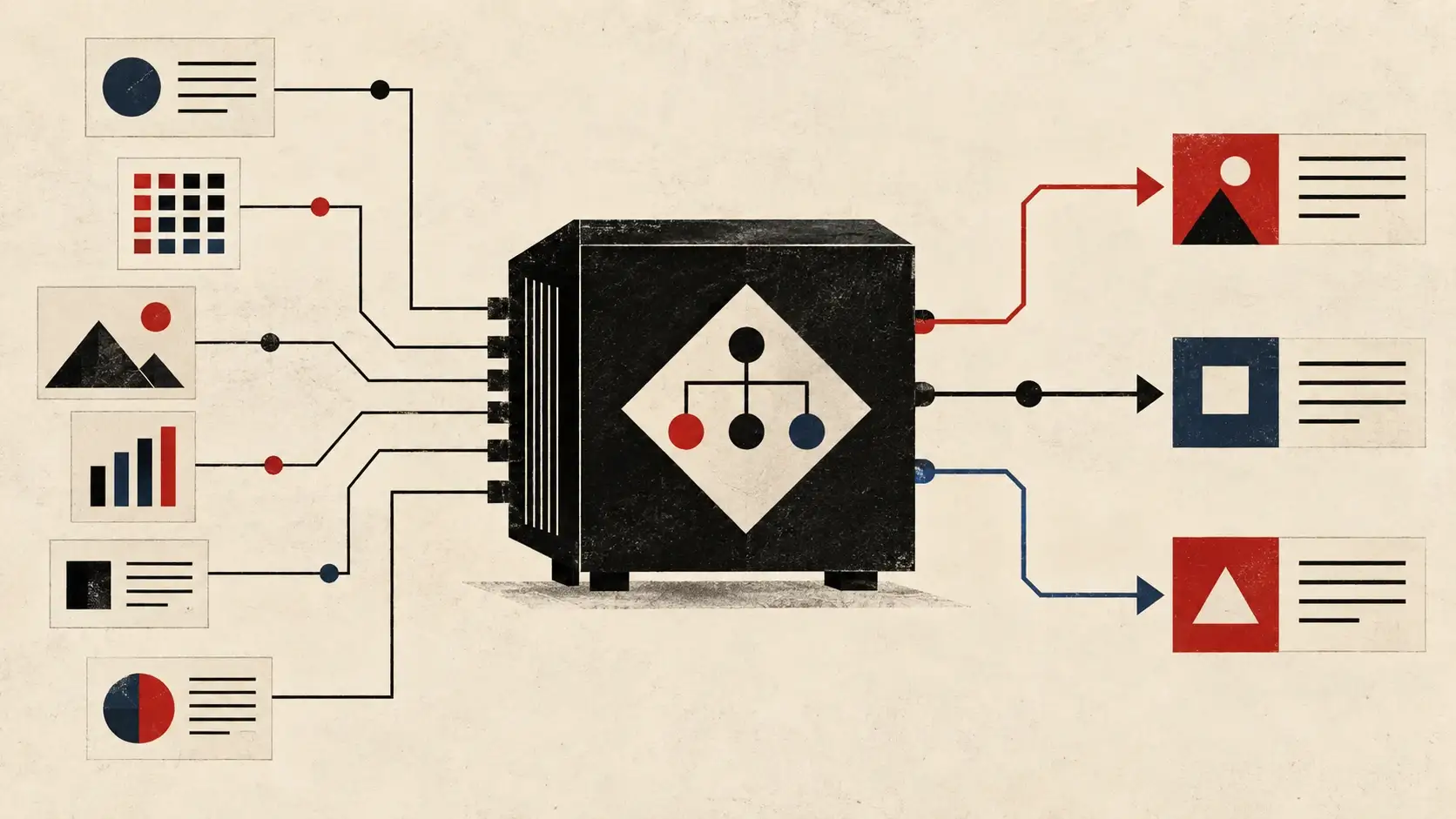
Cover: Generated editorial illustration. A magnifying lens over paper cards highlights a crimson diamond among black circles, a metaphor for inspecting individual decisions rather than an aggregate score.
The Evidence: Keep the Benchmark Inside Its Boundaries
Zhang and colleagues report Jev 1.13.0 at 77.38% baseline accuracy and $0.000228 per contract. Their repeated-condition panel contains 30 targets: Jev gets 23 correct in all 12 responses, repeats a wrong label on 5, and changes valid labels on 2. Claude Sonnet 5 gets 24 consistently correct targets. That one-target difference does not establish general superiority; the paired 95% interval spans −10.00 to 16.67 percentage points.[1]
These are configuration-specific research results. The panel varies visible hypotheses, requested outputs and ordering, across 4 conditions with 3 repeats per condition, producing 12 responses for each target. It tests classification, excludes evidence extraction, and cannot establish professional suitability. Model interfaces and inference settings differ, and some comparators were added after earlier results were inspected.[1]
The authors publish an evaluation repository for inspection.[3] Its underlying dataset, ContractNLI, supplies 17 fixed hypotheses across 607 non-disclosure agreements, with classification labels and evidence annotations.[4] The original 2021 paper establishes the task, not a fresh Jev endorsement.[5]
The commercial implication is our analysis: selecting an automation component requires evidence about the actual decision boundary. A contract classification score cannot approve a different application's action policy.
The Ecosystem: Repository Counts Cannot Approve a Workflow
Ling and colleagues collected 2,170 public GitHub projects as of September 22. Candidate inclusion and annotation used GPT-6 Luna Max agents, with a second agent reviewing key inclusion decisions and domain labels. The authors report 69.7% of projects with an identified purpose use multiple purposes. Public repositories and stars describe visible experimentation; private deployments are outside scope, and attention does not establish reliability.[2]
What's often overlooked is that a project can contain several decisions with very different consequences. A label used to sort a dashboard and a label used to initiate an operation should not share an acceptance test merely because both use Choice.
Build an inventory before choosing a model. Record the input, question, allowed answers, consumer of each answer and recovery path. A score with no defined consumer is a demo artifact. A score connected to a business process is a policy that needs an owner.
The Arithmetic: Equal Accuracy Can Hide a Changed System
Consider an illustrative evaluation of 100 labeled decisions. This is invented arithmetic, not a result from either paper. Configuration A answers 90 correctly. After changing how questions are grouped, configuration B also answers 90 correctly. Suppose B fixes 5 of A's errors but breaks 5 previously correct answers. The aggregate stays at 90%, while 10% of decisions change between correct and incorrect.
| Illustrative transition | Decisions | Business question |
|---|---|---|
| Correct to correct | 85 | Does the action remain appropriate? |
| Wrong to correct | 5 | Which cases improved? |
| Correct to wrong | 5 | Which customers or records now fail? |
| Wrong to wrong | 5 | Which unresolved cases need another path? |
A dashboard showing only the final percentage would approve both configurations. A decision audit would expose a migration with 5 newly failing cases. If those cases cost $100 each to correct, that particular cohort creates $500 of new recovery work, even though the accuracy score is unchanged. The dollar assumptions are illustrative and should be replaced with measured costs.
Repeated agreement needs its own column. A model that repeats an incorrect answer creates predictability without usefulness. CheckList's behavioral-testing approach provides an established reason to examine capabilities and failure cases beyond a single aggregate metric.[10]
The Checklist: Make the Evaluation Usable Before Launch
Here is a practical evaluation specification for a team introducing a decision component. These are editorial recommendations, not a claim that we ran this harness.
- Freeze the decision contract. Save the state format, question text, answer definitions and downstream action. TypeSafe recommends narrow questions composed in code.[6] Test the contract your application actually uses.
- Separate development from acceptance. Choose thresholds on development examples. Preserve a labeled acceptance set that includes common cases, rare classes and ambiguous inputs. Keep case identifiers so errors can be traced.
- Change one request factor at a time. Test the same cases alone, alongside additional questions and in a different order. Repeat the unchanged request as a reference. Save invalid answers and timeouts instead of discarding them.
- Report transitions and consequences. Publish corrections, regressions, persistent errors, invalid responses and class-specific results. Attach the business cost to each failure type rather than treating all mistakes as equally expensive.
- Evaluate the accepted subset. Record how many decisions the policy automates, how often that subset is wrong and how many cases it escalates. Compare those results on the same case set after every revision.
- Price the entire path. Include preparation, model calls, fallbacks and review. Record deployment settings and observed latency distribution. A token invoice alone cannot tell you the cost of completing a workflow.
Make the resulting artifact a versioned release record. A change to question wording deserves a new evaluation even when the model identifier stays fixed. A model change deserves one even when the application code stays fixed.
The Threshold: Confidence Needs an Empirical Meaning
TypeSafe's documentation says Choice and Score return distributions and a confidence statistic derived from them; Noul has no separate confidence property.[7] The primitives have different answer contracts, so the logger and policy must preserve those distinctions.[8]
Do not read a confidence value of 0.9 as a demonstrated 90% success rate for your application. Measure correctness within the bands your policy actually accepts. Record the number of examples in each band, and revisit it when input mix changes.
The vendor's patterns include confidence gating and composite scoring.[9] Our recommendation is to evaluate the composed policy as well as each component. Multiplying or combining scores in code creates another decision rule. It needs a labeled outcome and an acceptance criterion of its own.
The Key Insight
A stable answer can be wrong. An unchanged accuracy score can conceal new failures. The release decision should follow the observed consequences of the accepted actions, with unresolved cases routed to a defined fallback.
The uncomfortable truth is that cheap intelligence moves expenditure from inference into policy ownership, evaluation and recovery. Jev can make the calls inexpensive. The team still has to prove that the resulting workflow deserves authority.
Sources & References
Primary sources; documentation dates record access on September 29, 2026.
| # | Source | Outlet | Date | Key Takeaway |
|---|---|---|---|---|
| 1 | arXiv, Zhang et al. | 2026-09-23 | Preprint: classification and repeated-condition evaluation. | |
| 2 | arXiv, Ling et al. | 2026-09-24 | Preprint: a public GitHub snapshot, not production adoption. | |
| 3 | Research authors | 2026-09-29 | Original evaluation code and release materials. | |
| 4 | Stanford NLP | 2021-10-05 | Original labels, evidence spans and dataset specification. | |
| 5 | ACL Anthology | 2021-11 | Original document inference task and its limitations. | |
| 6 | TypeSafe AI | 2026-09-29 | Vendor interface documentation and atomic questions. | |
| 7 | TypeSafe AI | 2026-09-29 | Vendor definition of confidence and threshold guidance. | |
| 8 | TypeSafe AI | 2026-09-29 | Choice, Score and Noul interface contracts. | |
| 9 | TypeSafe AI | 2026-09-29 | Vendor architecture patterns for composed decisions. | |
| 10 | ACL Anthology | 2020-07 | Behavioral testing alongside aggregate accuracy. |
Last updated: September 29, 2026