TL;DR: Aleph Alpha released Kolibri on October 3; its technical report describes 78.1 billion total parameters and 3.46 billion active per token.[2][3] The model card recommends at most 262,144 tokens despite validating 1,048,576.[1] This opens a German-English deployment choice, but procurement should price the complete operated service.
Kolibri arrived through an official X announcement, with follow-ups linking the weights and technical report.[4] This October 5 analysis concerns that October 3 release. The downloadable checkpoint and its accompanying artifacts make the announcement concrete.[7]
For an enterprise buyer, the interesting question is what the release changes about control. A language model can become a dependency the organization chooses and maintains. That option has value even before anyone proves it cheaper than a hosted alternative. It also brings an obligation to test the whole service, rather than treating a parameter label as a purchasing specification.
Why This Matters Now
Aleph Alpha positions the launch around bilingual specialization.[3] Teams evaluating German and English document workflows can now examine an actual public checkpoint, then ask whether operating it improves their own cost, reliability and control.
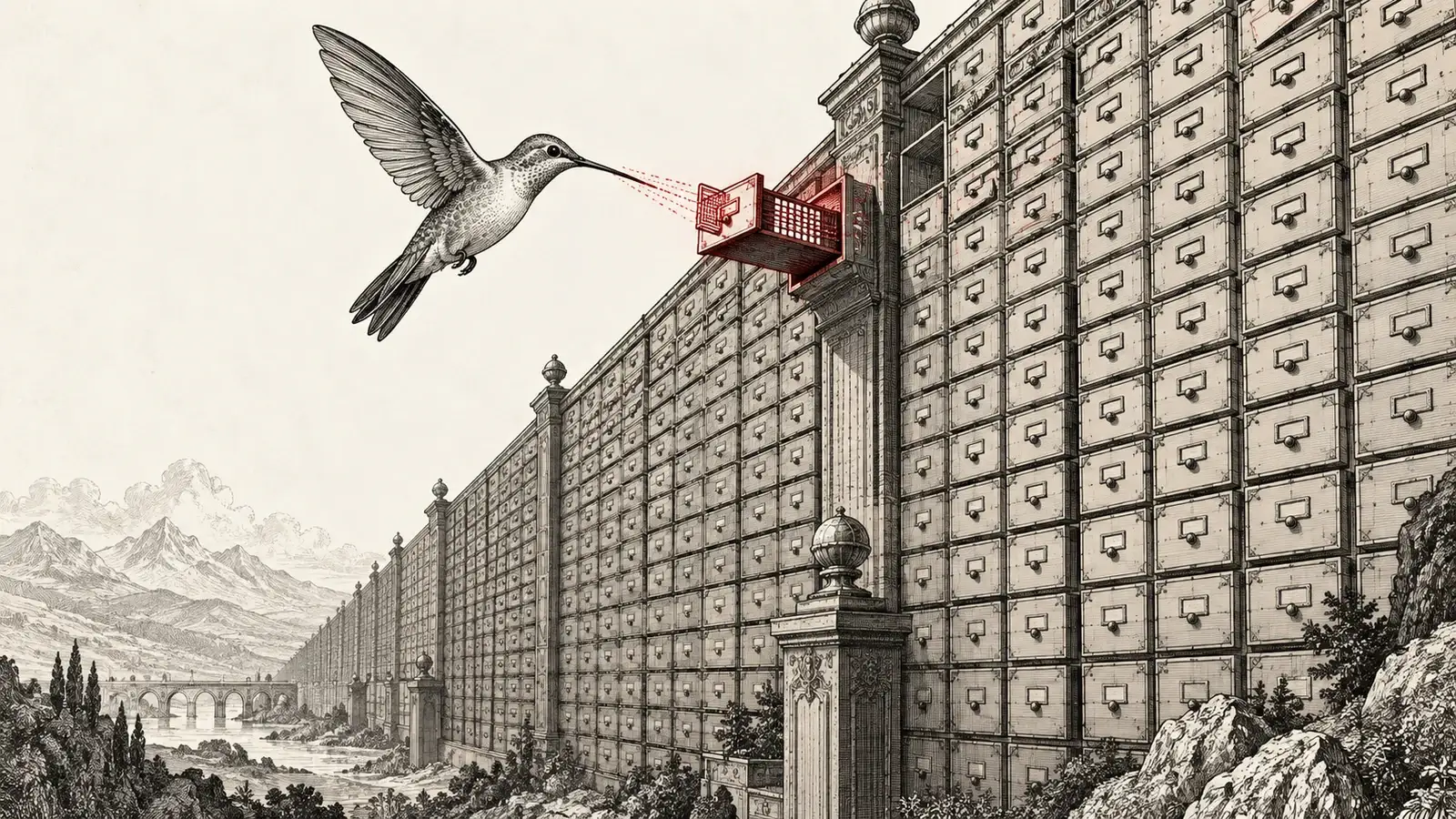
Cover: newly generated editorial ink engraving of a hummingbird activating one drawer in a large memory cabinet. It is illustrative artwork, not a product screenshot or measured evidence.
Model Size: Active Compute Does Not Pay the Memory Bill
The card gives 78,103,074,560 total parameters and 3,457,573,120 active parameters per token, with an estimated FP8 weight footprint of approximately 78 GB. That last number is a vendor estimate, not an exact service-memory measurement.[1]
The technical report explains the tradeoff directly: greater total capacity consumes memory otherwise available for activations and the key-value cache, restricting long-request concurrency. Its architecture combines 40 sliding-window blocks with 10 full-attention blocks.[2] Those are design choices, not an exemption from capacity planning.
The separate BF16 card estimates approximately 156 GB for weights and lists four H100 SXM5 GPUs as a recommended configuration.[9] Precision changes the deployment boundary. Neither weight estimate includes a measured concurrency guarantee.
A useful procurement sheet therefore needs separate rows for model storage, working memory, simultaneous sessions and output deadlines. An active parameter count cannot fill all four. Buying hardware from that count alone risks optimizing the wrong constraint: an engine might fit the checkpoint while failing the workload that justified the purchase.
Context Length: Choose a Workload Budget Before a Ceiling
The gap between the card's recommended and validated lengths is fourfold, calculated as 1,048,576 divided by 262,144.[1] Treat the recommendation as the initial pilot boundary. Expanding it should answer a specific business question: which necessary evidence cannot be retrieved or summarized within the smaller budget?
Long-document assistants need more than a successful response to a large prompt. Test conflicting passages, revised versions, scattered evidence and questions the documents cannot answer. Record whether the response cites the right passage, whether a reviewer can check it, and how many users can run those tasks together. A million-token ceiling without those observations is a capacity headline, not an acceptance result.
Serving Software: The Parser Is Part of the Product
Aleph Alpha's inference repository supplies a vLLM plugin with Kolibri-specific architecture, reasoning and tool parsers. At review time, its README specifies vLLM 0.29 support.[5] The plugin, tokenizer and checkpoint revision should form a pinned deployment record, not three independently moving assumptions.
The package manifest makes the compatibility boundary explicit: vllm>=0.29.0,<0.30.0, torch>=2.9.0 and transformers>=5.5.3.[10] The Dockerfile installs its release wheel with --no-deps, preserving the base image's libraries.[11] An unplanned dependency upgrade can invalidate the tested service; record the container digest alongside the checkpoint.
The file listing includes the weight shards and tokenizer artifacts.[7] Capture their revisions alongside the engine version. Then test ordinary answers, disabled reasoning and structured tool requests before a pilot receives internal material. A model producing plausible prose does not establish that the application interprets its tool requests correctly.
vLLM's general documentation explains that FP8 cache quantization reduces cache memory and discusses calibration.[8] That supports evaluating the cache configuration separately from weight precision. It does not certify a specific Kolibri deployment. Keep proposed improvements behind the same document tests used for the initial configuration.
Bilingual Control: Evaluate the Work, Not the Flag
The launch blog emphasizes German-English specialization.[3] For a bilingual organization, the practical test is whether one workflow handles both languages consistently. Include the same policy question in each language, source passages with legal or technical vocabulary, and requests that switch language mid-session.
The checkpoint ships with Apache 2.0 license text.[6] Licensing and operational success answer different questions. Availability of the weights creates room to inspect, adapt and operate; it does not establish that a particular application meets its contractual or regulatory duties. Those depend on the system and its use. A buyer should require evidence about its own data boundaries, access controls and review process.
Acceptance: Make Independence Earn Its Place
A sensible pilot measures successful reviewed tasks per operating budget. Record hardware, precision, input and output lengths, concurrency, reasoning settings, latency and failure handling. Keep vendor evaluations separate from these measurements. The report itself discusses weak benchmark rows as well as strengths.[2] Selecting only flattering results would hide exactly the cases a deployment team needs to discover.
The Claim to Reject
Sparse computation does not turn the full checkpoint into a small-memory model. Neither downloadable weights nor a large context ceiling proves an application safe, compliant or economically superior.
Kolibri gives buyers another component they can choose to operate. The advantage will come from proving where that choice improves useful work, and from accepting responsibility for the service around it. Control is valuable when the organization can exercise it.
Sources & References
Primary release materials and deployment documentation; vendor claims remain attributed.
| # | Source | Outlet | Date | Key Takeaway |
|---|---|---|---|---|
| 1 | Aleph Alpha / Hugging Face | Accessed October 5, 2026 | Exact parameter counts, recommended context and vendor memory estimate. | |
| 2 | Aleph Alpha | Accessed October 5, 2026 | Architecture and memory analysis, pp. 11–14; evaluation limitations, pp. 97–98. | |
| 3 | Aleph Alpha | October 3, 2026 | October 3 launch and bilingual specialization; vendor positioning. | |
| 4 | Aleph Alpha / X | October 3, 2026 | Public announcement and follow-up links. | |
| 5 | Aleph Alpha / GitHub | Accessed October 5, 2026 | Supported vLLM version, model architecture and reasoning/tool parsers. | |
| 6 | Aleph Alpha / Hugging Face | Accessed October 5, 2026 | Apache 2.0 text accompanying the released weights. | |
| 7 | Aleph Alpha / Hugging Face | Accessed October 5, 2026 | Downloadable weight shards, tokenizer and configuration artifacts. | |
| 8 | vLLM | Accessed October 5, 2026 | Cache memory and calibration considerations; general engine guidance. | |
| 9 | Aleph Alpha / Hugging Face | Accessed October 5, 2026 | Vendor BF16 weight estimate and recommended hardware; no measured concurrency guarantee. | |
| 10 | Aleph Alpha / GitHub | Accessed October 5, 2026 | Explicit vLLM version range and torch/transformers dependency floors. | |
| 11 | Aleph Alpha / GitHub | Accessed October 5, 2026 | Release wheel installed without replacing base-image dependencies. |
Last updated: October 5, 2026