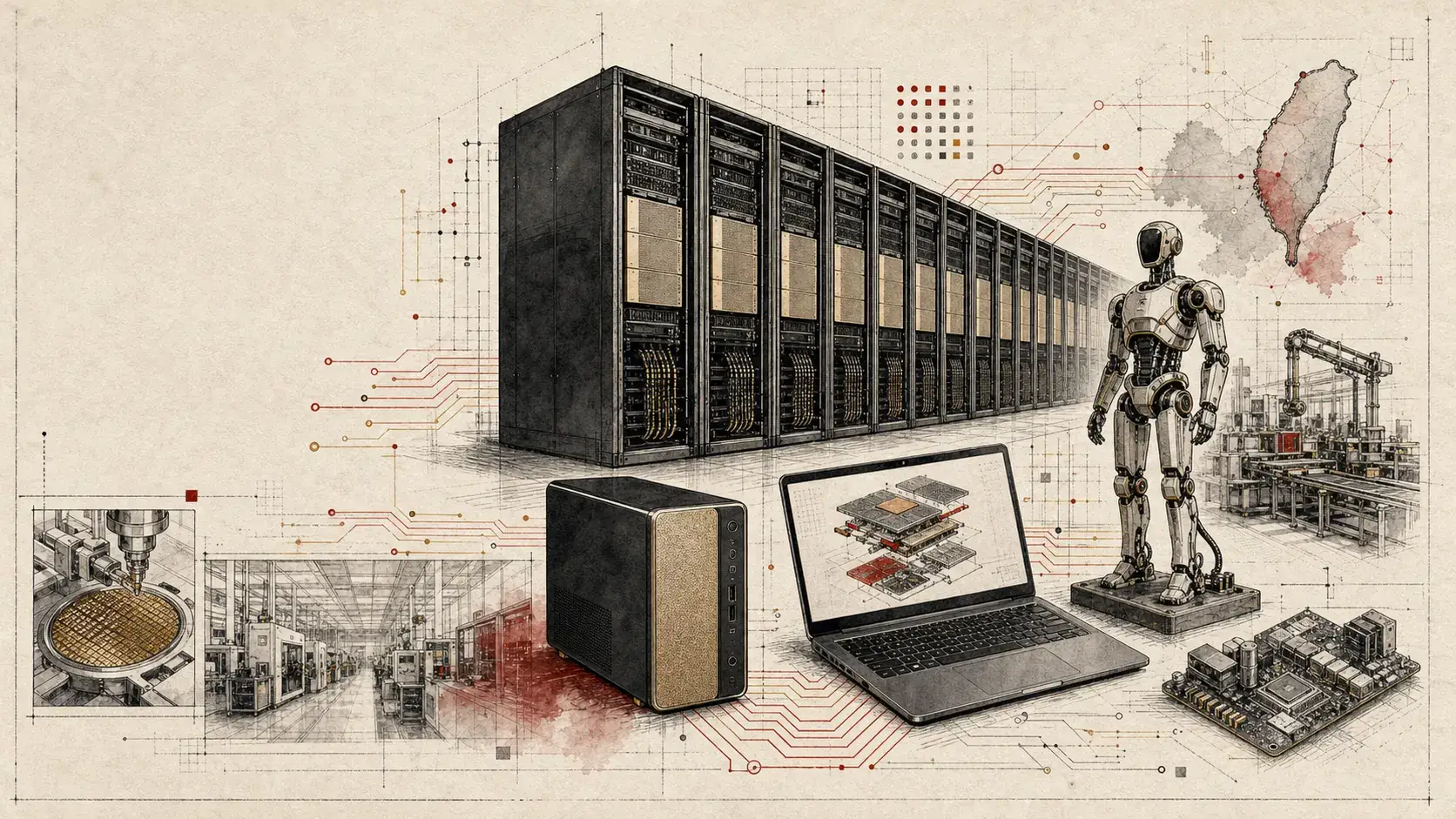
TL;DR: NVIDIA's GTC Taipei at COMPUTEX 2026 was not just another chip event, it was the company's clearest attempt yet to turn AI into an industrial supply chain: 60+ sessions, Vera Rubin production across 150 Taiwan partners, 350+ factories, and 30 countries, plus RTX Spark Windows PCs with 1 petaflop of AI compute, 128GB of unified memory, and Nemotron 3 Ultra as a 550B-parameter open model for long-running agents.[1][2][3][13] The real story isn't the keynote theatrics. It is NVIDIA moving from selling accelerators to owning the infrastructure grammar for agents, fabs, deskside systems, robots, cars, and hospitals.
NVIDIA used Taipei because Taipei was the point. The company did not merely announce products near the supply chain. It staged the intelligence-era thesis inside the geography that makes modern compute manufacturable. GTC Taipei ran through June 4 at the Taipei International Convention Center, attached to COMPUTEX, with sessions, workshops, demos, and a keynote built around AI factories, scaling infrastructure, agentic AI, and physical AI.[1]
The conventional read is simple: NVIDIA showed more hardware. That read is too small. Vera Rubin, RTX Spark, DGX Station for Windows, Nemotron 3 Ultra, TSMC fab AI, Cosmos 3, Isaac GR00T, Alpamayo, DRIVE Hyperion, and Foxconn healthcare robots are not isolated announcements. They are pieces of the same strategic move: make every major AI workload legible as an NVIDIA platform problem.
Why This Matters Now
AI demand is shifting from chat sessions to continuous agents, long-context inference, simulation loops, physical robots, and enterprise workflows. NVIDIA is arguing that the scarce asset is no longer only a GPU. It is the integrated factory that turns power, memory, networking, manufacturing, runtime security, and model tooling into tokens.
GTC Taipei by the Numbers
The event was framed as a product launch, but the numbers point to a broader industrial rollout.
Sessions, workshops, a Build-a-Claw event, and live demos ran through June 4 at the Taipei International Convention Center.
NVIDIA said 150 supply-chain ecosystem partners in Taiwan are part of the Vera Rubin ramp.
The Vera Rubin ramp spans more than 350 factories across 30 countries.
NVIDIA says Vera Rubin delivers 10x agent throughput at scale versus Grace Blackwell.
RTX Spark PCs pair up to 1 petaflop of AI compute with up to 128GB of unified memory for local agents.
DGX Station for Windows uses GB300 Grace Blackwell Ultra with up to 748GB coherent memory and up to 20 petaflops FP4.
NVIDIA's flagship open agent model uses a 550B-parameter MoE design with up to 55B active parameters.
The Real Story: NVIDIA Is Selling The Factory
Let's be clear: NVIDIA still sells GPUs. But GTC Taipei showed that the company does not want the market to think in GPU units anymore. It wants buyers to think in AI factories, personal AI computers, secure agent workspaces, synthetic data loops, and physical deployment pipelines.
That is a more defensible business than "we have the fastest accelerator this cycle." Accelerator advantages compress. Custom silicon improves. Cloud buyers negotiate. Hyperscalers test alternative stacks. But an AI factory architecture, if it becomes the default, moves the fight from chip price to system economics.
Here is the genius: NVIDIA is reframing the buyer's spreadsheet. The old question was, "How many GPUs can I buy for this budget?" The new question is, "How many profitable tokens can I produce per watt, per rack, per facility, per model workflow?" Once the unit of accounting becomes tokens, the product becomes the whole factory.
GTC Taipei was not a victory lap for GPUs. It was a declaration that compute is now an industrial production system.
The uncomfortable truth for competitors is that NVIDIA's moat is no longer just CUDA. CUDA matters, but the bigger lock-in is operational. If the buyer has NVIDIA reference designs, NVIDIA networking, NVIDIA DPUs, NVIDIA agent runtimes, NVIDIA security primitives, NVIDIA simulation tooling, NVIDIA physical AI models, and NVIDIA supply-chain partners, switching the GPU becomes a much larger organizational problem.
That is why Taipei mattered. NVIDIA's keynote was as much about manufacturing credibility as compute ambition. It put TSMC, Foxconn, ASUS, Pegatron, Quanta, Wistron, Wiwynn, and the broader Taiwan ecosystem inside the story. The event's subtext was direct: intelligence is not just trained, it is manufactured.
Rack Scale: Vera Rubin Makes Tokens The Unit Of Accounting
Vera Rubin was the cleanest example of the new NVIDIA message. The headline was that the platform is ramping into full production to power agentic AI factories worldwide.[2] The strategic detail is that NVIDIA described Vera Rubin as a POD-scale foundation, not as a single chip.
The platform ties together Vera Rubin NVL72 systems, Vera CPU, storage, networking, DPUs, security, and Spectrum-X Ethernet into a five-rack AI supercomputer for agentic workloads. NVIDIA claims 10x agent throughput at scale compared with Grace Blackwell, which is exactly the kind of metric the company wants the market to use.[2]
Old AI infrastructure was sold as performance. The new pitch is throughput, uptime, deployment speed, power efficiency, and token cost. Spectrum-X Ethernet Photonics makes that explicit: NVIDIA says the co-packaged-optics switch uses 200Gb/s SerDes, delivers 5x better power efficiency, 5x longer AI uptime, and 1.3x faster time to deployment than networks using traditional transceivers.[2]
What NVIDIA Is Trying To Change
| Feature | GPU-era sale | AI factory sale | Strategic consequence |
|---|---|---|---|
| Unit of value | Accelerator performance | Token output per watt | The buyer optimizes around production economics instead of component cost. |
| Product boundary | GPU and SDK | Rack, network, security, software, operations | NVIDIA moves higher in the infrastructure stack. |
| Customer decision | Which chip is fastest | Which factory produces intelligence reliably | Custom ASIC comparisons become less straightforward. |
| Competitive defense | CUDA ecosystem | Full deployment system | Switching costs spread across hardware, software, partners, and operations. |
| Manufacturing signal | Supplier relationship | Taiwan-centered ramp | Supply-chain credibility becomes part of the product. |
What's often overlooked is the supply-chain scale. NVIDIA said the Vera Rubin ramp involves hundreds of ecosystem partners, 150 in Taiwan alone, across 350+ factories and 30 countries.[2] That is not a normal chip launch footnote. That is NVIDIA reminding customers that AI infrastructure is now a procurement, facilities, power, cooling, manufacturing, and operations problem.
The platform also makes security an infrastructure feature. Vera Rubin combines rack-scale confidential computing with BlueField-4 DPUs and DOCA enforcement across the stack, aiming to protect data, agents, context memory, and inference at the factory level.[2] If enterprise AI becomes a fleet of long-running agents touching sensitive systems, that matters more than a benchmark slide.
NVIDIA is presenting AI infrastructure as a manufacturing network, not merely a silicon roadmap.
Local Agents: RTX Spark And DGX Station Move Onto Windows
The second story was local agents. NVIDIA and Microsoft announced RTX Spark, a Windows PC platform for personal AI agents, built around a Blackwell RTX GPU, 6,144 CUDA cores, fifth-generation Tensor Cores with FP4, NVLink-C2C, and a 20-core Grace CPU.[3]
The numbers are intentionally aggressive for a PC: up to 1 petaflop of AI performance and 128GB of unified memory. NVIDIA says RTX Spark can run 120B-parameter LLMs with up to 1 million tokens of context locally, render 90GB+ 3D scenes, edit 12K 4:2:2 video, generate 4K AI videos, and play AAA games at 1440p above 100 frames per second.[3]
The real story isn't that laptops got faster. It is that NVIDIA and Microsoft are trying to define a new endpoint class for agents. OpenShell and Windows security primitives are the important layer here. NVIDIA describes OpenShell as a runtime that gives users policy control, routes queries based on privacy settings, and disguises personal information before cloud calls when needed.[3]
That is not a gaming feature. That is a trust primitive for always-on agents.
Nemotron 3 Ultra fills the missing model slot in that story. NVIDIA described the new model as a 550-billion-parameter mixture-of-experts model for long-running agents, with up to 5x faster inference and up to 30% lower cost for complex agentic tasks compared with open frontier models in its class.[13] The model card makes the architecture more interesting: Nemotron 3 Ultra is a hybrid LatentMoE model with interleaved Mamba-2 and MoE layers, select attention layers, Multi-Token Prediction layers, 55B active parameters, 550B total parameters, roughly 20T pretraining tokens, and support for up to 1M tokens of context.[14]
The real story isn't that NVIDIA added another open model. It is that the company is trying to make the agent stack vertically legible: Nemotron for the model, NemoClaw for blueprints and harness integration, OpenShell for policy and privacy controls, CUDA-X as callable skills, RTX Spark for the local endpoint, and AI factories for production scale. What's often overlooked is that Nemotron 3 Ultra was post-trained for agent platforms and harnesses including Hermes Agent, LangChain Deep Agents, OpenClaw, OpenHands, and OpenCode.[13] That makes it less like a leaderboard drop and more like a distribution strategy.
NVIDIA is using a 550B-parameter MoE model to make long-running agents look like a system product, not a standalone model demo.
NVIDIA's Local Agent Ladder
The GTC Taipei PC story was not one device. It was a stack that moves from consumer PC to deskside frontier box to data-center AI factory.
RTX Spark
Personal AI PCs for secure local agents, creators, developers, and gamers.
1 petaflop class
RTX Spark pairs up to 1 petaflop of AI compute with up to 128GB unified memory.
OpenShell governance
NVIDIA uses OpenShell policy controls, NemoClaw blueprints, and Nemotron models to make local agent behavior governable.
Challenges:
- +User trust
- +Battery constraints
- +Model memory pressure
DGX Station
A Windows deskside AI supercomputer for enterprise developers and frontier local agents.
748GB coherent memory
DGX Station for Windows supports up to 748GB coherent memory and up to 20 petaflops FP4.
Managed Windows AI
NVIDIA is pushing data-center-class AI into a managed Windows footprint.
Challenges:
- +IT governance
- +Thermals
- +Cost justification
AI Factory
Production workloads scale from local development into GB300 and Vera Rubin infrastructure.
Factory handoff
The same agent stack can move from PC or workstation into a larger factory when volume demands it.
Challenges:
- +Cost per token
- +Network reliability
- +Data governance
DGX Station for Windows pushes the same idea upmarket. It uses the GB300 Grace Blackwell Ultra Desktop Superchip, connecting a Blackwell Ultra GPU to a 72-core Grace CPU via NVLink-C2C.[4] NVIDIA says it can run AI models of up to 1 trillion parameters locally, with up to 748GB coherent memory, up to 20 petaflops of FP4 performance, and ConnectX-8 networking up to 800Gb/s.[4]
This is the PC as a staging ground for the AI factory. Developers build and validate agents locally. Enterprises keep sensitive workflows under Windows governance. Heavy production scales to the factory. While competitors are still debating cloud versus edge, NVIDIA is trying to make local, deskside, and cloud feel like one product family.
Taiwan: The Venue Was The Message
Taiwan was not backdrop. It was product strategy.
NVIDIA and TSMC announced that TSMC is using NVIDIA accelerated computing and AI across semiconductor design and manufacturing, including lithography, transistor and process simulation, advanced process control, fab operations optimization, defect inspection, and virtual fab planning.[5]
The numbers are revealing. TSMC is using NVIDIA cuLitho for computational lithography, which NVIDIA says delivers a 20-50% improvement in cost effectiveness or cycle time compared with CPU-based computational lithography at the same cost of ownership.[5] TSMC is also using cuEST for 50x faster chemistry simulations on average, cuML for large-scale process analytics, H200 GPUs for scheduling computation, Metropolis and TAO for nanometer-scale defect inspection, and Omniverse libraries to build FabTwin, a virtual fab environment.[5]
Here is the uncomfortable truth: the company supplying the GPUs is also trying to optimize the fabs that make the chips that power the GPUs. That loop is not accidental. NVIDIA is positioning itself inside semiconductor manufacturing itself, not only downstream of it.
GTC Taipei Rollout
The announcements formed a supply-chain-to-device-to-robot sequence, not a random news dump.
| Date | Milestone | Significance |
|---|---|---|
| May 21 | Vera Rubin NVL72 won Best Choice of the Year, a Golden Award, and the Sustainable Tech Special Award at COMPUTEX 2026. | |
| May 31 | NVIDIA announced Vera Rubin production, RTX Spark, DGX Station for Windows, Nemotron 3 Ultra, TSMC fab AI, Cosmos 3, physical AI tools, Alpamayo, DRIVE Hyperion, and Isaac GR00T. | |
| Jun. 1 | NVIDIA expanded MGX AI factory infrastructure and detailed RTX PC and DGX Spark optimizations for local agentic workloads. | |
| Jun. 2 | NVIDIA and Microsoft framed agent deployment from Windows devices to cloud to local infrastructure as one unified stack. | |
| Jun. 4 | NVIDIA Nemotron 3 Ultra appeared on Hugging Face as a 550B-total, 55B-active open model for long-context agentic reasoning. | |
| Jun. 4 | GTC Taipei concluded its 60+ session program at the Taipei International Convention Center. |
The TSMC announcement also changes how to read NVIDIA's AI factory story. If the company can sell accelerated computing into fabs, then AI factories are not only for model companies. They are also for the industrial base that manufactures the future hardware cycle.
While competitors pitch cheaper accelerators, NVIDIA was showing a more expansive thesis: the same accelerated computing stack can optimize chip design, manufacture chip infrastructure, run agent workloads, power local PCs, simulate robots, and deploy physical AI. That is a far more ambitious claim than "we have the next GPU."
Physical AI: Robots Became A Developer Stack
The physical AI part of GTC Taipei was easy to misread because it involved robots, cars, and demos. The important part was the developer infrastructure behind them.
NVIDIA launched Cosmos 3 as an open world foundation model for physical AI, built on a mixture-of-transformers architecture that combines vision reasoning, world generation, and action prediction.[6] NVIDIA describes it as a fully open omnimodel that can understand and generate text, images, video, ambient sound, and actions, with the goal of reducing physical AI training and evaluation cycles from months to days.[6]
Then NVIDIA released open-source physical AI agent skills and tools spanning Omniverse, Cosmos, Alpamayo, Metropolis, Isaac, and Jetson, turning physical AI workflows into agent-executable tasks.[7] The examples are not hypothetical. NVIDIA says Pegatron reduced model training and deployment time by 67% using synthetic data from a Defect Image Generation skill, Delta Electronics improved defect detection rate by 17%, Inventec reduced laptop chassis defect-data collection effort by 30%, and Foxconn boosted first-pass yield by about 3%.[7]
That is the key transition. Physical AI is not just a robot running a model. It is a data flywheel: reconstruct scenes, generate synthetic examples, train policies, simulate behavior, validate safety, deploy to edge compute, and collect more data.
What GTC Really Shipped
The announcements look broad because NVIDIA is trying to own every layer where agents become infrastructure.
AI factory infrastructure
Vera Rubin, MGX, Spectrum-X Ethernet Photonics, BlueField-4, and DSX define the rack and facility layer.
Windows-native agents
RTX Spark, DGX Station, OpenShell, NemoClaw, and Nemotron put governed agents on the endpoints enterprises already use.
Semiconductor fab AI
TSMC's adoption makes accelerated computing part of lithography, simulation, inspection, and fab planning.
Physical AI models
Cosmos 3 and Alpamayo turn world modeling, driving reasoning, and synthetic data into reusable foundations.
Robotics reference systems
Isaac GR00T and Jetson Thor create a hardware and software reference path for humanoid research.
Industrial deployment loops
Healthcare, manufacturing, inspection, and robotaxi announcements gave the physical AI stack live markets.
The Isaac GR00T reference humanoid design made that stack tangible. NVIDIA announced an open humanoid reference design combining a Unitree H2 Plus humanoid, Sharpa tactile five-finger hands, Jetson Thor onboard compute, and Isaac GR00T software.[8] The robot stands nearly 6 feet tall, weighs 150 pounds, reaches 75 degrees of freedom across body and hands, and uses Jetson AGX Thor T5000 with 2,070 FP4 teraflops, a 14-core Arm CPU, 128GB unified memory, and a 40-130 watt configurable power range.[8]
On the vehicle side, Alpamayo 2 Super extends the story into autonomous driving. NVIDIA says the open model is a 32-billion-parameter reasoning VLA model for level 4 robotaxi development, scaling from prior 10-billion-parameter generations and designed as a teacher model that can be distilled into smaller models running on DRIVE AGX Thor inside vehicles.[9] The broader DRIVE Hyperion announcement tied Foxconn, VinFast, Uber, Autobrains, and HUMAIN into a level 4-ready robotaxi ecosystem.[10]
This is the same pattern again: model, simulator, reference stack, edge compute, partners, and deployment channel. The real story isn't one humanoid or one robotaxi program. It is NVIDIA industrializing the path from simulated world to physical machine.
The Competitive Read: NVIDIA Is Building Around The CUDA Threat
Every year, the market asks the same question: can someone break NVIDIA's GPU dominance? It is a fair question, but GTC Taipei suggests NVIDIA is not waiting for the answer. It is making the question harder.
If the contest is only matrix multiplication, competitors have room. AMD can improve hardware. Hyperscalers can build internal accelerators. Startups can attack inference niches. Model labs can optimize around cheaper silicon. The stack can fragment.
NVIDIA's answer is to move the battlefield. It wants the buyer to evaluate rack architecture, networking, software, security, local-agent endpoint deployment, simulation pipelines, manufacturing capacity, and partner readiness together. That makes the benchmark table less decisive.
Who Gets Pressured
GTC Taipei shifts pressure across the AI industry, not just the chip market.
Hyperscalers
Custom accelerators now compete against a whole AI factory architecture, not only against GPU throughput.
PC OEMs
RTX Spark gives OEMs a premium AI PC story that is not limited to NPU TOPS marketing.
Enterprise IT
DGX Station for Windows turns local frontier inference into a managed endpoint category.
Industrial software vendors
Omniverse, Cosmos, and physical AI skills push engineering workflows toward NVIDIA-native automation.
There is still risk. NVIDIA's ambition can become complexity. AI factories are expensive. Local agent PCs need compelling software. Physical AI needs safety, reliability, regulatory patience, and much better real-world data. The company can announce reference stacks faster than customers can operationalize them.
But that is the point of the Taipei strategy. NVIDIA is trying to compress the distance between announcement and deployment by carrying the ecosystem with it: OEMs, fab operators, hospitals, robot companies, AV networks, and cloud partners.
What happened at GTC was not a single thing. It was a map.
Vera Rubin turned AI infrastructure into a factory. RTX Spark and DGX Station turned agents into a Windows endpoint problem. Nemotron 3 Ultra gave that agent story an open model anchor. TSMC turned fab optimization into an accelerated computing workload. Cosmos 3 and the physical AI skills turned robot development into an agent-executable pipeline. DRIVE Hyperion and Isaac GR00T turned physical AI into reference platforms. Foxconn healthcare turned the whole idea into hospital operations.
GTC Taipei Takeaways
NVIDIA wants customers to buy AI production capacity, not individual accelerators. Token economics, uptime, networking, and power are now the story.
Windows is becoming a serious agent deployment surface. RTX Spark, DGX Station, OpenShell, NemoClaw, and Nemotron are about local trust, model memory, and governed execution.
Taiwan was the strategic center of the event because NVIDIA's AI factory thesis depends on manufacturing depth, not just chip design.
Physical AI is moving from demos to tooling. Cosmos, Omniverse, Isaac, Alpamayo, and agent skills are meant to make robotics and AV development repeatable.
The competitive race is no longer just NVIDIA versus cheaper chips. It is NVIDIA's full-stack industrial system versus everyone else's partial stack.
The Key Insight
The most important announcement at GTC Taipei was not a specific model, robot, workstation, or rack. It was NVIDIA making the case that intelligence has a supply chain, and that the company intends to control as many layers of that supply chain as possible.
Let's be clear: this does not make NVIDIA unbeatable. It makes the challenge larger. A competitor now needs more than a better chip. It needs a credible answer for the factory, the endpoint, the model runtime, the developer workflow, the simulator, the security layer, and the deployment ecosystem.
That is why GTC Taipei matters. NVIDIA did not just show what it is building. It showed what it wants the AI industry to become. The GPU era is not ending. It is being absorbed into something bigger, more physical, and much harder to copy.
Sources & References
Primary sources used for this article's figures, dates, and product details.
| # | Source | Outlet | Date | Key Takeaway |
|---|---|---|---|---|
| 1 | NVIDIA Blog NVIDIA Writers | Updated Jun. 4, 2026 | GTC Taipei ran through June 4 with 60+ sessions and a broad focus on AI factories, agentic AI, physical AI, and Taiwan's technology ecosystem. | |
| 2 | NVIDIA Newsroom | May 31, 2026 | Vera Rubin enters production with 10x agent throughput, 150 Taiwan supply-chain partners, 350+ factories, and Spectrum-X Ethernet Photonics. | |
| 3 | NVIDIA Newsroom | May 31, 2026 | RTX Spark brings 1 petaflop AI performance, 128GB unified memory, and OpenShell-backed local agents to Windows PCs. | |
| 4 | NVIDIA Newsroom | May 31, 2026 | DGX Station for Windows uses GB300 Grace Blackwell Ultra, up to 748GB coherent memory, 20 petaflops FP4, and supports 1T-parameter models locally. | |
| 5 | NVIDIA Newsroom | May 31, 2026 | TSMC is applying NVIDIA CUDA-X, cuLitho, cuEST, Metropolis, TAO, and Omniverse across lithography, simulation, inspection, and fab planning. | |
| 6 | NVIDIA Newsroom | May 31, 2026 | Cosmos 3 combines vision reasoning, world generation, and action prediction in an open physical AI foundation model. | |
| 7 | NVIDIA Newsroom | May 31, 2026 | Physical AI skills turn robotics, AV, vision AI, and industrial digital twin workflows into repeatable agent-executable tasks. | |
| 8 | NVIDIA Newsroom | May 31, 2026 | Isaac GR00T Reference Humanoid Robot combines Unitree H2 Plus, Sharpa hands, Jetson Thor compute, and Isaac GR00T software. | |
| 9 | NVIDIA Newsroom | May 31, 2026 | Alpamayo 2 Super is a 32B-parameter reasoning VLA model for level 4 robotaxi development and AV data pipelines. | |
| 10 | NVIDIA Newsroom | May 31, 2026 | DRIVE Hyperion ties Foxconn, VinFast, Uber, Autobrains, and HUMAIN into a level 4-ready robotaxi platform ecosystem. | |
| 11 | NVIDIA Blog Gerardo Delgado | Jun. 1, 2026 | NVIDIA detailed OpenShell, local agent optimizations, llama.cpp performance gains, vLLM updates, and RTX Spark creative workflow upgrades. | |
| 12 | NVIDIA Newsroom | May 31, 2026 | Foxconn and Taiwan medical centers are deploying NVIDIA-powered digital and physical agents under a $1.5B Healthy Taiwan initiative. | |
| 13 | NVIDIA Newsroom | May 31, 2026 | NVIDIA announced Nemotron 3 Ultra, NemoClaw, OpenShell, CUDA-X agent skills, and enterprise software partnerships for long-running agents. | |
| 14 | Hugging Face NVIDIA | Jun. 4, 2026 | Nemotron 3 Ultra is a hybrid LatentMoE model with 550B total parameters, 55B active parameters, roughly 20T pretraining tokens, and up to 1M-token context. |
Last updated: June 5, 2026