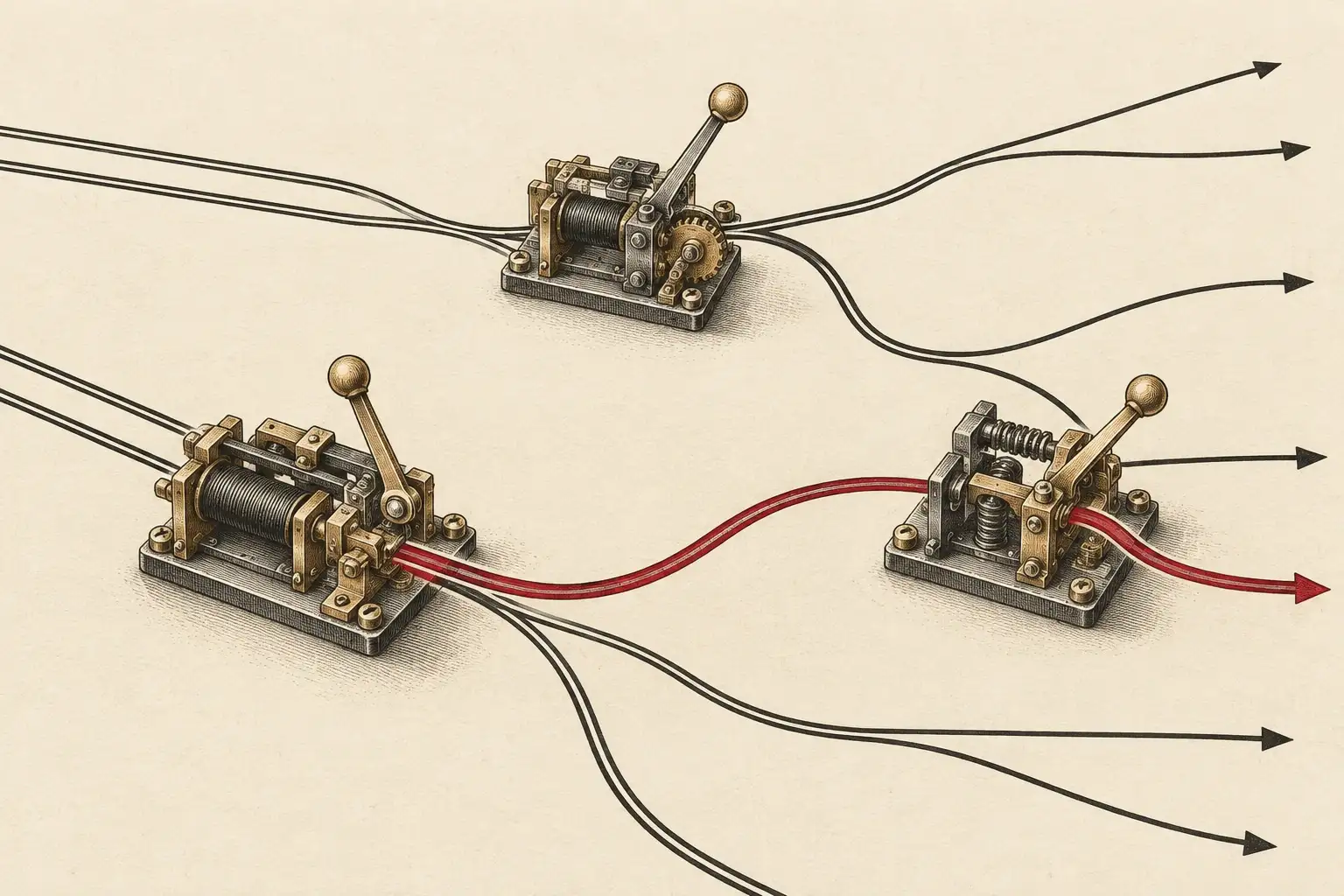
TL;DR: Reasoning effort is not one technology. Qwen3 fused thinking and non-thinking behavior during supervised fine-tuning, DeepSeek V4 trained mode-specific context windows and length penalties, NVIDIA used medium-effort prompts for 2.5% of Nemotron 3 Ultra's RLVR data, and Thinking Machines varied per-token costs across more than 30 million Inkling rollouts.[3][5][6][8] The real story isn't that users gained a “think harder” menu. It is that inference compute has become a routable business resource, and the same low, high, or max label can hide materially different training and serving systems.
The newest AI control looks almost insultingly simple. Pick low when speed matters. Pick high when the task is hard. Pick max when failure is expensive.
That interface hides the consequential part.
An effort label can select a behavior learned from mixed training examples. It can alter a token penalty during reinforcement learning. It can choose a specialist trained with a larger context window. It can tell the serving layer to cut off a reasoning trace after a fixed budget. Sometimes it combines several of those mechanisms. Two products can both advertise “high effort” while allocating different amounts of compute, time, context, tool use, and parallel work.
Sebastian Raschka's July 18 analysis assembled the clearest public overview yet of how these controls are being built.[1] The uncomfortable truth is what follows from that overview: reasoning effort is not a standardized measure of intelligence. It is becoming an inference control plane, a policy layer that determines how much work an AI system may spend on each request.

Why This Matters Now
Model choice is no longer the only major inference decision. The same deployed model can operate under different effort, budget, tool, and reasoning-state policies. That turns every production request into an allocation question: does this task deserve more compute, and what evidence would prove that the extra spend improved the outcome?
The Interface Lie: “High Effort” Is Not A Unit
Reasoning models became commercially important because additional test-time work could improve performance on some hard tasks. OpenAI's original o1 release reported that performance increased with more reinforcement learning during training and with more time spent reasoning during inference.[12] DeepSeek-R1 then showed that rule-based accuracy and format rewards could produce long reasoning traces, backtracking, and self-correction without a process reward model supervising every intermediate step.[2]
That established reasoning behavior. It did not establish one universal method for controlling it.
Even the familiar <think> delimiters are easy to misunderstand. They mark where a trace begins and ends inside a model's learned template. They do not create reasoning by themselves. Qwen3's non-thinking mode, for example, can prefill an empty thinking block so generation proceeds directly to the answer, but that switch works because Qwen trained the model on both thinking and non-thinking behavior.[3]
The same distinction applies to effort labels. OpenAI's open-weight gpt-oss model card documents low, medium, and high settings selected through a system-message instruction, with longer average chains of thought at higher settings.[4] That does not prove a closed commercial model uses the same implementation. Prompting an arbitrary model with “reasoning effort: high” will not recreate post-training it never received.
Let's be clear: the slider is an interface. The capability comes from the policy the model learned and the limits the serving system enforces.
Training The Knob: The Model Must Learn What “Enough” Means
The public recipes reveal a common structure, but not a common implementation.
Qwen3 used a four-stage post-training pipeline. Long-chain-of-thought supervised fine-tuning came first, followed by reasoning reinforcement learning, Thinking Mode Fusion, and general reinforcement learning. The fusion stage mixed long reasoning examples with ordinary instruction data so one checkpoint could produce both deliberate and direct responses.[3]
DeepSeek V4 went further. Its report describes Non-think, Think High, and Think Max as separate post-training configurations with different reinforcement-learning context windows and length penalties. Think Max also receives a dedicated system instruction. The resulting specialists are consolidated into a unified model through on-policy distillation.[5]
NVIDIA's Nemotron 3 Ultra combines learned modes with a serving-layer budget. Medium effort was introduced with teacher-generated supervised data and then represented in roughly 2.5% of RLVR prompts across math, STEM, and coding. NVIDIA also trained on randomly truncated reasoning traces while retaining the original answers, preparing the model to continue when an external client closes the reasoning block.[6]
Kimi K2.5 attacks a different failure mode. A fixed budget can teach a model to prefer short solutions so aggressively that it loses the ability to benefit from more test-time compute. Kimi's Toggle method alternates budget-constrained and unconstrained reinforcement-learning phases. The Kimi team reports 25% to 30% fewer output tokens with negligible benchmark impact in its experiments, but it does not disclose one universal budget or one directly portable score.[7]
Inkling makes the economic mechanism unusually explicit. Thinking Machines says it placed a requested effort value in the system message and varied the cost assigned to each generated token during reinforcement learning. The company reports more than 30 million rollouts and an aggregate held-out reward increase from 0.264 at supervised-fine-tuning initialization to 0.356 for the released checkpoint.[8] Those are vendor-reported training results, not proof that effort conditioning alone caused the gain.
What's often overlooked is that all of these methods teach a policy, not a stopwatch. Low effort usually encourages less work. It does not guarantee an exact token count. High effort creates room for more work. It does not guarantee that the work will be useful.
The Evidence Curve: Mode Bundles Improve, Then Flatten
DeepSeek V4 provides a useful example precisely because it is not a clean “more tokens equals more intelligence” experiment. Its three modes bundle several changes together, including post-training penalties and context limits. That makes the results commercially realistic and scientifically messy.
On the report's GPQA Diamond evaluation, DeepSeek V4 Pro rises from 72.9% in Non-think mode to 89.1% in Think High and 90.1% in Think Max.[5] The first jump is 16.2 percentage points. The second is 1.0 point. That looks like diminishing returns, but the modes also use different context allowances, so the chart cannot isolate reasoning length as the cause.
Here's the genius of the explorer: it makes the business problem visible. The last increment of quality can cost much more than the first, and the value of that increment depends on the task. One extra point on a benchmark may be irrelevant for rewriting a meeting note and decisive for a difficult research or coding workflow. “Max” has no rational default until the operator knows the cost of being wrong.
The API Budget Sheet: Tokens, Latency, Tools, And State
Reasoning controls have now moved from model reports into production APIs. Their names look similar. Their operational consequences are not.

OpenAI documents reasoning.effort values that can include none, minimal, low, medium, high, xhigh, and max, depending on the model. Lower effort favors speed and fewer tokens. Higher effort allows more complete reasoning. The reasoning tokens are hidden from API output, occupy context space, and are billed as output tokens.[9]
Anthropic exposes low, medium, high, xhigh, and max on supported models. Its documentation calls effort a behavioral signal rather than a strict budget. The setting can affect visible text, extended thinking, and tool calls, which means lowering effort can change how many external actions an agent attempts, not merely how verbose its answer becomes.[10]
Google uses two control families. Gemini 3 models expose minimal, low, medium, and high where supported. Gemini 2.5 models use an integer thinkingBudget; Gemini 2.5 Flash accepts 0 to 24,576, while Gemini 2.5 Pro accepts 128 to 32,768 and cannot disable thinking. Google bills thought tokens with output tokens even when the API returns only a summary.[11]
Reasoning Controls Share An Intent, Not A Standard
| Feature | OpenAI | Anthropic | Google Gemini |
|---|---|---|---|
| Primary control | Model-dependent effort labels | Effort labels across response and tool use | Thinking level or integer budget |
| Strict token cap? | No, effort guides behavior; max output can cap total generation | No, effort is explicitly behavioral | Budget guides token use and may underflow or overflow |
| Can thinking be off? | On some models and settings | Not a universal effort value | On some Flash models; not Gemini 2.5 Pro |
| Hidden economic effect | Reasoning tokens consume context and output billing | Effort can change text, thinking, and tool calls | Full thought tokens are billed even when only summaries appear |
The real story isn't which provider offers the longest menu. It is that product teams now need an application-level policy that survives provider differences. “High-stakes analysis with tools and verification” is a durable workload class. thinkingBudget: 8192 is one vendor-specific implementation.
The Routing Moat: Spend More Only When Evidence Demands It
Maximum reasoning everywhere is not a serious production strategy. It is the inference equivalent of assigning the most expensive employee to every support ticket.
The better architecture starts with a cheap initial allocation, tests the result, and escalates when external evidence says the answer is inadequate. A structured extraction can be checked against a schema. Code can be compiled and tested. A research answer can be checked for source coverage. A calculation can be recomputed. A consequential action can require human approval.
This is where reasoning effort connects to agent design. The model setting is only one control. The surrounding system also decides which tools are available, how many attempts are allowed, which result counts as verified, and when work must stop.

While competitors expose ever-higher settings, the durable moat will be the evaluation data that tells an operator when those settings earn their keep. Anyone can send high. A tax platform knows which reconciliation failures require it. A software company knows which tests, files, and rollback risks justify a more expensive pass. A research tool knows when missing primary evidence should trigger another search.
Cost per request is therefore the wrong metric. The useful number is cost per accepted outcome, including failed retries and human review. Low effort that fails twice can cost more than medium effort that passes once.
The Disclosure Rule: Effort Must Travel With Every Score
Reasoning effort makes benchmark theater easier because the model name no longer describes the full system.
A serious result now needs the model, effort level, reasoning mode, context allowance, output limit, tools, number of samples, selection method, verifier, temperature, latency distribution, and billing basis. Without those details, a benchmark score is not a portable capability claim. It is a signal from one deployment configuration.
This is especially important when the setting changes more than trace length. DeepSeek V4 changes mode-specific training and context. Nemotron combines learned effort with hard budgets. Anthropic says effort can alter tool calls. OpenAI's GPT-5.6 separates reasoning effort from reasoning mode, and its Ultra product coordinates multiple agents rather than simply extending one trace.[5][6][9]
The Expensive Failure Mode
More reasoning can amplify a bad objective, exploit a weak verifier, or produce a longer explanation without a better answer. Token expenditure is not evidence of rigor. Only an external acceptance signal can show whether additional effort improved the result.
The Reasoning-Control Playbook
Treat effort labels as provider-specific policies, not standardized units of compute or intelligence.
Separate learned modes, reward conditioning, hard budgets, and budget-robustness training when evaluating a model's control surface.
Route effort by task stakes, verification failures, latency targets, and the cost of being wrong.
Measure cost per accepted outcome, including retries, tool calls, and human review, instead of cost per first request.
Publish effort, mode, context, tools, samples, verifier, output budget, and latency with every benchmark claim.
Keep business-level workload classes portable even when provider parameter names change.
The best AI system will not be the one that always thinks longest. It will be the one that knows which task deserves more work, which evidence can validate the result, and when another token is unlikely to change the decision.
Reasoning effort is not a smartness slider. It is the emerging operating policy for inference economics. The companies that learn to allocate it will buy capability where it matters and refuse to pay for theater everywhere else.
Sources & Evidence
Primary papers and official documentation support technical claims. Vendor-reported results are labeled in the article.
| # | Source | Outlet | Date | Key Takeaway |
|---|---|---|---|---|
| 1 | Ahead of AI Sebastian Raschka | July 18, 2026 | Secondary synthesis of public reasoning-effort training and inference mechanisms. Used as the starting point for independent primary-source verification. | |
| 2 | arXiv DeepSeek-AI | January 22, 2025 | Documents rule-based accuracy and format rewards for R1-Zero and the emergence of long reasoning behavior without a process reward model. | |
| 3 | arXiv Qwen Team | May 15, 2025 | Documents Thinking Mode Fusion, mixed thinking and non-thinking training, and inference-time thinking-budget control. | |
| 4 | OpenAI OpenAI | August 5, 2025 | Documents low, medium, and high effort labels in the system message and longer average chains of thought at higher settings. | |
| 5 | DeepSeek DeepSeek-AI | April 24, 2026 | Documents Non-think, Think High, and Think Max mode bundles, distinct RL context windows and length penalties, and vendor-reported benchmark results. | |
| 6 | NVIDIA Research NVIDIA | June 9, 2026 | Documents medium-effort SFT and RLVR data, a 2.5% medium-effort RLVR share, and training for externally truncated reasoning budgets. | |
| 7 | arXiv Kimi Team | February 2, 2026 | Introduces Toggle, alternating budgeted and unconstrained reinforcement learning to improve token efficiency without discarding test-time scaling. | |
| 8 | Thinking Machines Lab Thinking Machines Lab | July 15, 2026 | Reports effort conditioning through system messages and per-token costs across more than 30 million reinforcement-learning rollouts. | |
| 9 | OpenAI API Documentation OpenAI | Accessed July 20, 2026 | Documents model-dependent reasoning-effort values, separate GPT-5.6 modes, reasoning-token accounting, context use, and output billing. | |
| 10 | Claude Platform Documentation Anthropic | Accessed July 20, 2026 | Defines effort as a behavioral signal across text, tool calls, and extended thinking, with low through max levels on supported models. | |
| 11 | Google AI for Developers Google | Accessed July 20, 2026 | Documents Gemini 3 thinking levels, Gemini 2.5 token budgets, thought-token reporting, model-specific disable behavior, and billing. | |
| 12 | OpenAI OpenAI | September 12, 2024 | Vendor report that o1 performance increased with training-time reinforcement learning and additional test-time compute. |
Last updated: July 20, 2026