TL;DR: OpenAI's Jalapeño is a custom chip for running AI models, not training them. In OpenAI-reported InferenceX tests, it delivered 1.5 to 1.9 times higher peak work per package-TDP watt and 1.7 to 3.6 times lower end-to-end latency than selected NVIDIA GB200 and GB300 systems across three public models.[1] AI also helped OpenAI move from initial design to tapeout in nine months, port three unplanned model families in two months, and produce selected kernels that ran 1.5 to 1.8 times faster than earlier human-written versions.[1] The results are strong, but they do not establish fleet cost, reliability, or performance on long, multi-turn agent traffic.[3][4]
Is this the beginning of the end for purely human-written chips?
That is the provocative question hiding inside Jalapeño. OpenAI did not hand an AI a blank page and receive a finished processor. Human engineers still chose the architecture, verified the design, signed off on manufacturing, and remain responsible for whether the system works. But OpenAI says its models were already helping explore implementations, shorten measurement and verification loops, optimize arithmetic circuits, and write faster kernels.[1]
The shift is not from human-designed chips to autonomous AI-designed chips overnight. It is from engineering teams testing a limited number of ideas by hand to human-led teams using AI to explore far more circuits, schedules, and implementations. Jalapeño may be the first visible proof that the chips running tomorrow's AI will increasingly be co-designed by the AI running today.
Here is the simple version. Training an AI model is like writing and testing an enormous cookbook. Inference is the restaurant serving meals from that cookbook, one order after another, all day. NVIDIA sells powerful kitchens that can cook almost anything. Jalapeño is OpenAI building a kitchen around the few meals it expects to serve billions of times.
Why does that matter? Every ChatGPT reply, API completion, and Codex step is inference. If OpenAI can produce more useful tokens from the same power budget while making users wait less, it can serve more demand inside the same data center. It may also gain leverage when it negotiates for NVIDIA capacity.
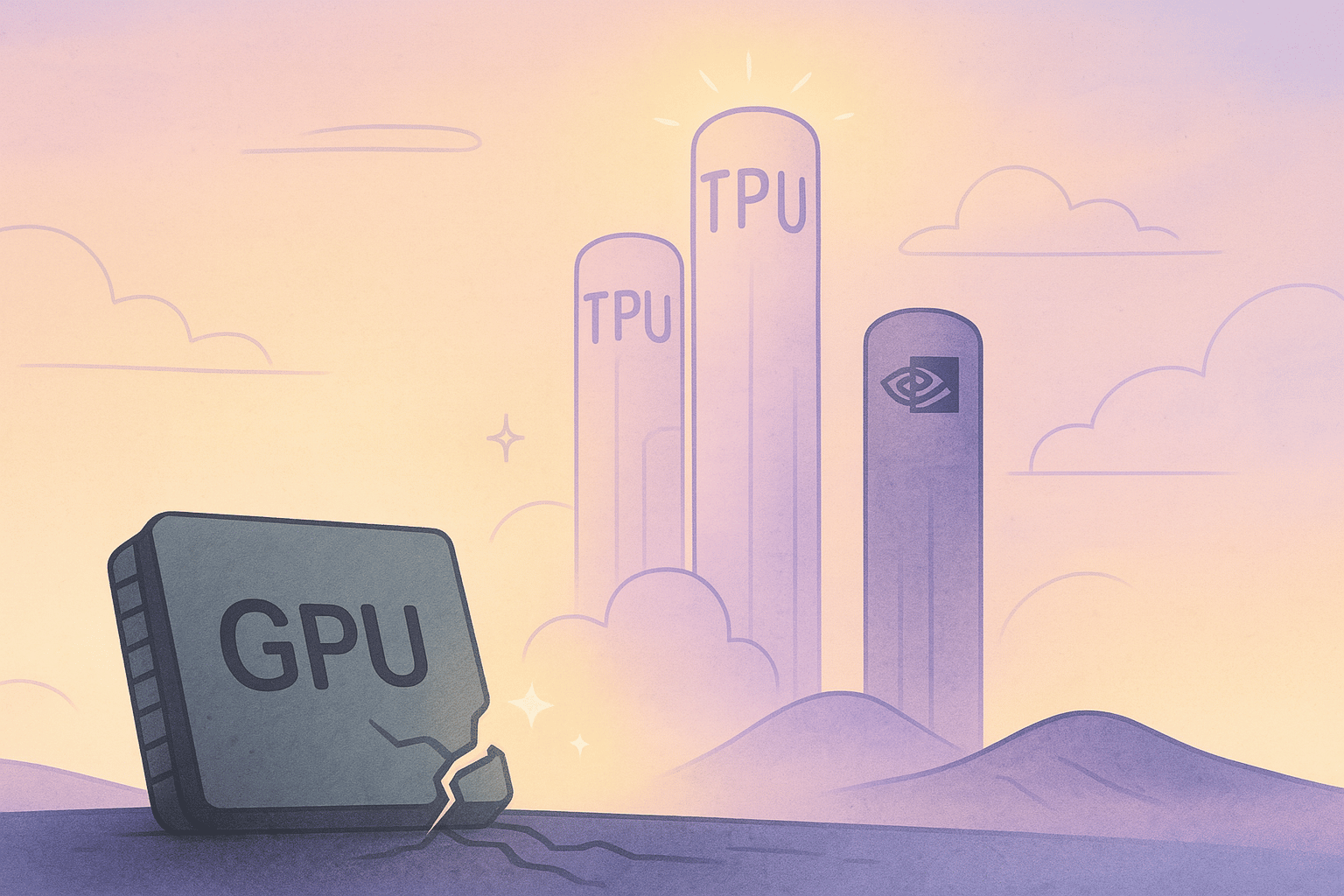
That does not mean NVIDIA has been replaced. Jalapeño is an inference accelerator in production qualification. OpenAI says initial deployment should begin by the end of 2026, while it continues to deploy NVIDIA hardware for both training and inference.[1] The real story isn't a GPU funeral. It is the world's most important AI customer learning to own the economics of serving its products.
Why This Matters Now
OpenAI plans to begin deploying Jalapeño before the end of 2026, and it says Gen 2 is already deep in development.[1] The company also has separate, forward-looking 10-gigawatt arrangements involving both Broadcom custom accelerators and NVIDIA systems.[6][7] This is not a clean supplier swap. It is a deliberate multi-sourcing strategy at unprecedented scale.
Jalapeño in Plain English: A Serving Chip, Not a Training Replacement
Jalapeño is OpenAI's first custom inference accelerator. OpenAI designed the architecture around language-model serving. Broadcom contributes silicon implementation and networking technology. Celestica helps industrialize the board, rack, and system design.[2]
The distinction between training and inference is crucial. Training changes model weights across a large and fast-moving research workload. Inference loads finished weights and repeatedly turns prompts into responses. A general GPU is valuable when workloads change quickly, developers need a mature software ecosystem, or the same hardware must train and serve many different model families. A custom accelerator becomes attractive when one operator has enough repeatable demand to optimize the whole path.
Jalapeño focuses on the bottlenecks that appear during that path. Prefill reads the prompt and is compute-intensive. Decode generates the answer token by token and often depends more on memory bandwidth. The KV cache holds working memory from the conversation. Networking moves weights and state when one chip cannot hold the job alone. OpenAI says Jalapeño keeps more state local and coordinates compute, memory, and networking as one system, reducing time spent waiting for data.[1]
How OpenAI Turns A Prompt Into A Jalapeño Workload
The advantage is supposed to come from co-designing the full serving path, not from one isolated chip specification.
Product demand defines the workload
ChatGPT, Codex, and API traffic reveal prompt lengths, latency targets, model shapes, and cache behavior.
OpenAI shapes the accelerator
The architecture balances prefill compute, decode bandwidth, local state, communication, and changing model needs.
Broadcom and Celestica industrialize it
Silicon implementation, networking, boards, racks, integration, and production turn the design into a deployable system.
OpenAI writes the serving software
Model-specific kernels place, schedule, and coordinate work across the accelerator and its network.
Useful tokens return to users
The business outcome is lower waiting time and more completed requests inside a fixed power envelope.
OpenAI says AI-assisted workflows helped move the chip from initial design to manufacturing tapeout in nine months. It also says Codex with GPT-Astra brought three unplanned open-weight models to high performance in two months. For selected GPT-OSS attention and mixture-of-experts blocks, AI-generated implementations ran 1.5 to 1.8 times faster than earlier human-expert versions.[1] Those last figures are block-level kernel results, not end-to-end model speedups.
AI Turns The Custom-Chip Tax Into A Faster Loop
Here is the part that changes the industry math. A custom chip is not useful merely because the silicon comes back from the factory. Engineers must verify that it behaves correctly, understand where it stalls, write low-level kernels for each model operation, decide where data should live, and repeatedly benchmark thousands of possible schedules. That work is slow, specialized, and expensive. It is one reason NVIDIA's mature software stack has been so hard to challenge.
AI can make each loop cheaper. During chip design, a coding or reasoning model can explore circuit implementations, inspect verification failures, compare timing and power tradeoffs, and help engineers narrow the search space. After tapeout, it can read traces, propose schedules, generate kernels, test them against correctness checks, and keep the versions that run faster. When a new model arrives, the same system can inspect its attention and mixture-of-experts blocks, then repeat the optimization loop for a new target.
Think of it like moving from hand-tailoring every suit to running an automated workshop. Human engineers still choose the pattern, materials, tolerances, and quality bar. AI cuts, measures, tests, and revises far more candidates before the team commits to one. The result is not zero human work. It is more engineering experiments per day.
How AI Makes Custom Silicon Easier
| Feature | What AI can accelerate | What still requires hard engineering |
|---|---|---|
| Chip design | Explore circuit variants, surface tradeoffs, and shorten verification loops | Architecture choices, physical design, sign-off, foundry constraints, and accountability |
| Bring-up | Read traces, find bottlenecks, propose tests, and compare measured behavior | Debugging real silicon, lab instrumentation, errata, and failure analysis |
| Kernel development | Generate and tune low-level implementations across placements and schedules | Correctness, numerical quality, safety checks, and production review |
| New-model support | Translate unfamiliar attention and MoE blocks into optimized kernels faster | Keeping pace with changing architectures and validating the entire model |
| Fleet operations | Potentially improve routing, scheduling, anomaly detection, and preventive maintenance | Yield, HBM supply, networking, cooling, uptime, and physical replacement |
OpenAI's disclosed numbers show the first three rows beginning to work. The nine-month tapeout, two-month porting cycle, and 1.5 to 1.8 times selected-block result are all vendor-reported, and OpenAI does not quantify how much time AI alone saved. Still, the direction is strategically important. The fixed cost of building an alternative software stack may fall faster than the fixed cost of fabricating the chip.
That creates a compounding loop. Better AI helps design and program better accelerators. Better accelerators make inference cheaper and faster. Cheaper inference lets developers run more AI experiments, including more chip-design and kernel-search work. Each generation supplies tools and workload data for the next one.
The AI Co-Design Flywheel
AI helps explore more designs and kernels. The winning implementations make AI inference faster. Faster inference makes it cheaper to run the next round of design, simulation, testing, and optimization. If the loop holds, custom silicon becomes easier to improve with every generation, even though manufacturing and fleet operations remain physical bottlenecks.
Here's the genius: OpenAI is using models to reduce the software tax of owning non-CUDA hardware. That does not erase the tax. OpenAI explicitly says every new model family still needs new kernels and model-specific optimization. AI makes the workshop faster; it does not remove the factory.
The First Results: Strong Signals With Narrow Boundaries
OpenAI tested Jalapeño with SemiAnalysis's public InferenceX harness on GPT-OSS 120B, DeepSeek R1 670B MXFP4, and Kimi K2.5 1T MXFP4. The disclosed runs used nominal 8K input and 1K output sequences with single-token prediction, not speculative decoding.[1]
The headline is impressive. Across the three tests, OpenAI reports 1.5 to 1.9 times higher peak mixed tokens per package-TDP kilowatt and 1.7 to 3.6 times lower end-to-end latency than its selected NVIDIA comparison systems.
What OpenAI Actually Reported
Vendor-reported InferenceX results. These are fixed-sequence 8K/1K STP deployment signals, not a universal hardware leaderboard.
Mixed tokens per second normalized by published package TDP
Across the three disclosed model and comparator pairs
OpenAI says measured sustained power stayed at or below 550 W
Production qualification and software maturation are still underway
Gen 2 is in development; Gen 3 has no disclosed schedule
Note: Source: OpenAI. No unit cost, fleet share, rack-level wall power, yield, uptime, or production cost per token was disclosed.
The model-level pairs matter more than the aggregate range. On GPT-OSS 120B, OpenAI reports 85,448 versus 44,960 mixed TPS/kW and 1.03 versus 1.80 seconds of end-to-end latency against a GB200 comparison. On DeepSeek R1 MXFP4, it reports 19,641 versus 11,781 mixed TPS/kW and 1.65 versus 5.99 seconds against GB300. On Kimi K2.5 MXFP4, the figures are 18,195 versus 11,862 mixed TPS/kW and 1.56 versus 5.31 seconds against GB300.[1]
Evidence graphic
OpenAI-Reported Peak Efficiency Advantage
Ratio of Jalapeño to the named NVIDIA comparison for mixed TPS per published package-TDP kilowatt. Each bar belongs to its own disclosed model and system pair.
GPT-OSS 120B vs. GB200
85,448 vs. 44,960 mixed TPS/kW
DeepSeek R1 MXFP4 vs. GB300
19,641 vs. 11,781 mixed TPS/kW
Kimi K2.5 MXFP4 vs. GB300
18,195 vs. 11,862 mixed TPS/kW
Source: OpenAI, August 25, 2026. Nominal 8K/1K, STP. Package TDP: Jalapeño 700 W, GB200 1,200 W, GB300 1,400 W. These figures do not measure total rack power, cooling, networking, purchase price, or production reliability.
OpenAI normalizes efficiency using the published package power rating for each accelerator. It rates Jalapeño at 700 watts, versus 1,200 watts for the GB200 comparison and 1,400 watts for the GB300 comparisons. That makes the charts useful for a chip-power-normalized serving signal. It does not turn them into a facility electricity bill or a total-cost-of-ownership result.
The public harness improves transparency, but the announced Jalapeño results remain OpenAI-reported. SemiAnalysis says it observed InferenceX runs in OpenAI's lab, confirmed the silicon was real, and did not run the complete suite or see AgentX results.[3] That is meaningful third-party scrutiny. It is not the same as an independent fleet reproduction.
The 104x Trap: A Pareto Win Is Not 104x More Hardware
The most viral numbers in OpenAI's appendix are 53.7x, 104.3x, and 56.1x more throughput at the NVIDIA system's previous-best time between tokens. They sound like Jalapeño is fifty to one hundred times faster. That is not what the comparison says.
The test holds the user's streaming speed constant at the comparison system's low-concurrency point, then asks how much total throughput each system can carry at that same interactivity. Jalapeño's architecture can keep more work in flight without surrendering the target response speed. That is valuable for agents and interactive products. It is not a peak-throughput multiplier, a purchase-price ratio, or a claim that one Jalapeño replaces 104 GB300s.
An iso-interactivity operating-point comparison, not a peak hardware-speed or fleet-cost multiple.
What's often overlooked is that the same multiplication can expose a common misreading of the 1.9x GPT-OSS efficiency figure. Multiplying the displayed TPS/kW by each system's stated package TDP implies roughly 59,814 mixed TPS for Jalapeño and 53,952 mixed TPS for GB200 at those peak points. The reported advantage is primarily about useful work per rated watt, not 1.9 times more absolute throughput.
What The Evidence Proves, And What It Does Not
| Feature | Supported by disclosed evidence | Still unknown or incomparable |
|---|---|---|
| Silicon | Working engineering samples ran three public model configurations | Production yield, volume, failure rate, and lifetime |
| Efficiency | Higher package-TDP-normalized mixed TPS/kW in the disclosed pairs | Measured facility power, cooling, networking, and cost per useful token |
| Latency | Lower reported E2E latency and minimum TBT on fixed 8K/1K STP | Long-context, multi-turn, cached, bursty agent traffic |
| Software | Three unplanned models reportedly optimized in two months | Porting speed across every new frontier architecture at fleet scale |
| NVIDIA impact | A credible first-party inference path and negotiating lever | A quantified reduction in NVIDIA purchases or training dependence |
SemiAnalysis now argues that fixed-sequence 8K/1K tests miss important production behavior. Its AgentX workload models long contexts, repeated prefixes, multi-turn sessions, tool pauses, and subagent bursts. In its published dataset, the median full-scenario request has 142,016 input tokens, not 8,000.[4] Jalapeño has no disclosed AgentX result yet.
A Pareto Frontier Is Not A Purchase Order
OpenAI's figures are credible evidence that Jalapeño is real and promising. They are not proof that it is cheaper to own at fleet scale, better on all OpenAI production traffic, or replacing NVIDIA capacity. Keep the model, precision, 8K/1K sequence, STP setting, package-TDP normalization, and deployment status attached to every comparative claim.
The CUDA Question: Serving Is Where the Moat Gets Thinner
CUDA's advantage has never been one instruction set. It is the accumulated software, libraries, debugging tools, cloud availability, developer knowledge, networking, and compatibility that let a new workload run quickly on hardware already deployed almost everywhere.
Jalapeño does not disprove that advantage. OpenAI is an exceptional customer with huge recurring demand, direct knowledge of its model roadmap, dedicated kernel engineers, and hardware partners. Most companies cannot justify a bespoke target. They want a shared platform that handles changing workloads without rebuilding the serving stack.
But Jalapeño reveals where the moat is most vulnerable. A frontier lab may serve a small number of high-volume models often enough to justify hand-tuned kernels. OpenAI describes Jalapeño as a predictable programming target on which AI can map, place, schedule, and coordinate work. If coding models keep reducing the cost of that optimization, the economic premium for generality shrinks on mature inference workloads.
The NVIDIA moat is not that nobody else can multiply matrices. It is time-to-a-new-model on a shared, deployed, and supported platform.
NVIDIA is attacking the same problem from the other direction. It says Dynamo 1.0 and TensorRT-LLM integrate with frameworks including vLLM, SGLang, llm-d, LMCache, and LangChain, while improving Blackwell inference by up to 7x in NVIDIA's selected benchmarks.[8] That is also a vendor-reported, workload-dependent claim. It shows why the contest is software plus systems, not ASIC versus GPU in isolation.
The uncomfortable truth is that AI-assisted kernel writing can weaken part of CUDA's lock-in without making CUDA irrelevant. OpenAI still needs new kernels for new model families. NVIDIA can spread each software improvement across millions of GPUs, clouds, and customers. Jalapeño can optimize first for OpenAI. Those are different advantages.
What It Means for NVIDIA: Margin Pressure Before Volume Collapse
NVIDIA does not need to lose OpenAI for Jalapeño to matter. It only needs to lose the assumption that every mature OpenAI inference token must run on an NVIDIA accelerator.
OpenAI and NVIDIA announced a letter of intent for at least 10 gigawatts of NVIDIA systems, with the first gigawatt planned on Vera Rubin in the second half of 2026 and NVIDIA intending to invest up to $100 billion as capacity is deployed.[6] OpenAI and Broadcom separately announced a 10-gigawatt custom-accelerator collaboration targeted to begin in the second half of 2026 and complete by the end of 2029.[7] Neither announcement is proof of installed capacity or booked future revenue.
The two arrangements are not mutually exclusive. OpenAI needs enormous amounts of compute. NVIDIA remains central to training, broad inference, networking, and rapid model bring-up. Jalapeño gives OpenAI a path to move predictable serving demand onto hardware it helps control.
The Strategic Winners And Risks
The same chip can pressure NVIDIA's share while expanding the total market for AI infrastructure.
OpenAI
Own more of the cost curve behind recurring ChatGPT, Codex, and API demand.
NVIDIA
Protect training and broad-platform demand while defending high-volume inference economics.
Broadcom
Capture silicon implementation, Ethernet, and networking value as hyperscalers internalize accelerator design.
AI customers
More efficient infrastructure can improve availability and latency, but lower operating cost does not guarantee lower prices.
NVIDIA reported $75.2 billion of Data Center revenue in its fiscal 2027 first quarter, up 92% year over year.[9] Jalapeño has no disclosed unit volume, production cost, fleet share, or revenue displacement. Any near-term NVIDIA loss calculation would be fiction.
The long-run risk is more subtle. Custom silicon can pressure the portion of NVIDIA's margin earned from a workload that has become stable, repeatable, and large enough for vertical integration. Even a modest Jalapeño deployment can strengthen OpenAI's negotiating position. If lower inference cost creates far more agent usage, total compute demand may still rise fast enough for NVIDIA revenue to grow. Share, margins, and absolute volume can move in different directions.
The real story isn't that efficiency destroys demand. It can create demand. Faster, cheaper tokens make longer reasoning, more tool calls, and more always-on agents economically viable. NVIDIA may sell more accelerators into a world where its largest customers also build more of their own.
The Fleet Test: What Must Happen Next
X reaction split along the right fault line. OpenAI and Sam Altman emphasized that the chip exists and is fast.[10] SemiAnalysis called the first-generation result unusually competitive after visiting the lab, while highlighting the absence of complete AgentX testing.[3][11] Skeptics argued that Vera Rubin, not Grace Blackwell, is the more relevant 2027 comparison.[12]
All three views can be true. The chip can be technically impressive, strategically important, and unproven at production scale.
The next evidence should answer six questions:
- How many Jalapeño systems carry real OpenAI traffic in 2027?
- What are measured wall-power, uptime, failure-rate, and maintenance results at rack scale?
- How does the system perform on long-context, multi-turn, prefix-cache-heavy agent workloads?
- What happens when Jalapeño and NVIDIA systems use comparable speculative decoding settings?
- How quickly can OpenAI support a newly released model family without compromising quality?
- What is the all-in cost per successful production task after silicon, memory, networking, cooling, software, and operations?
The Jalapeño Verdict
Jalapeño is a real inference accelerator with strong OpenAI-reported results, not a slideware concept.
The disclosed gains belong to three fixed 8K/1K STP model tests normalized by package TDP. They are not universal fleet economics.
OpenAI is not replacing NVIDIA in training and says it will keep deploying NVIDIA accelerators for inference too.
The strategic threat is that repeatable hyperscale inference can move from merchant GPUs to customer-designed systems.
AI-assisted kernel development may narrow CUDA's software advantage at the very top of the market, while NVIDIA's ecosystem remains decisive for everyone else.
Rubin comparisons, AgentX results, production volume, reliability, and total cost will determine whether Jalapeño changes NVIDIA's business or only its bargaining table.
Let's be clear: Jalapeño is structurally bearish for the idea of an NVIDIA inference monopoly. It is not evidence of a 2026 collapse in NVIDIA demand.
OpenAI has shown that a first-generation custom serving chip can reach the conversation. Now it has to reach the fleet. If that happens, NVIDIA may keep the training throne and still lose something valuable: the assumption that its best customers have no credible alternative for serving intelligence.
Sources & References
Primary announcements, benchmark methodology, independent analysis, NVIDIA materials, and X posts. Comparative performance remains attributed to the reporting party.
| # | Source | Outlet | Date | Key Takeaway |
|---|---|---|---|---|
| 1 | OpenAI OpenAI | August 25, 2026 | Primary benchmark figures, 8K/1K STP conditions, architecture, AI-assisted kernel claims, power normalization, roadmap, and deployment caveats. | |
| 2 | OpenAI OpenAI and Broadcom | June 24, 2026 | Primary source for Jalapeño's role, Broadcom and Celestica responsibilities, nine-month tapeout claim, and end-2026 deployment target. | |
| 3 | SemiAnalysis Bryan Shan, Myron Xie, Jordan Nanos et al. | August 25, 2026 | Lab-visit analysis confirming observed runs while stating that OpenAI supplied the figures, the full suite was not rerun, and AgentX remains untested. | |
| 4 | InferenceX SemiAnalysis | August 2026 | Documents the long-context, multi-turn, cache-aware agent workload missing from the disclosed Jalapeño tests. | |
| 5 | OpenAI Sarah Friar | August 25, 2026 | OpenAI's strategic case for a multi-vendor compute portfolio and first-party silicon as an operating-leverage tool. | |
| 6 | OpenAI OpenAI and NVIDIA | September 22, 2025 | Letter of intent for at least 10 GW, first Vera Rubin gigawatt in the second half of 2026, and intended NVIDIA investment of up to $100 billion. | |
| 7 | OpenAI OpenAI and Broadcom | October 13, 2025 | Primary source for the 10 GW custom-accelerator target and deployment window through the end of 2029. | |
| 8 | NVIDIA NVIDIA | March 16, 2026 | NVIDIA's software and ecosystem counterstrategy, including its workload-dependent claim of up to 7x higher Blackwell inference performance. | |
| 9 | NVIDIA NVIDIA | May 20, 2026 | Reports $75.2 billion of Data Center revenue, up 92% year over year, illustrating why no near-term displacement figure follows from Jalapeño's lab results. | |
| 10 | X OpenAI | August 25, 2026 | Primary social launch thread summarizing efficiency, latency, planned deployment, and the multi-generation roadmap. | |
| 11 | X Dylan Patel | August 25, 2026 | High-signal reaction from SemiAnalysis after its lab visit, framing the first-generation ASIC as unusually competitive. | |
| 12 | X Chad Wallace | August 26, 2026 | Technical criticism that a chip ramping in 2027 should ultimately be judged against Vera Rubin rather than only Grace Blackwell. | |
| 13 | TechCrunch Russell Brandom | August 25, 2026 | Independent reporting from Hot Chips, including the deployment-timing context and the relevance of NVIDIA's advancing roadmap. | |
| 14 | InferenceX SemiAnalysis | Accessed August 26, 2026 | Definitions for 8K/1K, interactivity, iso-interactivity, throughput, TBT, KV cache, and other benchmark terminology. |
Last updated: August 26, 2026