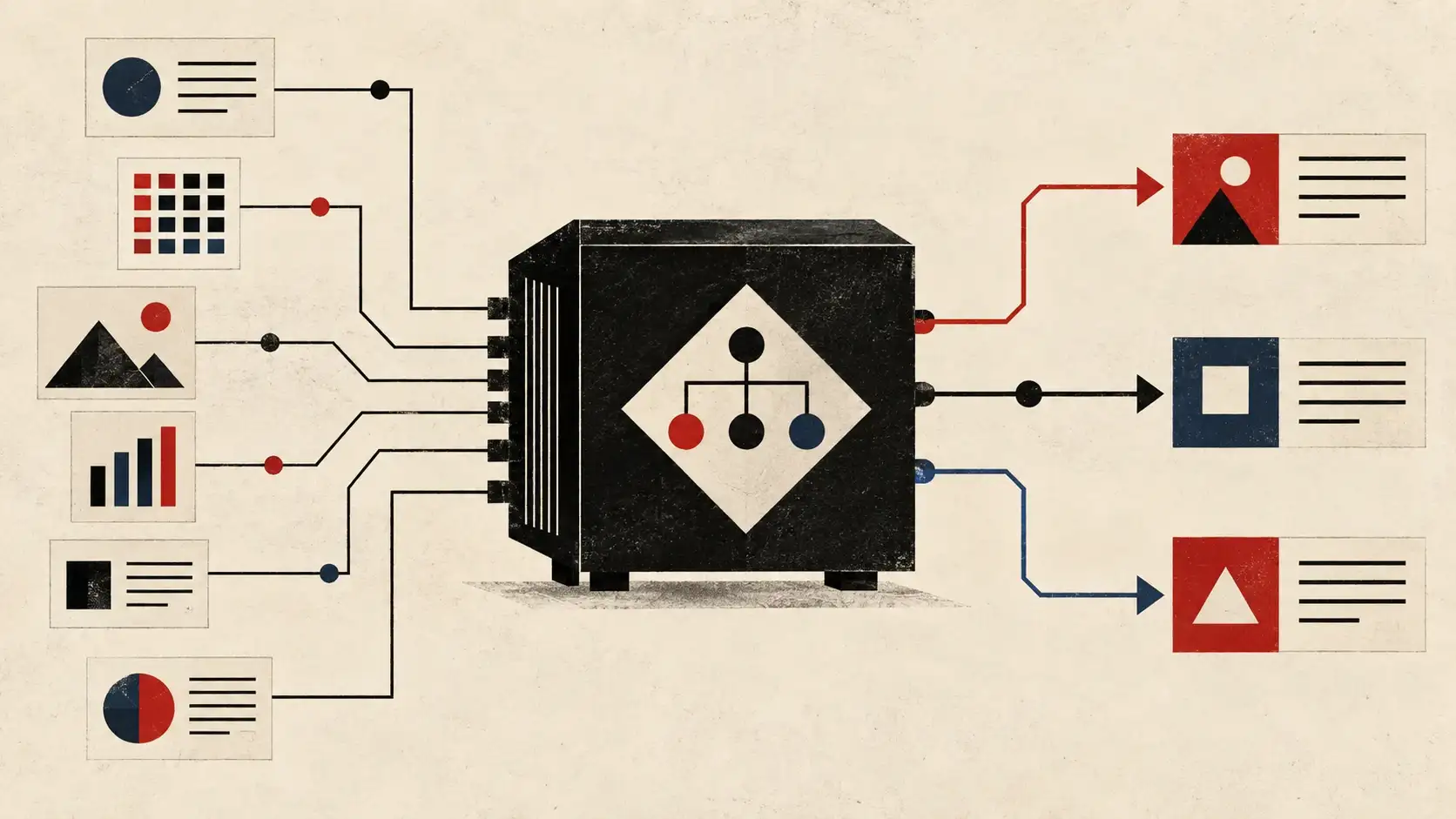
TL;DR: Recursive Agent Harnesses turn the full agent runtime into the unit of delegation. A parent agent can write executable code that launches child agents with their own tools, context, and planning loops, then aggregate their outputs. In a controlled preprint evaluation, Recursive Agent Harnesses scored 81.36% on 199 Oolong-Synthetic samples, compared with 71.75% for a Codex-style coding-agent baseline and 64.38% for an RLM configuration, a 9.61-point gain over the authors' published GPT-5-matched coding-agent baseline, not a paired rerun.[1] Prime Intellect's Prime Agent makes the pattern concrete with a persistent IPython runtime, durable subagents, agent-to-agent messaging, and a continual harness that can revise prompts, memories, skills, and subagent specifications.[3]
The real story isn't that agents learned to call more agents. It is that the orchestration layer is becoming programmable. The model supplies judgment, but the harness decides what gets parallelized, what gets remembered, what gets verified, and when the run is allowed to stop.
That shift matters because the next AI bottleneck is not a missing chat feature. It is the gap between a plausible answer and a reliable result delivered across a long, messy workflow. Recursive harnesses attack that gap with more context windows, more independent attempts, and more explicit control over execution. They also create more ways to waste tokens, duplicate mistakes, leak credentials, and confuse activity with progress.
Why This Matters Now
Frontier models are increasingly capable of writing programs that operate their own tools. Prime Intellect argues that fixed tool schemas and hand-written subagent trees leave that capability on the table.[3] Recursive harnesses let the model choose the decomposition at runtime, while persistent state lets useful operating lessons survive beyond one chat. The strategic question is moving from “Which model answers best?” to “Which runtime can turn model calls into accepted work at the lowest risk and cost?”
The Unit Of Scale: From Model Call To Harness
Recursive Language Models, or RLMs, start with a simple observation: a long prompt does not have to remain a single opaque string. The model can treat context as a variable in a persistent read-eval-print loop, inspect slices of it, transform it with code, and call child model instances when a region needs focused reasoning.[8] The recursion is over model calls. In the RLM comparison used by the RAH paper, that baseline cannot open files, run code, or call external services. RLM implementations more generally may expose a persistent REPL and other host-provided capabilities.[1][5]
Recursive Agent Harnesses, or RAHs, extend the recursive unit. In the RAH design, each child has filesystem access, code execution, planning, and the same spawning capability, bounded by a configurable recursion limit. The preprint's authors argue that a parent can use executable code to fan out work beyond per-turn function-call limits, give each child an isolated workspace, and aggregate structured outputs after the branches finish.[1]
That distinction sounds semantic until the workload becomes large. An RLM can ask a child model to summarize a document. An RAH can ask a child agent to inspect a repository, run tests, write an artifact, call a verifier, and delegate a deeper subproblem when the first pass exposes one. The recursion now carries execution state, not just text.
The Evidence In One View
Reported scores and workload boundaries from the RAH preprint. These are research signals, not a universal ranking of agent architectures.
GPT-5 backbone on the 199-sample Oolong-Synthetic protocol
Codex-style coding agent with no retriever, same backbone
Absolute improvement over the strongest matched prior result
Context lengths across 13 buckets, average 629K tokens
Note: The preprint reports 89.77% with Claude Sonnet 4.5, but that result uses a different backbone and must not be used to isolate the harness effect.
The paper's result is encouraging because the GPT-5 comparison holds the backbone and temperature at zero. It is also narrow because the sample is synthetic, the benchmark is one long-context aggregation task, and the authors do not publish a complete cost or wall-clock profile. A harness can raise accuracy while multiplying inference spend. Production buyers need both numbers.
Three Different Meanings Of Recursive
| Feature | RLM | RAH | Continual harness |
|---|---|---|---|
| Recursive unit | Model call | Full agent runtime | Harness state |
| Primary mechanism | Persistent context variables | Executable spawning and isolated workers | CRUD edits to prompts, memory, skills, and subagents |
| What persists | REPL variables and history | Child sessions, files, and outputs | Versioned operating instructions and reusable behavior |
| Main promise | Reason over context beyond one window | Scale work across agents and tools | Improve the runtime from observed trajectories |

These are stacked layers, not interchangeable product categories. Prime Agent combines a persistent RLM runtime, durable harness state, and recursive child agents. The RAH preprint evaluates a separate harness-recursion design; it does not evaluate Prime Agent.
The Prime Agent Launch: A Productized Recursive Runtime
Prime Intellect's August 5 launch is the clearest product statement of the trend. The company describes Prime Agent as an open-source coding and research agent built around two abstractions: RLM for programmatic context and subagent calls, and Continual Harness for durable supplemental state.[3] The linked announcement is not a claim that the base model retrains itself. It is a claim that the runtime can change the instructions and resources around a model while a session continues.
At the center is a persistent IPython kernel. File operations, shell commands, skills, context management, and recursive subagent calls appear as functions in that kernel. A call such as await rlm("inspect the authentication flow") admits a child session with its own model, kernel, history, and session directory. The child can send a reply later, after the parent has continued other work.[3]
The background daemon provides the continuity layer. Sessions can detach and reattach. JSONL history, kernel snapshots, branch pointers, and worker recovery keep a long run from disappearing when a terminal disconnects. Agent-to-agent messaging lets parents, children, and siblings coordinate without routing every update through the user.[6][7]
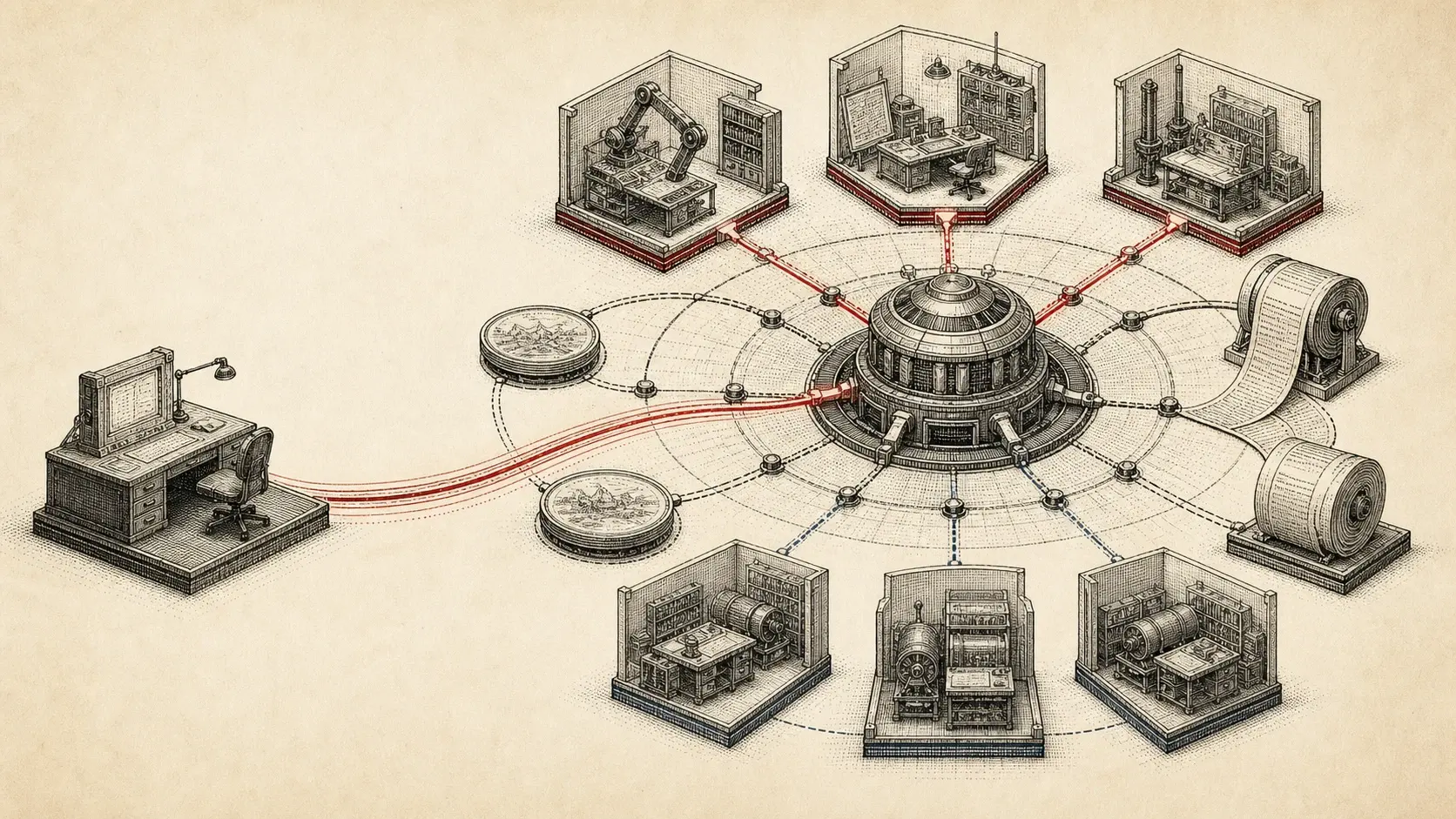
Here's the genius: Prime Agent makes orchestration an object the model can inspect. Instead of calling a fixed “researcher” or “tester” tool, the model can create a named child, continue working, message that child later, and retain the session for another turn. That changes subagents from disposable requests into stateful workers.
How A Recursive Harness Run Actually Unfolds
A representative execution pattern distilled from the RAH paper and Prime Agent's runtime documentation.
Scope the workload
The parent inspects the task, context size, file structure, and acceptance criteria before choosing serial, parallel, or nested work.
Generate the fan-out
The parent writes executable code or uses a structured task call to create child harnesses with bounded instructions and isolated workspaces.
Run independent loops
Each child reads its assignment, uses tools, writes intermediate artifacts, and can spawn a grandchild when the task requires another level of decomposition.
Collect structured outputs
The parent reads result files or receives messages, normalizes the records, and resolves conflicts instead of blindly concatenating prose.
Gate the result
Tests, verifiers, human review, or a second model pass decide whether the artifact is accepted, retried, rolled back, or escalated.
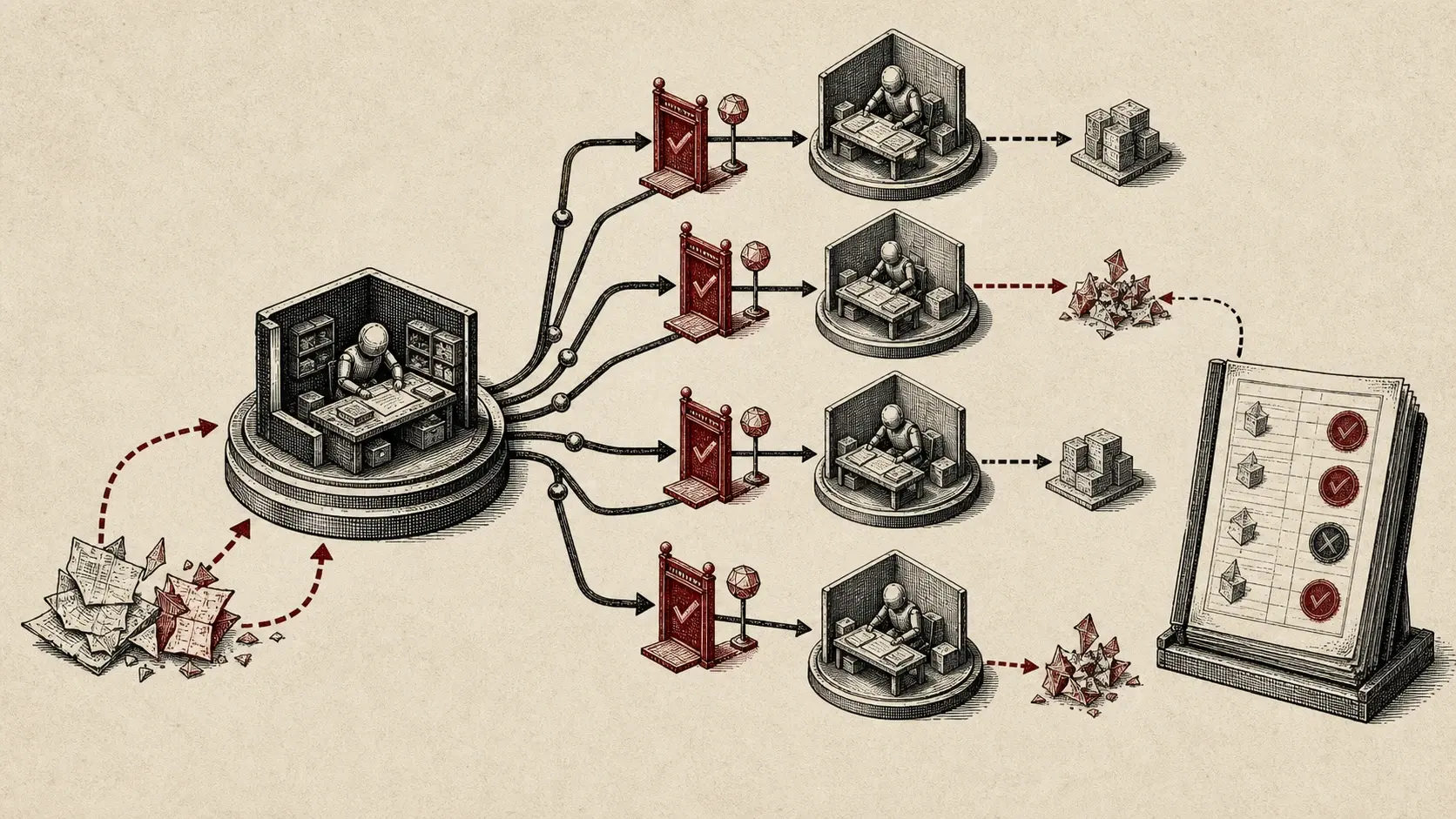
The safety boundary is just as important as the orchestration feature. Prime Agent's own README warns that model-generated Python and project commands run with the user's permissions. Its worker and kernel processes improve lifecycle isolation and recovery, but they are not a security sandbox.[4] A recursive harness magnifies that distinction. A bad instruction can now propagate through a tree of children, each with the ability to read files, execute commands, or alter a shared workspace.
Recursion is an execution primitive. It is not a proof that the work is correct.
The Benchmark: Strong Signal, Narrow Claim
The RAH preprint evaluates 199 samples from Oolong-Synthetic, stratified across 13 context-length buckets from 1,000 to 4 million tokens, with an average instance length of 629,000 tokens.[1] The task is long-context aggregation. It is a useful stress test because the answer depends on information scattered across a huge corpus rather than one salient passage.
On a GPT-5 backbone at temperature zero, the RAH configuration reports 81.36%. The same paper reports 71.75% for a Codex-style coding agent with no retriever and 64.38% for an RLM configuration. The absolute gain over the matched coding-agent baseline is 9.61 points, or 13.39% relative to that baseline. The conclusion that survives the comparison is modest but meaningful: giving the recursive unit a full harness improved this long-context workload in the reported setup.
Evidence graphic
Reported Oolong-Synthetic Scores
The GPT-5 comparison is the cleanest evidence for a harness effect. The Sonnet 4.5 result is shown separately in the source paper and is not plotted here.
RAH, GPT-5
Recursive full harness, 199 samples
Codex, no retriever
Strongest matched prior baseline
RLM
Recursive model calls without the full harness
Full-context baseline
One model context without recursive delegation
Paper-reported Oolong-Synthetic results. The GPT-5 bars hold the backbone fixed; no full cost, latency, branch-count, or independent replication data were available at publication.
The uncomfortable truth is what the table does not tell us. There is no complete cost curve, wall-clock comparison, branch-count ablation, recursion-depth sweep, or code-spawning-versus-tool-calling breakdown. As of August 6, 2026, the preprint said the implementation and evaluation scripts would be released shortly; no public RAH repository was identified in this review. Because Oolong's public repository and evaluation tooling continue to evolve, future comparisons should pin the dataset revision, split, and scoring protocol.[10][11]
The preprint treats the earlier baseline point estimates as fixed references rather than re-running all systems side by side, so its confidence interval quantifies the RAH sample, not a paired head-to-head experiment. Prime Agent reports a different class of evidence. Its launch materials cite ARC-AGI-3 runs of 95.0%, 95.2%, and 95.5%, plus a 99.97% Best@3 claim with all 183 of 183 levels completed.[3] Those are vendor-reported system results. They do not isolate recursion from model choice, task prompt, budget, or the rest of the runtime.
While competitors often publish a single score card, Prime is publishing a runtime thesis. The thesis is that agent quality can scale through test-time organization, persistent work, and better feedback loops even before a model is trained specifically around the harness. That is a stronger commercial proposition than another prompt template, but it still requires independent replication.
The Harness Is The Product Surface: Six Layers That Now Matter
Once the runtime is programmable, the model is no longer the whole product. The strategic surface moves into the layers that decide how model calls become work.
The Recursive Harness Control Plane
These layers determine whether recursion compounds useful work or simply compounds activity.
Context router
Slices long inputs, preserves provenance, and sends only the relevant working set to each child.
Recursive allocator
Chooses serial work, parallel fan-out, or another level of nesting based on workload shape and budget.
State layer
Keeps session history, artifacts, memories, skills, and child handles recoverable across turns.
Verifier
Tests outputs against deterministic checks, reference answers, policy rules, or a human gate.
Resource governor
Bounds tokens, time, tool calls, retries, permissions, and parallel branches before the tree grows out of control.
Refinement ledger
Records which prompt, memory, skill, or subagent edit followed a failure and whether the next run improved.
What's often overlooked is that these layers are where differentiation becomes durable. Model weights are increasingly rented through interchangeable APIs. A well-designed harness can still accumulate workflow-specific memory, verifier libraries, data connectors, and traces of accepted results. That creates switching costs without pretending that the underlying model is unique.
The data also gets better when the evaluator is built into the loop. A failed test is more useful than a thumbs-down because it identifies an observable defect. A branch that is rejected for a known reason can become a negative example. A successful trajectory can be replayed, compressed into a skill, or used to train a future policy. The harness is therefore both a runtime and a data collection instrument.
This is why Prime's Verifiers and environment work matter even when they are not part of a single benchmark table. A model can generate thousands of trajectories. Only a reliable environment can distinguish a clever-looking trace from a correct state transition.[12][13]
The Verification Bottleneck: Recursion Creates Search, Not Truth
Recursive delegation increases the number of attempts. It does not guarantee that the attempts are independent, relevant, or correct. If the parent makes a bad decomposition, every child receives a distorted assignment. If the siblings share the same blind spot, majority voting only produces a more confident error. If aggregation discards provenance, the parent cannot tell which branch invented a claim.
The useful pattern is not “spawn more agents.” It is “spawn agents whose outputs can be checked.” A research child should return evidence spans, not only a summary. A coding child should return a patch plus tests. A planning child should expose assumptions and stop conditions. The parent should preserve branch identity long enough to compare disagreements before it compresses the result.
A Verification-First Recursive Loop
The minimum control loop for a production harness that wants more than a pile of plausible text.
Decompose with a contract
Define the child question, allowed tools, expected artifact, evidence format, and maximum budget before spawning.
Isolate the branch
Use separate workspaces, credentials, and output paths so one child cannot silently rewrite another branch's evidence.
Capture the trajectory
Record prompts, tool calls, intermediate artifacts, retries, and the exact model configuration needed to replay the branch.
Run a verifier
Use tests, schemas, reference data, policy checks, or human approval to turn a branch result into an observed pass or fail.
Aggregate with provenance
Resolve disagreements using evidence and scorecards. Never turn a majority of unsupported claims into a fact.
Terminal-Bench 2.0 makes this problem visible at the benchmark level. Its containerized tasks evaluate a complete agent system, including the model, tools, environment, and harness. A high score is therefore a statement about a deployment recipe, not a pure property of a model checkpoint.[14] Recursive harnesses make that recipe even more consequential because the number and shape of tool interactions become part of the answer.
The correct unit of measurement is accepted work per unit of spend and risk. That means reporting at least the model, hardware, precision, prompt and output lengths, decoding settings, concurrency, time to first token, tail latency, branch count, recursion depth, retry policy, verifier cost, and human review rate. Without those conditions, a recursive result is a deployment signal, not a leaderboard.
The Economics: Agentic RL Turns Harnesses Into Data Businesses
The first economic advantage of recursion is obvious: it can spend more inference at test time. The second is more important: it can produce structured trajectories that are easier to evaluate and reuse.
Agentic reinforcement learning needs environments, verifiers, reward signals, and traces. A static chatbot produces conversations. A recursive harness produces a tree of attempts, tool calls, artifacts, failures, retries, and acceptance decisions. That tree is closer to a training dataset for behavior because it records not only what the model said, but what happened when the system acted.
Continual Harness research formalizes a related idea: prompts, subagents, skills, and memory can be treated as mutable state that an agent updates from its own experience.[9] Prime Agent implements that idea as a CRUD surface with /refine, while keeping its base system prompt immutable and recording snapshots for rollback.[3] The distinction matters. It is online harness adaptation, not online weight training.
VeRO makes the governance requirement explicit from another angle. Its harness-optimization setup treats snapshots, evaluation budgets, and trajectory evidence as first-class controls, because an outer loop that edits an agent without those records cannot tell improvement from a lucky patch.[15]
Here's the genius: a harness vendor can monetize the same loop three times. It can sell inference for the run, sell the evaluation environment that decides whether the run passed, and use the resulting traces to improve the next harness or train a better model. The moat is not “our prompt is secret.” It is “our system knows which trajectories become reliable outcomes.”
Where The Economic Moat Moves
| Feature | Fixed agent | Recursive harness |
|---|---|---|
| Work allocation | Hand-written sequence | Runtime-generated decomposition |
| Context strategy | One window plus compaction | Variables, files, child windows, and aggregation |
| Evaluation | Final answer or human spot-check | Branch-level verifiers and acceptance gates |
| Learning signal | Conversation logs | Structured trajectories with pass or fail outcomes |
| Operational risk | Predictable but rigid | More capable, with a larger blast radius |
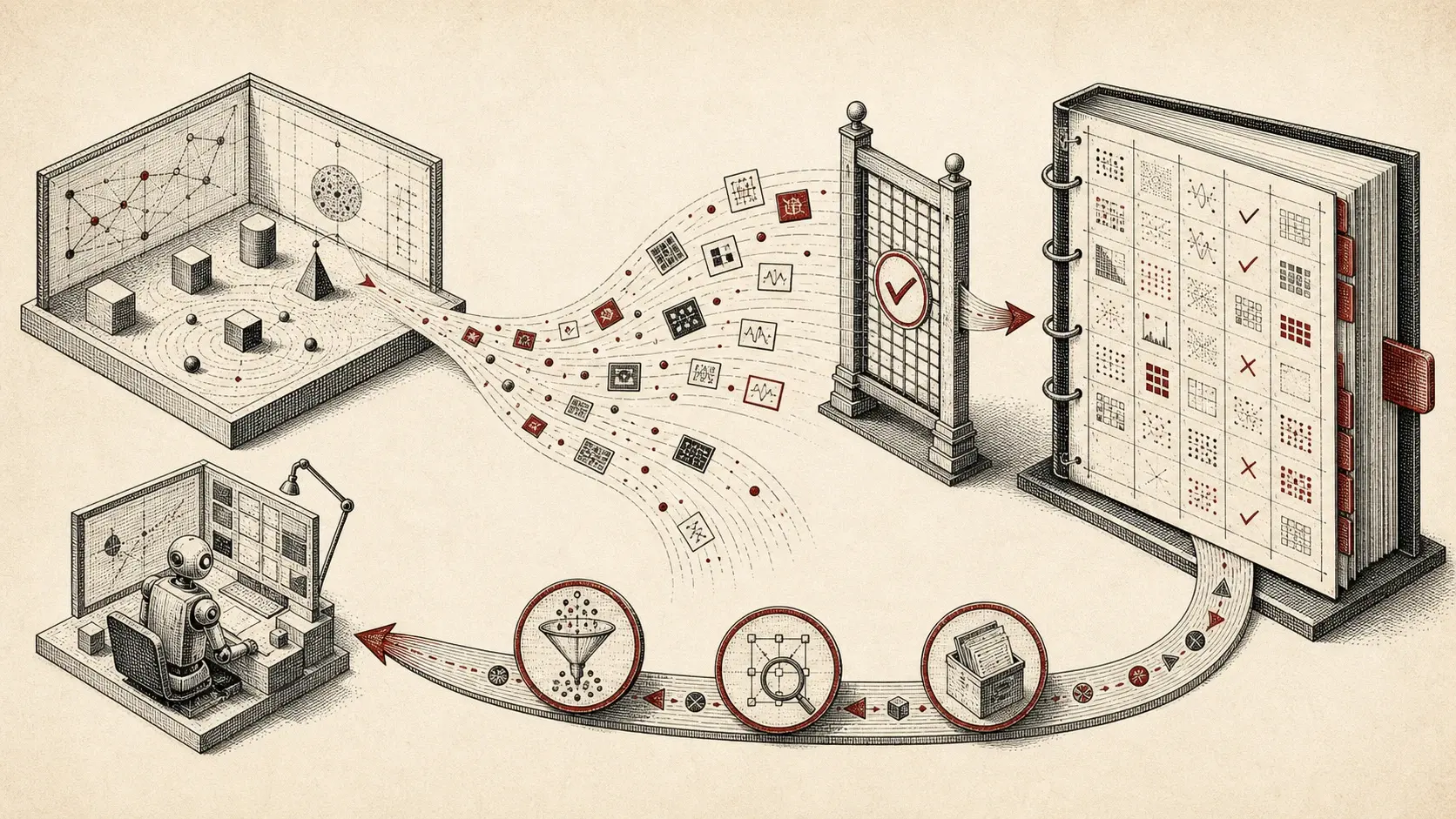
The business implication is uncomfortable for model companies. If a customer can swap the model while preserving the context router, verifier suite, artifact store, and trajectory format, the harness owns the workflow. The model becomes a component selected for cost and quality on each branch. If the harness is open source, the commercial battleground moves to hosted execution, private environments, observability, and verified data.
That is why “open agent” is not a synonym for “commodity agent.” Open source can distribute the runtime while a hosted platform captures the expensive parts: secure sandboxes, long-running workers, GPU scheduling, secrets management, replay, and evaluation. Prime Agent's warning about user permissions is not a footnote to the product. It is a map of where the production business still has to be built.
The Adoption Test: Make Recursion Boring Before Making It Huge
Most teams should not begin with thousands of children. They should begin with one bounded task where the acceptance test is clear and the branch outputs can be audited. The goal is to make recursion boring: predictable budgets, visible artifacts, reversible changes, and a clear answer when the run should stop.
What Teams Should Do Next
Start with a workload that has a deterministic verifier, such as a test suite, schema check, reconciliation rule, or benchmark answer key.
Treat the recursive harness as privileged infrastructure. Use isolated workspaces, restricted credentials, explicit network policy, and an external sandbox for untrusted code.
Log every branch with model, prompt, tool, budget, and acceptance metadata. If a result cannot be replayed, it cannot become a dependable operating lesson.
Measure accepted work per dollar and per minute, not raw token throughput. Include retries, failed branches, verifier calls, and human review.
Keep harness edits versioned and reversible. A prompt, memory, skill, or subagent change is a production change when it alters the behavior of every future run.
The winning implementation will not be the one that can spawn the most agents. It will be the one that can prove why a branch existed, what it changed, how it was checked, and whether it was worth the cost. Depth limits and concurrency caps are not signs of weak autonomy. They are the controls that make autonomy deployable.
Recursive Does Not Mean Self-Correcting
More branches can amplify a shared bad assumption. More persistent memory can preserve a mistake. More autonomous time can hide a failure behind a longer transcript. A recursive harness needs independent evidence, least-privilege execution, explicit budgets, and rollback. Without those controls, recursion is merely a faster way to scale an error.
The real story isn't that the model race is over. It is that model quality is becoming one input to a larger control plane. RLMs showed how to turn context into a programmable object. RAHs show how to turn the full agent into a recursive worker. Continual harnesses show how the surrounding operating system can be revised from experience. Prime Agent packages a persistent RLM runtime, durable harness state, and recursive child agents into a runtime that developers can inspect and run today. The evidence is strong enough to justify attention, not strong enough to declare a universal architecture. The RAH result is one preprint on one synthetic long-context protocol, while Prime Agent's benchmark claims are vendor-reported system results. The production question remains open: can a recursive tree deliver more accepted work than a well-designed single agent after the cost of coordination, verification, security, and failure is counted?
That question will decide the next AI moat. The model may write the code, but the harness will decide what gets attempted, remembered, checked, and shipped.
The RAH paper is a preprint. Prime Agent's ARC-AGI figures are vendor-reported system results, not independent comparisons. This article treats both as signals to test, not settled leaderboard facts.
Sources & References
Primary papers, product documentation, and benchmark sources used in this analysis.
| # | Source | Outlet | Date | Key Takeaway |
|---|---|---|---|---|
| 1 | arXiv Lumer, Sen, Paul, Subbiah | June 11, 2026 | Defines harness recursion and reports the controlled Oolong-Synthetic comparison. | |
| 2 | Prime Intellect on X Prime Intellect | August 5, 2026 | Original launch post; technical claims are substantiated by the linked Prime Intellect blog post. | |
| 3 | Prime Intellect Prime Intellect | August 5, 2026 | Documents persistent IPython, recursive subagents, refinement, and vendor-reported evaluations. | |
| 4 | GitHub Prime Intellect | Accessed August 6, 2026 | Provides the open-source implementation and the user-permission safety warning. | |
| 5 | Prime Agent documentation Prime Intellect | Accessed August 6, 2026 | Explains the persistent kernel, programmatic tools, and recursive subagent calls. | |
| 6 | Prime Agent documentation Prime Intellect | Accessed August 6, 2026 | Details daemon, worker, session, snapshot, and recovery boundaries. | |
| 7 | Prime Agent documentation Prime Intellect | Accessed August 6, 2026 | Documents goals, heartbeats, schedules, autonomous mode, and retained sessions. | |
| 8 | arXiv Zhang et al. | December 2025 | Introduces recursion over model calls for long-context reasoning and reports its tradeoffs. | |
| 9 | arXiv Continual Harness authors | May 2026 | Frames prompts, memory, skills, and subagents as mutable harness state. | |
| 10 | arXiv Oolong authors | November 2025 | Defines the long-context aggregation benchmark used by the RAH evaluation. | |
| 11 | Hugging Face Oolong benchmark team | June 20, 2026 | Records the June 20, 2026 correction of 14 instances, chiefly very-long temporal queries. Reproductions must pin the dataset revision. | |
| 12 | Prime Intellect documentation Prime Intellect | Accessed August 6, 2026 | Explains the environment layer used to run and observe agent behavior. | |
| 13 | Prime Intellect Prime Intellect | Accessed August 6, 2026 | Shows how verifiers turn agent trajectories into measurable outcomes. | |
| 14 | arXiv and Harbor Terminal-Bench authors | January 2026 | Illustrates why terminal-agent scores measure the full deployment stack, not just the model. | |
| 15 | arXiv VeRO authors | February 2026 | Connects harness search, evaluation budgets, snapshots, and trajectory evidence. |
Last updated: August 6, 2026