TL;DR: HydraFusion offers 3 execution patterns in Copilot CLI, while Sakana reports that Fugu-Ultra v1.1 gained up to 7.9 benchmark points over v1.0.[14][4] Together with OpenRouter Fusion, they signal a shift from choosing one model to deciding when several models should solve, review, or compare work. This is runtime orchestration and output deliberation; it does not require merging model weights.
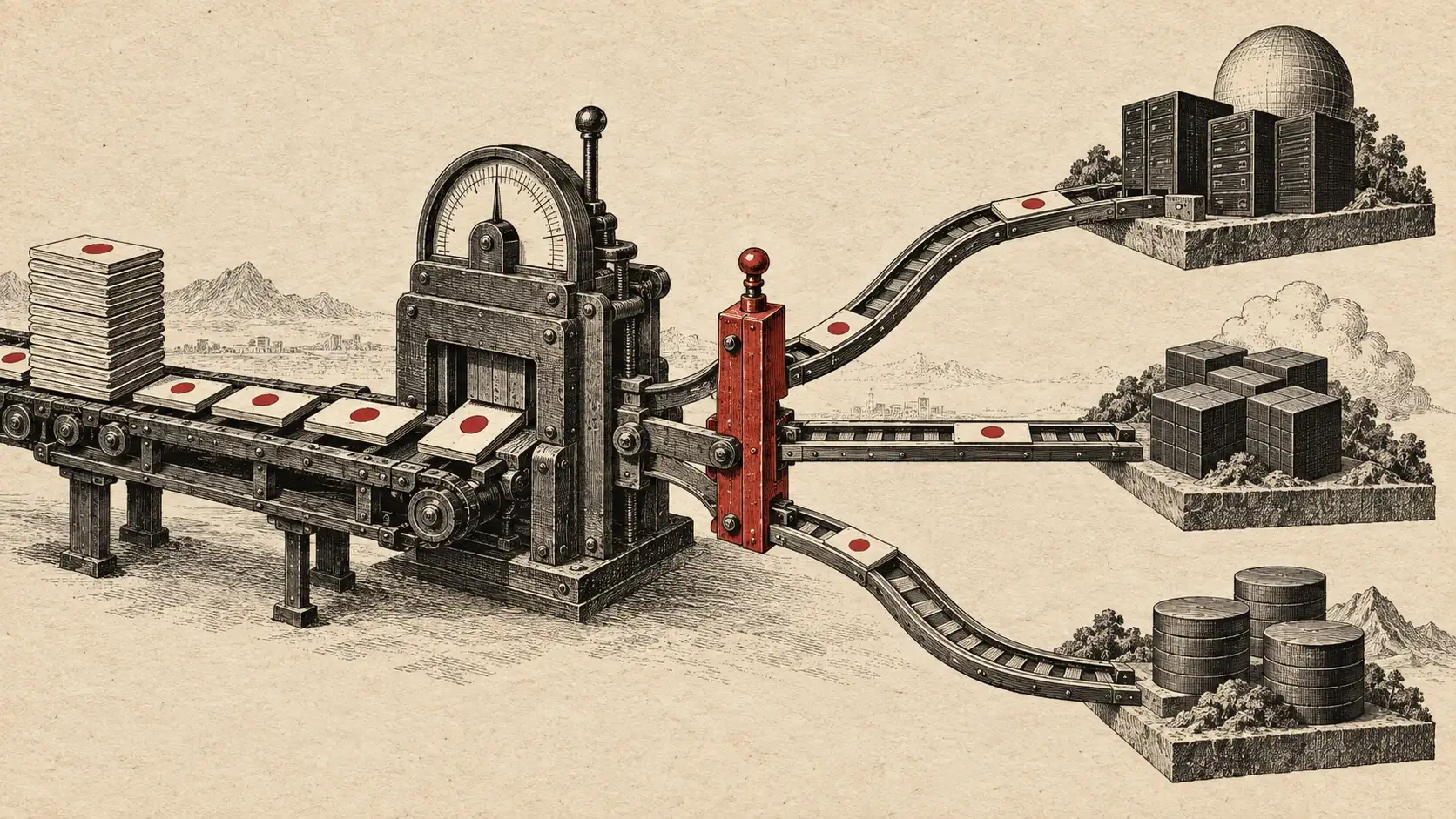
Cover: LLM Rumors conceptual illustration of separate reasoning streams passing through a routing press. It represents orchestration, not the internal architecture of any product.
For years, the AI market trained buyers to ask a deceptively simple question: which model should we use? The answer came as a leaderboard, a token price, and a default dropdown.
That question is now too small. A production coding task may deserve a cheap first pass, a stronger model only after a quality gate fails, and a separate critic before a patch reaches a repository. A research task may need independent answers surfaced for disagreement before anybody writes a conclusion. The system is no longer just choosing intelligence. It is choosing a workflow.
GitHub's September 4 HydraFusion results make this shift concrete.[1] Alongside Sakana Fugu and OpenRouter Fusion, the preview shows how coordination is becoming something customers can buy through a familiar model interface. Our argument is that the provider controlling those decisions can capture value even when another company supplies the strongest underlying model.
Why This Matters Now
The next AI control plane will decide more than a model name. It will set the first solver, the escalation rule, the reviewer, the tool permissions, the cancellation boundary, and the evidence required to accept an answer. That policy can change quality, latency, spend, reliability, and vendor exposure at once.
The New Unit Of Competition: A Workflow
Conventional routing is a one-shot allocation. A request arrives, a classifier estimates the required capability, and the platform sends it to one model. GitHub's earlier HyDRA work framed that job as selecting the cheapest model that meets predicted needs for reasoning, code generation, debugging, and tool use.[10] That is useful infrastructure. It is also only the first branch of the decision tree.
Workflow orchestration makes subsequent choices conditional. Was the draft adequate? Did a test pass? Did a second model find a flaw? Is the extra spend justified by the cost of a bad answer? The runtime becomes a small operations team with an explicit budget and stopping rule.
This is why the real story isn't that every company suddenly has a magical supermodel. It is that systems can turn model diversity into a policy. A strong coding model can draft. A different family can criticize without editing. A quality gate can decide whether the cheap path was sufficient. Each call stays separate, with its own price, latency, context, and failure mode.
From Model Choice To Runtime Policy
LLM Rumors design framework, not a description of every product: each additional leg needs a job and an acceptance rule.
Classify the work
Estimate task stakes, required tools, budget, latency tolerance, and what proof would count as success.
Use the economical path first
A single capable solver handles routine work. The system retains the option to escalate instead of paying frontier prices by default.
Escalate or review on evidence
Tests, a critic, a schema check, or disagreement can trigger a stronger solver or an independent review step.
Return one accountable outcome
Capture the model roles, cost, latency, outcome, and reason the workflow stopped. Those records become the next routing dataset.
HydraFusion's Policy Stack: More Than One Model Choice
GitHub's community announcement makes the change concrete. HydraFusion's Single route uses one solver; Cascade adds gated escalation; Critique puts a read-only reviewer from another model family between drafting and one revision. The preview is in Copilot CLI. Its FAQ says customers cannot currently choose or exclude constituent models, and billing sums the underlying phases.[14]
That makes the model menu a purchasing interface for a process. The customer delegates both the task and the decision about how to perform it. Here's the genius of that packaging: developers can adopt a more elaborate workflow without maintaining its moving parts. The burden shifts to the provider to prove the extra machinery earns its place.
GitHub's Offline Results Versus Opus 5
Vendor-reported best tuned HydraFusion configuration; quality differences are percentage points.
GitHub reports 67% lower estimated workflow cost.
GitHub reports 36% lower estimated workflow cost.
GitHub reports 65% lower estimated workflow cost.
GitHub tuned policies across these benchmarks, including internal CheckpointBench, and identifies first-turn, single-prompt tasks as the preview's best starting point. Longer sessions and production behavior need further validation.[1]
The useful result is a trade-off: one benchmark gains quality, two surrender some, and all report lower estimated cost. A buyer should ask whether the forgone quality is acceptable for its own tasks. A small average gap can conceal an expensive failure in the wrong repository. The evidence supports testing a different spending policy, not replacing acceptance tests with a brand name.
Fugu's Business Model: Sell The Coordinator, Not The Checkpoint
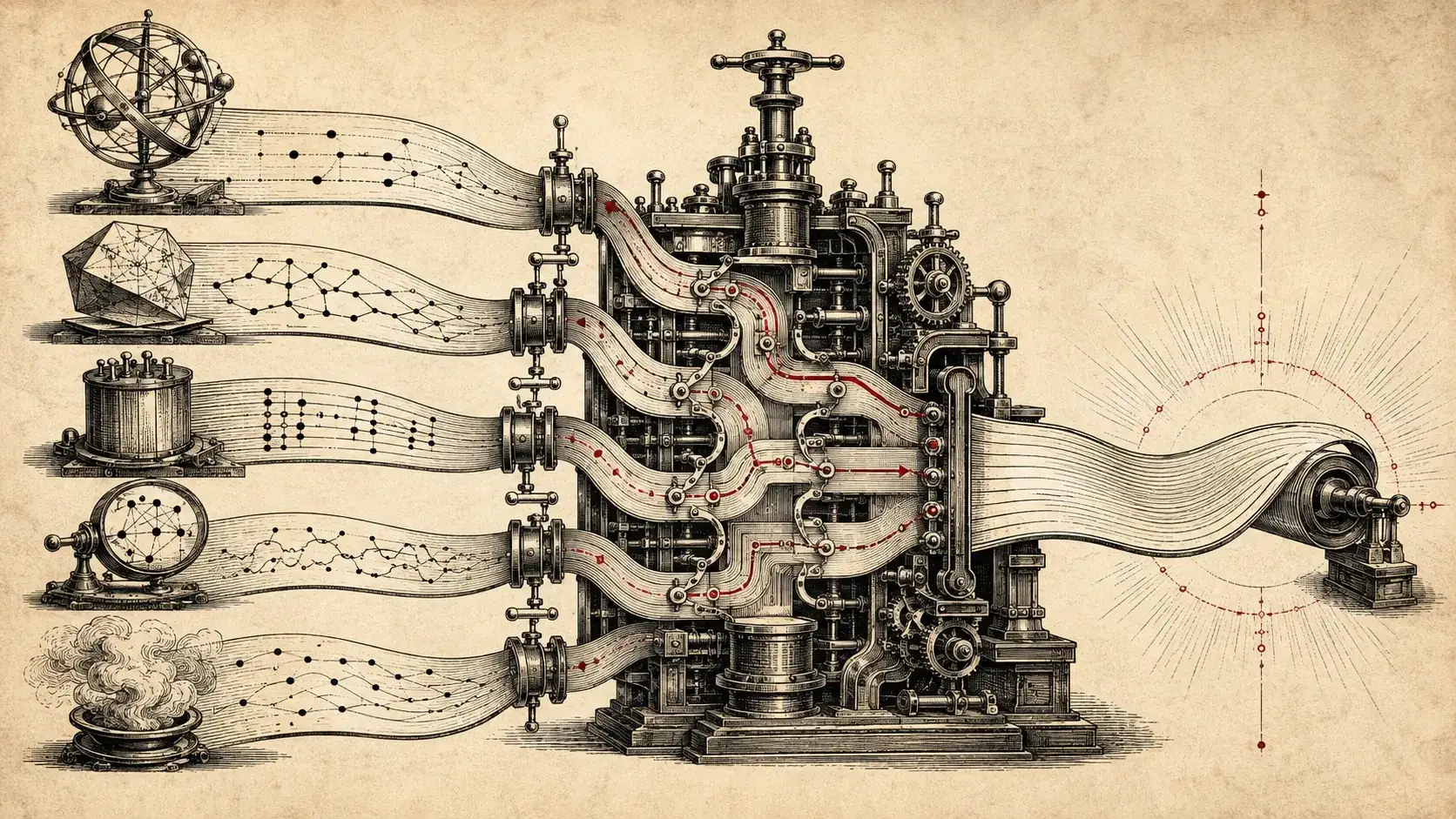
Sakana Fugu makes the product thesis even more explicit. In its June 22 launch, the company described Fugu as a model trained to call an agent pool, including recursive instances of itself, through a single OpenAI-compatible API. Fugu targets everyday latency-sensitive work; Fugu Ultra is positioned for more difficult multi-step tasks.[2] The technical report describes the coordination system behind that interface.[3]
That changes the buyer relationship. The customer gets one endpoint rather than a collection of provider accounts, prompt templates, and brittle hand-built loops. Sakana's public description traces the system to TRINITY and Conductor research, where coordination is learned across turns and roles such as Thinker, Worker, and Verifier are assigned adaptively.[7][8]
On July 24, Sakana reported that Fugu-Ultra v1.1 improved selected tracked benchmarks by up to 7.9 points over v1.0 at the same price, after incorporating new frontier models.[4] That is a revealing vendor claim. A fixed checkpoint does not absorb a new competitor's capabilities by itself. An orchestrator can change its available capability by updating the pool and policy; that still requires fresh evaluation.
The uncomfortable truth is that this convenience comes with opacity. Sakana says it does not expose the underlying model selections or coordination per request.[5] Its standard Fugu product lets users opt out of specified providers or models, while Fugu Ultra uses a fixed pool, but neither option gives a request-level routing trace. Sakana also currently lists the EU/EEA as unavailable.[5] That becomes a procurement question for code, regulated workflows, or any system that needs provider provenance, reproducibility, residency control, or incident diagnosis. An orchestration layer can reduce vendor dependence at the application level while creating dependence on its own hidden policy.
A Taxonomy Of Fusion: Four Different Layers
“Fusion” can refer to combining answers, coordinating calls, or constructing a new checkpoint. The commercial consequences depend on which thing is actually being combined.
Four Mechanisms
| Feature | Decision or combination | Example |
|---|---|---|
| Request routing | Choose one model for a request | HyDRA |
| Workflow orchestration | Choose call sequence, roles and escalation | HydraFusion; Fugu |
| Output deliberation | Compare independent answers before final synthesis | OpenRouter Fusion |
| Weight merging | Combine checkpoint parameters before serving | Sakana Evolutionary Model Merge |
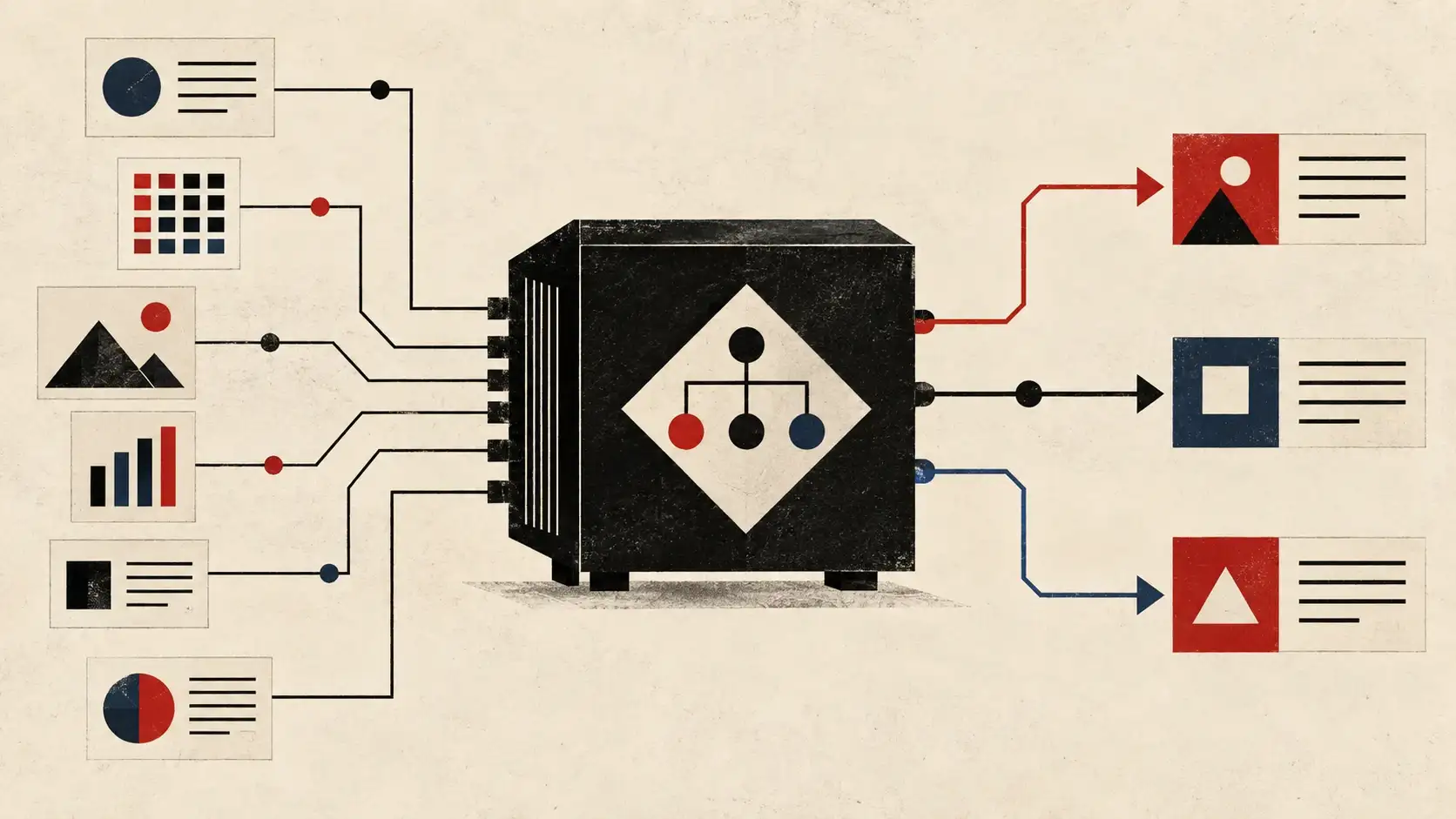
OpenRouter Fusion illustrates output deliberation. An outer model can invoke a configurable panel of models, which answer in parallel. An analyst then returns structured findings about consensus, contradictions, coverage gaps, unique insights, and blind spots. The outer model writes the final answer. OpenRouter explicitly says the analyst does not merge the panel answers.[9]
That design can be powerful for research and critique because disagreement is itself useful evidence. It also has a visible economic shape. OpenRouter estimates its default three-model panel plus analyst at roughly 4 to 5 times the cost of one completion on the same prompt, with cost rising linearly as members are added.[9] The system should therefore be invoked when the expected cost of being wrong exceeds the added calls, not as a vanity setting for every summary.
Weight merging combines parameters or task vectors into a new checkpoint before deployment, subject to compatibility constraints.[12] Sakana's Evolutionary Model Merge is actual work in this category.[11] Fugu's repository, by contrast, explicitly describes coordination without weight merging or shared architectures.[6]
A systematic study of merging methods also reports uneven results across checkpoints and tasks.[13] Combining weights does not guarantee that useful abilities survive. Combining answers does not guarantee their mistakes cancel out. The word “fusion” removes neither burden of proof.
The Moat In Practice: Evaluation, Not More Model Calls
Anyone can put three APIs behind a prompt. That is not the hard part. The difficult work is learning when a second call changes the accepted outcome enough to pay for itself.
A buyer's accounting should include retries, human review, tool failures, cache misses, and the cost of a wrong action. Cost per first response is a misleading metric. Cost per accepted outcome is the one that matters.
The data advantage will come from the system's own operating record: which task classes pass cheaply, which failure signals predict escalation, which critics actually catch defects, and which expensive loops only create polished mistakes. That is why reasoning effort is becoming an inference control plane, and why speculative decoding's economics matter to the same architecture. Both change the cost of deciding how much work an answer deserves.
The New Benchmark Disclosure Rule
An orchestration score needs the whole runtime recipe: model pool, reasoning level, prompt and output limits, tools, panel size, reviewer, routing policy, benchmark revision, verifier, retry rules, latency distribution, and cost accounting. Without those conditions, a claim about a compound system cannot tell a buyer what will transfer to its own workload.
The Runtime-Orchestration Playbook
Treat model choice as the first decision in a workflow, not the product's final architecture.
Use cheap one-shot routes for routine tasks, then escalate only on a measurable failure signal or a high cost of error.
Distinguish selecting calls, comparing answers, and merging checkpoint parameters.
Measure cost per accepted outcome, including retries, reviewers, tool calls, and human intervention.
Demand request-level observability when a compound endpoint controls provider selection and model roles.
Publish the runtime recipe with every quality or cost comparison.
The Strategic Asset: Owning The Task Outcome
The winning AI company will not necessarily own the best model at every task. It will know, with evidence, which task can accept a fast answer, which needs a specialist, which merits an adversarial review, and which should stop because more inference will not improve the outcome.
That is a profound shift in where product value accumulates. Model makers still matter because a stronger or cheaper worker expands what the system can do. But the buyer-facing differentiation moves upward to the policy that composes workers into accountable results. GitHub is productizing a bounded coding workflow. Sakana is selling a learned coordinator behind a single endpoint. OpenRouter is turning answer comparison into a configurable service.
The model dropdown is becoming the least interesting part of the stack. The strategic asset is the runtime that decides what happens after the first answer is not enough.
Sources & References
Primary releases, technical reports, and research used to distinguish runtime orchestration from output deliberation and weight merging.
| # | Source | Outlet | Date | Key Takeaway |
|---|---|---|---|---|
| 1 | GitHub Blog | 2026-09-04 | GitHub-reported offline quality/cost results and evaluation limits. | |
| 2 | Sakana AI | 2026-06-22 | Primary launch description of Fugu and Fugu Ultra as an agent-pool orchestration product. | |
| 3 | arXiv Fugu Team | 2026 | Technical report describing variants, evaluated task families, and the system's research framing. | |
| 4 | Sakana AI | 2026-07-24 | Vendor-reported claim of up to 7.9 benchmark points over Fugu-Ultra v1.0 after pool updates. | |
| 5 | Sakana AI | 2026 | Discloses that per-request underlying model selection and coordination are proprietary and not exposed. | |
| 6 | GitHub | 2026 | Explicitly describes runtime coordination without weight merging or shared architectures. | |
| 7 | arXiv | 2025 | Research basis for learned multi-turn coordinator and agent-role assignment. | |
| 8 | arXiv | 2025 | Research on adaptive task assembly, routing, and coordination. | |
| 9 | OpenRouter | 2026 | Panel-and-analyst mechanism, explicit non-merging design, approximate 4 to 5 times cost, and routing metadata. | |
| 10 | arXiv Microsoft and GitHub authors | 2026 | A routing baseline that distinguishes one-shot model selection from compound execution. | |
| 11 | GitHub | 2024 | Primary reference for Sakana's separate work on offline compatible-checkpoint merging. | |
| 12 | arXiv Song and Zheng | 2026 | Survey taxonomy for parameter-space merging methods and their limits. | |
| 13 | arXiv Hitit et al. | 2025 | Empirical caution that weight merging is not a universal substitute for runtime orchestration. | |
| 14 | GitHub Community | 2026-09-01 | Explains the distinction between per-request Auto selection and HydraFusion's multi-model workflow selection. |
Last updated: September 6, 2026