TL;DR: Self-Instruct's authors audited 200 generated examples: 92% had a valid task instruction, but only 54% had every field valid.[3] Nature's July 2024 model-collapse paper and separate research on accumulating original data show why the feedback setup matters more than a blanket synthetic-versus-human label.[1][2] The useful unit is an example with a known acceptance rule, preserved provenance and an independently tested benefit.
A generated training example can look excellent while teaching the wrong thing. A clear instruction may be paired with an unsuitable input. A fluent answer may be incorrect. A dataset counter records one more row in all three cases, even though the learning value is different.
The uncomfortable truth is that synthetic data is neither automatically toxic nor automatically cheap. Its economics depend on how candidates become accepted examples and how those examples affect a held-out task. This November 9, 2026 analysis revisits primary research first released from 2022 through 2024. It does not claim a newly discovered collapse in a deployed frontier model.
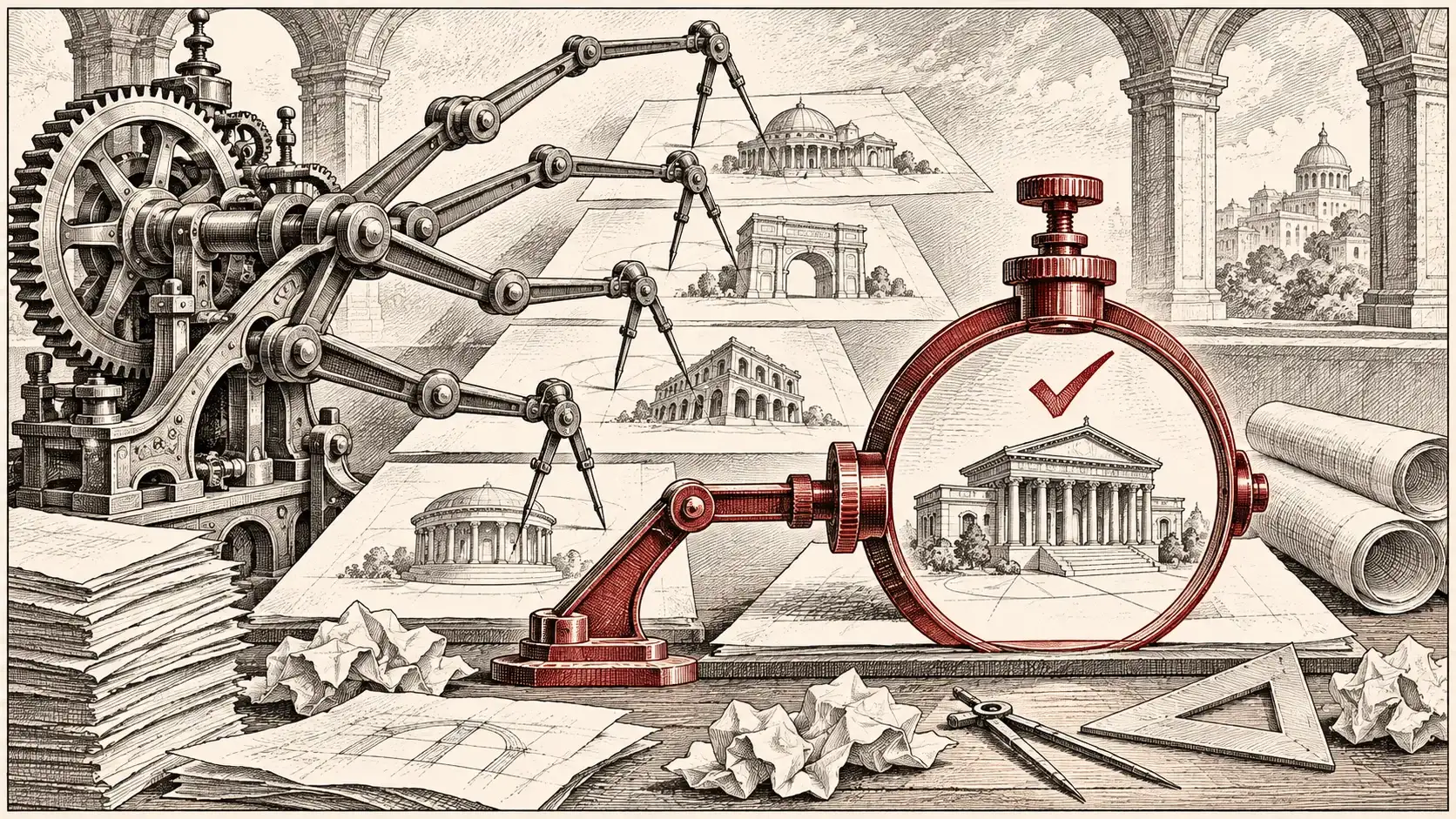
Generated editorial illustration: botanical copies fade along a printing line while preserved originals feed an inspection stage. This is a metaphor for provenance and filtering, not measured model collapse or evidence that verification restores lost information.
Why This Matters Now
A data supplier can deliver a large corpus without delivering a reliable learning signal. Buyers need the acceptance rule, source mixture and held-out evidence alongside the row count, especially when generated material feeds later generations.
The audit: valid instructions are not valid examples
Self-Instruct, first submitted in December 2022, generates instructions and associated examples, filters candidates and uses the retained material for instruction tuning. Its authors manually reviewed 200 sampled examples with one expert annotator. They reported 92% valid instructions, 79% appropriate inputs, 58% correct and acceptable outputs, and 54% with all fields valid.[3]
These are different checks on the same audit, not stages in a measured conversion funnel. The result does not estimate the error rate of all synthetic datasets. It illustrates a procurement problem: accepting a plausible task description is a weaker condition than accepting its complete training record.
Evidence graphic
Self-Instruct's quality audit applied four different tests
Author-reported percentages from one expert's review of 200 sampled examples, Table 2. Each check uses the audited sample as its denominator.
Instruction describes a valid task
Input is appropriate
Output is correct and acceptable
All fields are valid
Source: Wang et al., Self-Instruct, Table 2. Author-conducted audit of 200 examples by one expert annotator; no uncertainty intervals reported here. These are overlapping quality criteria, not additive shares, a funnel or an industry-wide estimate.
A buyer should ask which of those checks a vendor's quality claim represents. A language-quality score can be useful for readability while saying little about factual correctness. A format validator can reject broken records while admitting a beautifully formatted falsehood. The label on the acceptance rule is part of the product specification.
Model collapse: inspect what the loop replaces
Shumailov and colleagues' Nature paper, published July 24, 2024, studied recursive training on model-generated data. It describes loss of distribution tails and distinguishes early from late collapse under its analyzed conditions.[1] That finding deserves attention without being turned into a claim that any synthetic example poisons a model.
Gerstgrasser and colleagues' April 2024 study changes a central assumption. It contrasts replacing data across generations with accumulating synthetic generations alongside the original real data, finding that accumulation avoids collapse in its studied settings.[2] This is evidence about particular feedback designs, not a universal warranty for every mixture or training budget.
The strategic implication is straightforward. Preserving the original archive is a capability. If a team cannot reconstruct which material was retained, replaced or repeatedly resampled, it cannot diagnose whether a later model lost useful coverage. Provenance should record generation lineage and mixture changes, not merely whether a row carries a synthetic flag.
Positive examples: the selection objective does the work
The June 2023 phi-1 paper combined selected web material with generated textbooks and exercises.[4] TinyStories, introduced in May 2023, deliberately restricted generated stories to a simple language domain.[7] These are different designs for shaping a learning problem. Their existence does not make arbitrary generated text interchangeable with their curated inputs.
Evol-Instruct, introduced with WizardLM in April 2023, rewrites seed instructions into more complex instructions before tuning.[8] That makes complexity a controllable input to data construction. A buyer still needs to check whether increasing instruction complexity improves its chosen outcome rather than simply producing harder-looking prompts.
This is why the relevant comparison is often between selection procedures. Keep the training budget and target evaluation stable. Compare a baseline collection with the proposed filtered mixture. Preserve rejected examples for inspection when permitted. A dataset becomes commercially defensible when its supplier can explain the intervention that improved learning, not when it can display the largest generation counter.
Verification: correct answers still need meaningful coverage
STaR, first released in March 2022, generates rationales and fine-tunes on those that yield correct answers, including a retry path conditioned on the known correct answer.[5] The acceptance signal is explicit. It does not mean every retained explanation has been independently proven logically sound.
A checker can also create a selection bias. If it accepts only easy cases, the retained dataset may improve its own pass rate while neglecting the failures a customer most needs addressed. This is an operational risk to test, not a numerical finding attributed to any one paper. Report acceptance by task family and difficulty, then evaluate coverage on material kept outside generation and filtering.
Web-derived data requires curation too. FineWeb's June 2024 research documents and ablates filtering and deduplication decisions.[6] Human origin alone is not a quality certificate. The practical distinction is whether a training record has the coverage, correctness and diversity needed for the learning objective.
Economics: buy evidence about the accepted mixture
Consider an explicitly hypothetical purchase of 100,000 generated candidates costing $1,000. If 50,000 meet a specified acceptance rule, generation alone costs $0.02 per accepted example. Spending another $500 on checks brings that figure to $0.03. This arithmetic assumes the acceptance count is reliable and excludes training and evaluation costs. It is not a price quote or a measured acceptance rate.
The next question is whether the accepted collection improves the target model at a fixed training budget. A cheaper record that teaches duplicate behavior can be less valuable than an expensive example covering a persistent failure. Likewise, a higher pass rate from an easier task mix can be a worse purchase.
| Contract field | Evidence to retain |
|---|---|
| Origin and lineage | Seed source, generator version and generation settings |
| Acceptance rule | Checker version, rubric and audit procedure |
| Mixture and coverage | Retained original data, task balance and duplicate policy |
| Learning benefit | Fixed-budget comparison on protected held-out tasks |
The synthetic flag cannot substitute for a quality standard
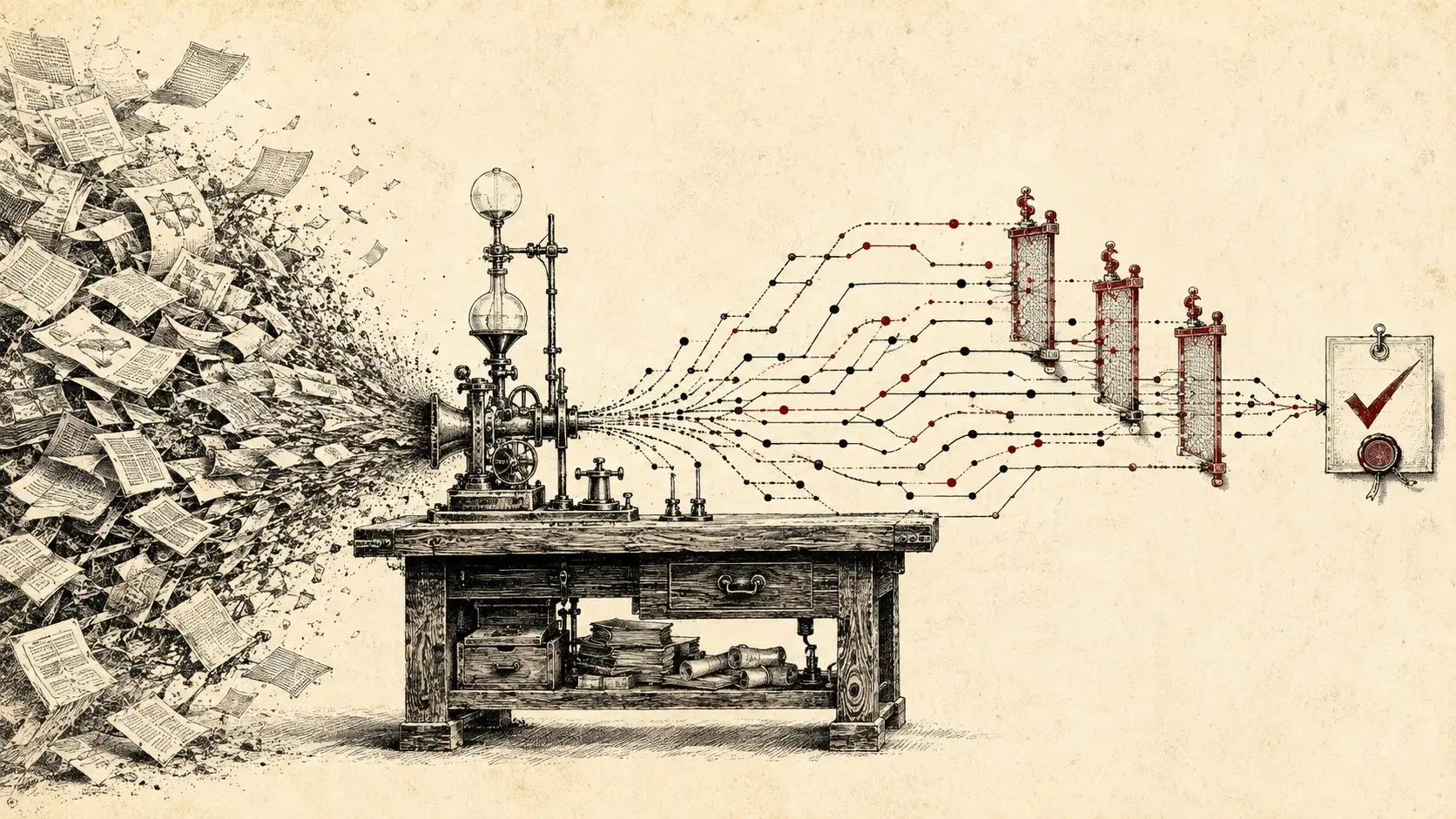
Recursive replacement, accumulated data and verified task generation are different training setups. Name the setup and its limits before applying a model-collapse claim or promising that generated data will improve a model.
The defensible supplier sells a reproducible selection process and evidence about the resulting model. Generation creates candidates. Preserved reality and credible evaluation determine which candidates deserve to become training data.
Sources & References
Key sources and references used in this article
| # | Source | Outlet | Date | Key Takeaway |
|---|---|---|---|---|
| 1 | Shumailov et al., Nature | 2024-07-24 | Recursive training can lose distribution tails under the studied conditions. | |
| 2 | Gerstgrasser et al. | 2024-04-01 | Accumulating original and successive synthetic data changes the feedback setup. | |
| 3 | Wang et al. | 2022-12-20 | A 200-example audit distinguishes valid instructions from fully valid examples. | |
| 4 | Gunasekar et al. | 2023-06-20 | Phi-1 combined selected web material with generated textbooks and exercises. | |
| 5 | Zelikman et al. | 2022-03-28 | The training loop selects rationales that yield correct final answers. | |
| 6 | Penedo et al. | 2024-06-25 | Filtering and deduplication also govern web-derived training corpora. | |
| 7 | Eldan and Li | 2023-05-12 | Synthetic stories test a deliberately restricted language domain. | |
| 8 | Xu et al. | 2023-04-24 | Evol-Instruct transforms seed instructions into more complex tasks. |
Last updated: November 9, 2026