TL;DR: Liquid AI's LFM2.5-8B-A1B is not just another small model, it is a thesis about where AI compute is moving: 8.3B total parameters, 1.5B active parameters, 24 layers, 38 trillion training tokens, 128,000-token context, and support for llama.cpp, MLX, vLLM, SGLang, ONNX, and GGUF from day one.[1][3] The real story isn't that small models are getting better. It is that model labs, chipmakers, operating systems, and device companies are converging on the same economic target: useful agents that run locally, cheaply, privately, and often offline.
Liquid AI published LFM2.5-8B-A1B on May 28, 2026, as a reasoning-tuned, text-only model built for on-device assistants, tool use, structured outputs, multilingual workflows, and local deployment.[1][2] The headline number looks familiar: 8B. The strategic number is different: A1B. In Liquid's framing, only 1.5B parameters are active during inference, which changes the budget line from "how big is the model" to "how much of the model wakes up per token."
That distinction matters because the edge market is not a miniature version of the cloud market. Phones and laptops do not have datacenter cooling. Robots cannot wait for round trips to an API. Enterprise laptops cannot send every sensitive document to a hosted model. The edge race is a fight over latency, memory, privacy, battery, and distribution. LFM2.5 sits directly inside that fight.
Why This Matters Now
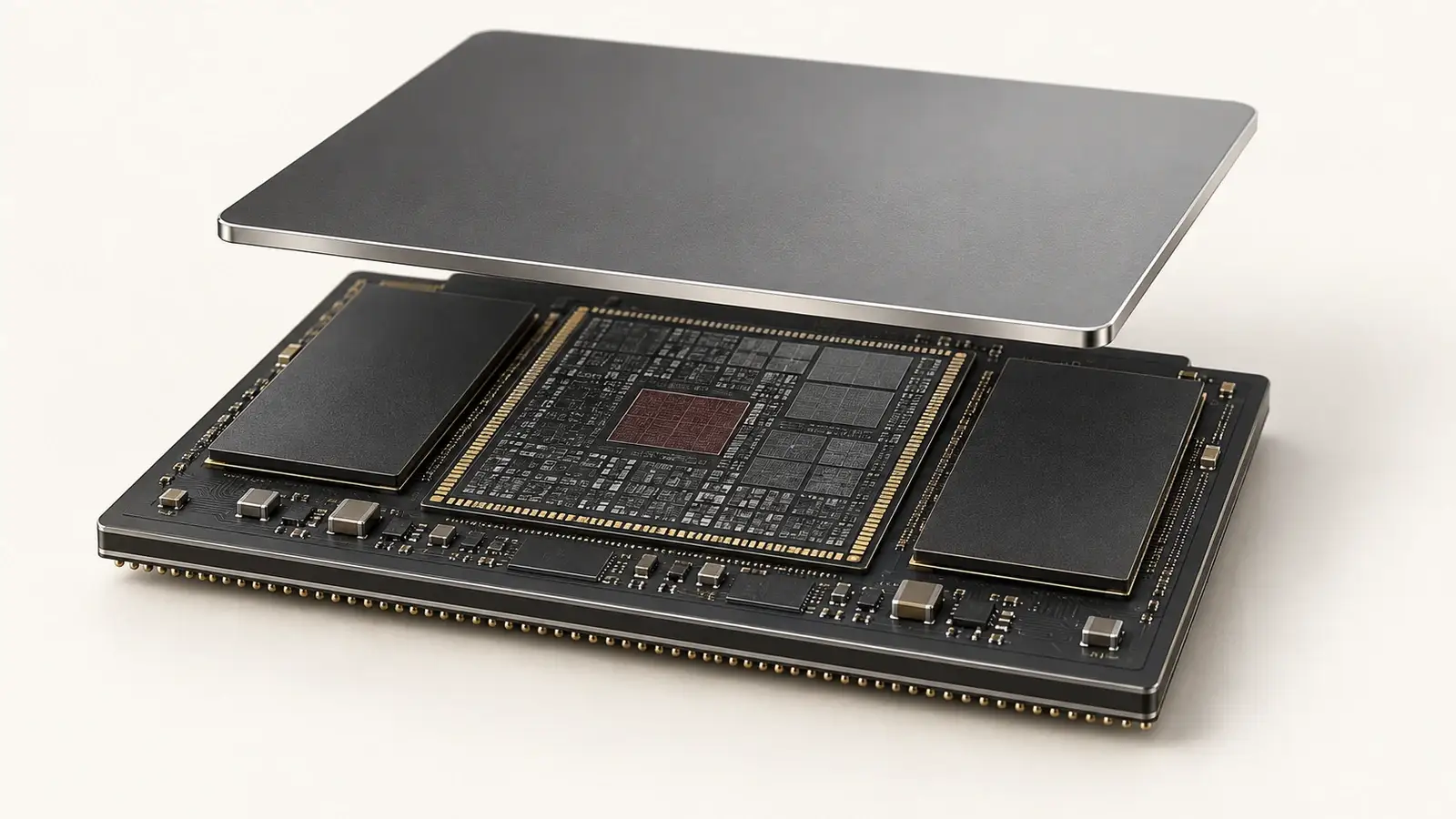
Microsoft's Copilot+ PC floor is 40+ TOPS on the NPU. Intel's Lunar Lake reaches 48 NPU TOPS. AMD's Ryzen AI 300 reaches 50 NPU TOPS. Apple M5 shifts the pitch toward Neural Accelerators, 153 GB/s unified memory bandwidth, and larger local models.[11][12][13][14] The model race is now tied to the device replacement cycle.
LFM2.5-8B-A1B by the Numbers
Liquid's model card and config reveal a model optimized around active compute, long context, and local runtime support rather than raw dense scale.
Total model capacity across the LFM2.5-8B-A1B checkpoint.
The active compute budget per forward pass, which is the number that matters for edge inference.
Tokens used for LFM2.5, up from 12T for LFM2-8B-A1B.
The model card lists a 128,000-token context window.
Doubled vocabulary improves non-Latin tokenization efficiency versus the prior 65,536-token vocabulary.
The config lists 32 experts and 4 experts per token in the routed MoE stack.
The Real Story: Edge AI Is A Memory Business
Let's be clear: the cloud model economy taught everyone to worship parameter count. More parameters meant more memorized knowledge, broader reasoning templates, better benchmark averages, and larger model bills. That logic still matters for frontier systems. It is not the right frame for edge models.
At the edge, the binding constraint is not only intelligence. It is memory movement. It is how many weights must be loaded, how many KV-cache entries must be retained, how quickly the runtime can stream tokens on commodity hardware, and whether the model survives quantization without becoming useless.
That is why LFM2.5's name is strategically honest. The important part is not 8B. It is A1B. Liquid is telling developers that this is not a dense 8B-style local model in the old sense. It is a routed model where total capacity and active compute are different economic objects.
Here's the genius: active parameters let a model carry more latent capacity than a dense model of the same active budget, while making the deployed workload look closer to a smaller model. That is exactly what edge hardware wants. A phone, laptop, or robotics module does not care how impressive the inactive weights are. It cares how many parameters must be touched per token, how much memory bandwidth is consumed, and how much heat the interaction creates.
What's often overlooked is that local AI is not one workload. A desktop coding assistant, a laptop meeting summarizer, a phone writing tool, an enterprise RAG agent, and a warehouse robot planner have different latency and memory profiles. They all benefit from smaller active compute, but they do not all benefit from the same architecture.
The edge model race is not a smaller copy of the frontier race. It is a fight over which models can fit into the device economy without becoming toys.
LFM2.5 is Liquid's answer to that device economy. It combines a hybrid architecture, long context, tool calling, reasoning traces, and local runtime packaging. That combination says something important: small models are no longer just fallback models. They are becoming product infrastructure.
How It Works: Hybrid Layers, MoE Routing, And Local Runtimes
The model card describes LFM2.5-8B-A1B as a 24-layer model with 18 double-gated LIV convolution layers and 6 grouped-query attention layers.[1] The config names the architecture Lfm2MoeForCausalLM, sets model_type to lfm2_moe, lists 32 experts, routes 4 experts per token, uses 32 attention heads, and uses 8 key-value heads for grouped-query attention.[3]
That stack is not random. It is a compromise between three needs that fight each other on-device.
First, the model needs local sequence mixing that is cheaper than full attention everywhere. That is where Liquid's convolution-heavy layer mix matters. Short convolutional mixing can process local token patterns without paying the full attention bill at every layer.
Second, the model still needs global attention. Long documents, tool call history, and assistant context require global routing across the sequence. The 6 GQA layers are the expensive but necessary global coordination layer.
Third, the model needs extra capacity without dense compute. The MoE configuration provides that. It keeps 32 experts available, but routes only 4 for each token. In business terms, Liquid is packaging latent capacity as optional compute.
How LFM2.5 Turns Capacity Into Edge Inference
The design goal is simple: keep enough model capacity to be useful, but avoid waking the whole model for every token.
Token budget
The model starts with a larger multilingual vocabulary and a longer context target.
128K vocabulary
Liquid doubled the vocabulary from 65,536 to 128,000 tokens to improve non-Latin tokenization efficiency.
128K context
The model supports a 128,000-token context window for long documents and agent histories.
Challenges:
- +KV-cache pressure
- +Memory bandwidth
- +Battery budget
Hybrid blocks
Most layers use double-gated LIV convolution, with periodic GQA layers for global sequence coordination.
18 convolution layers
Convolution-heavy mixing reduces dependence on full attention in every layer.
6 GQA layers
Grouped-query attention handles global dependencies while reducing KV duplication.
Challenges:
- +Long-context reliability
- +Reasoning consistency
Selective activation
MoE routing lets the model carry 8.3B total parameters while activating 1.5B for inference.
32 experts
The config exposes a routed expert pool rather than a purely dense feedforward path.
4 experts per token
Only a subset of experts is used for each token, turning model capacity into selective work.
Challenges:
- +Runtime support
- +Quantization quality
- +Router behavior under load
The uncomfortable truth is that architecture alone does not make an edge model real. Runtimes do. Liquid lists support for Transformers, vLLM, SGLang, llama.cpp, MLX, LM Studio, GGUF, ONNX, and MLX 8-bit formats.[1] That is not a footnote. That is the distribution strategy.
For the cloud, the API can hide the implementation. For the edge, the implementation is the product. If the model does not run in llama.cpp, it misses a huge local developer base. If it does not run on MLX, Apple Silicon users will ignore it. If it does not have ONNX packaging, Windows deployment becomes harder. If it does not have vLLM and SGLang, production teams cannot test the same model in server-style inference stacks.
The Numbers: Tool Calling Is The Product
Liquid's benchmark table is not subtle. The company reports LFM2.5 at 91.84 on IFEval, 88.76 on MATH500, 42.53 on AIME25, 64.79 on BFCLv3, 49.73 on BFCLv4, 88.07 on Tau2 Telecom, and 39.82 on Tau2 Retail.[1]
The pattern matters more than any single score. IFEval measures instruction following. BFCL measures function calling. Tau2 measures simulated agent tasks. These are not vanity benchmark choices. They are the edge assistant workload: follow an instruction, call the right tool, read the tool result, and continue the workflow without cloud latency.
LFM2 to LFM2.5: What Changed
| Feature | LFM2-8B-A1B | LFM2.5-8B-A1B | Strategic meaning |
|---|---|---|---|
| Training budget | 12T tokens | 38T tokens | Liquid bought more capability with data, not only more parameters. |
| Context length | 32,768 tokens | 128,000 tokens | Local assistants move from short chat to document and workflow memory. |
| Vocabulary | 65,536 tokens | 128,000 tokens | Non-Latin languages become less expensive at the tokenizer level. |
| IFEval | 79.44 | 91.84 | Instruction adherence becomes the headline capability. |
| AIME25 | 20.00 | 42.53 | Reasoning improves, but this is still not a frontier coding model. |
| BFCLv3 | 45.07 | 64.79 | Tool use is moving into the small-model core workload. |
| Tau2 Telecom | 13.60 | 88.07 | Agent simulation gains are the most commercially interesting jump. |
Let's be clear about the caveat. Liquid's own model card says LFM2.5-8B-A1B is not the best fit for heavy programming or knowledge-intensive question answering without retrieval.[1] That is not weakness. That is product honesty. A 1.5B-active edge model should not be sold as a cloud frontier replacement. It should be sold as a local agent engine with retrieval and tools.
That is the market signal. The next wave of edge models will not win by answering trivia from memory. They will win by orchestrating apps, documents, notifications, calendars, file systems, sensors, and private enterprise data.
The Field: Small Models Are Splitting Into Camps
While competitors chase one more frontier leaderboard point, the small-model field is fragmenting into practical niches. Google is pushing multimodal edge models through Gemma and Android. Microsoft is using Phi to make small reasoning models work in Windows and Azure ecosystems. Meta is treating Llama 3.2 1B and 3B as mobile assistant infrastructure. Alibaba's Qwen3 line is pushing local reasoning with thinking and non-thinking modes. Hugging Face's SmolLM3 is a fully open 3B long-context reasoner. IBM's Granite is enterprise-friendly local RAG. NVIDIA's Nemotron 3 Nano is built for Jetson, RTX, and DGX Spark-style edge hardware.
The Smaller Model Field Around LFM2.5
| Feature | Size | Context | Edge angle | License |
|---|---|---|---|---|
| Liquid LFM2.5-8B-A1B | 8.3B total, 1.5B active | 128K | Hybrid MoE assistant model with tool calling and local runtimes. | LFM Open License v1.0 |
| Google Gemma 3n | E2B, E4B effective | 32K | Selective activation, multimodal inputs, and explicit on-device positioning. | Gemma terms |
| Microsoft Phi-4 mini | 3.8B dense | 128K | Reasoning, math, coding, multilingual use, and function calling. | MIT |
| Meta Llama 3.2 | 1B, 3B | 128K text models | Mobile writing assistants, retrieval, summarization, and prompt rewriting. | Llama 3.2 Community License |
| Alibaba Qwen3-4B | 4B dense | 32,768 native, 131,072 with YaRN | Thinking and non-thinking modes for local reasoning efficiency. | Apache 2.0 |
| Hugging Face SmolLM3 | 3B | 64K trained, 128K with YaRN | Open local reasoner with tool calling and hybrid reasoning. | Apache 2.0 |
| IBM Granite 3.3 8B | 8B | 128K | Enterprise RAG, document QA, structured reasoning tags. | Apache 2.0 |
| NVIDIA Nemotron 3 Nano | 4B | 262K | Hybrid Mamba2-Transformer model aimed at Jetson Thor, RTX, and DGX Spark. | NVIDIA Nemotron Open Model License |
The important split is not open versus closed. It is edge-native versus merely small.
Gemma 3n is edge-native because Google talks about selective parameter activation, multimodal input, and Android pathways.[5] Phi-4 mini is edge-native because Microsoft gives it 3.8B parameters, 128K context, function calling, and a permissive MIT license.[6] Llama 3.2 is edge-native because Meta explicitly lists mobile writing assistants and constrained on-device use cases for the 1B and 3B models.[7]
Qwen3 is different. It is not primarily an edge hardware story. It is a local reasoning strategy. The 4B model supports thinking and non-thinking modes, native 32,768-token context, and YaRN-validated extension to 131,072 tokens.[8] That makes it a strong developer model even when the hardware story is supplied by the user rather than the vendor.
SmolLM3 and Granite show the other side of the market. SmolLM3 is a 3B fully open model trained on 11.2T tokens, with 64K context training, 128K YaRN support, and tool calling.[9] Granite 3.3 8B is a 128K enterprise model aimed at long-document summarization, RAG, and instruction following under Apache 2.0.[10] These are not chatbot toys. They are building blocks for private local workflows.
The Devices: TOPS Is The Floor, Memory Is The Moat
The hardware race is messier than the marketing decks suggest. TOPS numbers are not directly comparable across vendors, precision formats, sparsity assumptions, and workloads. A 50 TOPS NPU does not mean a laptop can run every 8B model well. A desk-side AI workstation is not a phone. A Neural Engine number does not expose memory bandwidth, model format support, or runtime maturity.
Still, the direction is obvious: the device stack is being rebuilt around local inference.
The Hardware Layers Powering Edge Models
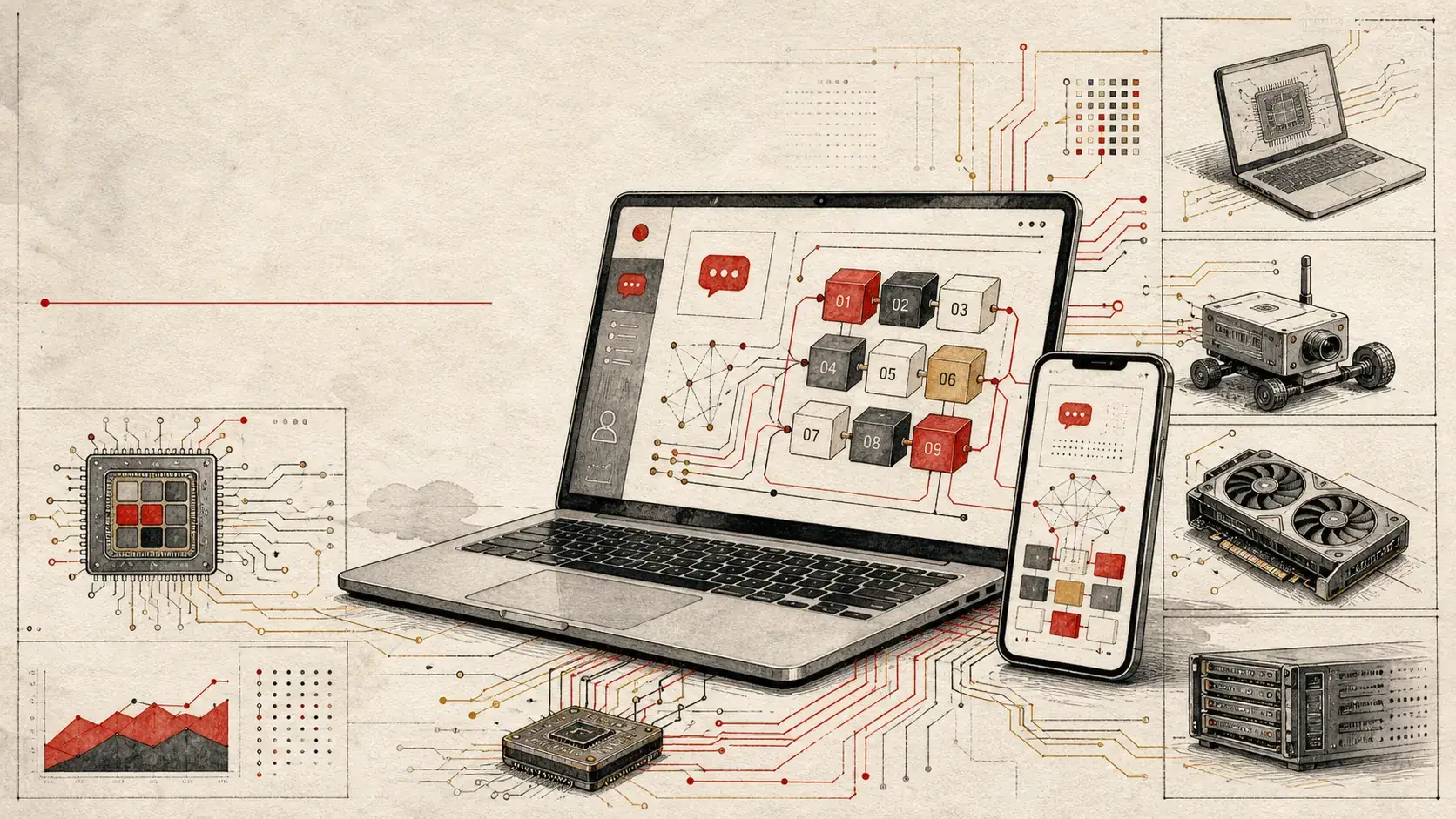
Edge AI is not one device category. It is a stack of form factors, each with different constraints and model winners.
Phones
The phone market prioritizes privacy, offline behavior, and sustained performance inside tight thermal envelopes.
Copilot+ PCs
Windows has turned 40+ NPU TOPS into a platform requirement, then shifted developer access toward Windows ML.
Apple Silicon
Apple is using unified memory, Neural Engine, GPU Neural Accelerators, and Metal APIs as the local model story.
Robotics Edge
NVIDIA Jetson Thor moves edge inference into physical AI with 128GB memory and 2,070 FP4 TFLOPS inside a 130W envelope.
Workstation Edge
Developer workstations blur local prototyping and private inference by keeping larger agent workflows close to the user.
Local Runtime Layer
The winners are the models that travel across llama.cpp, MLX, ONNX, vLLM, SGLang, and vendor inference stacks.
Microsoft has drawn the clearest platform line: Copilot+ PCs require an NPU capable of more than 40 trillion operations per second, and Microsoft says the recommended way to access NPU and GPU acceleration has shifted from DirectML to Windows ML.[11] That matters because it makes local AI a mainstream app-development target rather than a hobbyist runtime problem.
Intel and AMD are competing around that floor. Intel's Lunar Lake, sold as Core Ultra Series 2 mobile processors, reaches 48 NPU TOPS.[13] AMD's Ryzen AI 300 announcement describes an XDNA 2 NPU reaching 50 TOPS.[12] Qualcomm's Snapdragon X line pushes the Arm laptop angle, and later X2 SKUs raise the NPU ceiling further, but the strategic point is the same: the laptop is becoming an AI appliance.
Apple is playing a different game. M5 moved the story toward a 10-core GPU with a Neural Accelerator in each core, an improved 16-core Neural Engine, and 153 GB/s unified memory bandwidth.[14] That shift is telling. For local language models, memory is not a side detail. It is the moat.
NVIDIA is the outlier because its edge systems are not consumer laptops. Jetson Thor delivers up to 2,070 FP4 teraflops, 128GB memory, and a 130-watt power envelope for robotics and physical AI.[15]
The lesson is not that every device will run the same model. The lesson is that the edge market is stratifying. Phones will run compressed multimodal assistants. Laptops will run private productivity agents. Workstations will prototype large local workflows. Robots will run sensor-driven agents where latency is safety-critical.
The edge model race is not only a model race. It is a distribution race.
Google owns Android and AICore. Microsoft owns Windows ML and the Copilot+ PC developer pathway. Apple owns the device, the silicon, the OS frameworks, and the memory architecture. NVIDIA owns Jetson, RTX, DGX Spark, CUDA, TensorRT, and the robotics software stack. Meta owns open-weight distribution and app surfaces. Alibaba owns Qwen's developer mindshare and Apache-licensed local reasoning. Liquid is smaller, but it is betting on a portable architecture and broad runtime support.
That is why LFM2.5 matters. It is not trying to beat GPT-5-class systems at everything. It is trying to be useful exactly where a frontier API is structurally inconvenient: private data, low latency, offline behavior, high call volume, device-local tools, and agent loops that do not justify cloud pricing.
Who Feels The Edge Model Race First
Small model progress changes incentives across the AI stack.
Model labs
The winning small models will be judged by active compute, runtime support, tool calling, and license terms.
Chipmakers
TOPS is now a platform checkbox, but memory bandwidth and software support decide real local model quality.
App developers
Local models create a new product surface: private assistants that can operate before an API call is needed.
Enterprises
Edge models turn internal data into a deployment advantage instead of a compliance risk.
While competitors market raw model size, Liquid was putting the more important number in the name. A1B. Active parameters. That is not cosmetic. It is a signal that model capacity, deployed compute, and device economics are separating.
The License And Benchmark Caveat
LFM2.5-8B-A1B is not Apache 2.0. Hugging Face lists license: other and license_name: lfm1.0; the LFM Open License v1.0 limits commercial use for legal entities at or above $10 million in annual revenue unless they obtain separate permission.[4] Liquid's own model card also says the model is not the best fit for heavy programming or knowledge-intensive question answering without retrieval.[1] This is an edge assistant model, not a universal frontier replacement.
The Bottom Line: Edge Models Are Becoming The Default Front Door
The next AI interface will not always start in the cloud. It will start on the device, decide what can be handled locally, retrieve what the user has permission to see, call tools when needed, and escalate to larger models only when the task deserves the latency, cost, and data movement.
That is the real market behind LFM2.5-8B-A1B. The model is interesting because it compresses serious agent capability into a 1.5B-active workload. The broader race is bigger: Gemma, Phi, Llama, Qwen, SmolLM, Granite, Nemotron, Apple Silicon, Copilot+ PCs, Android AICore, Jetson Thor, and DGX Spark are all converging on local inference as a first-class platform.
The uncomfortable truth for frontier labs is that the edge does not need a perfect model. It needs a model good enough to own the first interaction, cheap enough to run constantly, private enough to trust with user context, and portable enough to ship everywhere.
That is where the next distribution war begins.
Sources & References
Key sources and references used in this article
| # | Source | Outlet | Date | Key Takeaway |
|---|---|---|---|---|
| 1 | Hugging Face Liquid AI | 2026-05-28 | Primary model details: 8.3B total parameters, 1.5B active, 24 layers, 38T tokens, 128K context, benchmarks, runtime formats, tool use, and caveats. | |
| 2 | Liquid AI Liquid AI | 2026-05-28 | Liquid frames LFM2.5 as a hybrid on-device model family with extended pretraining, reinforcement learning, larger vocabulary, and longer context. | |
| 3 | Hugging Face Liquid AI | 2026-05-28 | Config exposes Lfm2MoeForCausalLM, 32 experts, 4 experts per token, 24 layers, 32 attention heads, 8 KV heads, and 128,000 max positions. | |
| 4 | Hugging Face Liquid AI | 2026-05-28 | Commercial use is limited for legal entities with annual revenue of $10 million or more unless separately licensed. | |
| 5 | Google AI for Developers Google | Accessed 2026-06-04 | Gemma 3n uses selective parameter activation, E2B and E4B effective sizes, multimodal inputs, and 32K context for edge deployment. | |
| 6 | Hugging Face Microsoft | Accessed 2026-06-04 | Phi-4 mini is a 3.8B dense model with 128K context, function calling, 5T training tokens, and MIT licensing. | |
| 7 | GitHub Meta | Accessed 2026-06-04 | Llama 3.2 includes 1B and 3B text models with 128K context, up to 9T training tokens, and explicit mobile assistant use cases. | |
| 8 | Hugging Face Qwen | Accessed 2026-06-04 | Qwen3-4B offers thinking and non-thinking modes, 32,768-token native context, 131,072-token YaRN extension, and Apache 2.0 licensing. | |
| 9 | Hugging Face Hugging Face TB | Accessed 2026-06-04 | SmolLM3 is a 3B open model trained on 11.2T tokens with hybrid reasoning, 64K training context, 128K YaRN support, and tool calling. | |
| 10 | Hugging Face IBM Granite | Accessed 2026-06-04 | Granite 3.3 8B is a 128K enterprise model for reasoning, instruction following, RAG, long-document summarization, and document QA. | |
| 11 | Microsoft Learn Microsoft | Accessed 2026-06-04 | Microsoft defines Copilot+ PCs around NPUs with more than 40 TOPS and recommends Windows ML for local NPU and GPU acceleration. | |
| 12 | AMD AMD | 2024-06-02 | AMD positions Ryzen AI 300 around an XDNA 2 NPU reaching 50 TOPS for Copilot+ PC-class local AI workloads. | |
| 13 | Intel Intel | Accessed 2026-06-04 | Intel Core Ultra Series 2 mobile processors include an NPU4.0 block reaching up to 48 TOPS. | |
| 14 | Apple Newsroom Apple | 2025-10-15 | Apple shifts the M5 AI pitch toward GPU Neural Accelerators, a faster 16-core Neural Engine, and 153 GB/s unified memory bandwidth. | |
| 15 | NVIDIA Newsroom NVIDIA | 2025-08-25 | Jetson Thor delivers up to 2,070 FP4 teraflops, 128GB memory, and a 130W power envelope for robotics edge AI. |
Last updated: June 4, 2026