TL;DR: PrismML's Ternary Bonsai 2 27B is not one universal 5.9 GB file. The GGUF PTQ1_0 language model is 5.95 GB, while the MLX multimodal package is 8.60 GB: 7.67 GB for the language model plus a 0.92 GB unquantized vision tower.[1] The system uses 27.36 billion parameters, ternary language weights and a 262,000-token context. PrismML reports 143 tokens per second on an RTX 5090 and 46.8 on an M5 Max, but these are separate vendor measurements under different hardware and kernels, not a direct leaderboard.[2]
The real story isn't that a model got smaller. It is that compression is becoming a deployment strategy. If capable reasoning fits on a workstation, a phone or an edge device, the cloud stops being the default location for every inference.
Why This Matters Now
The Release: Three Files, Three Different Deployment Claims
PrismML publishes multiple representations. The 5.95 GB GGUF PTQ1_0 artifact covers the language model at roughly 1.75 bits per weight. A 7.21 GB PQ2_0 alternative spends more bits for a different quality and runtime tradeoff. The MLX package totals 8.60 GB and stores the language model at 2.25 bits per weight while leaving the 0.92 GB vision tower unquantized.[1]
Those numbers answer different questions. The smallest GGUF file demonstrates language-model density. The MLX package is the relevant number for a Mac user who wants the released vision-language experience. Neither number includes every byte consumed during inference. Runtime buffers, the KV cache, prompt tokens, image preprocessing and the host application still need memory.
The 27B label also compresses several components into one headline. PrismML lists 27.36 billion total parameters: a 24.35 billion language backbone, 2.54 billion parameters in embeddings and the language-model head, and a 0.46 billion vision tower.[1] The compressed language blocks provide most of the memory gain. Embeddings, heads and vision components do not all share the same representation.
The Apache 2.0 license is commercially significant. Teams can inspect, modify and deploy the weights without sending every request to PrismML. The harder dependency is the runtime. A compressed checkpoint delivers its promised advantage only when kernels on CUDA or MLX exploit the representation efficiently.
The Deployment Profile
Language-model artifact at roughly 1.75 bits per weight.
7.67 GB language model plus 0.92 GB vision tower.
Backbone, embeddings and head, plus vision tower.
The Architecture: Compression Works Because the Runtime Understands It
The language backbone combines roughly 75% linear attention with 25% full attention, plus SwiGLU blocks, RoPE position encoding and RMSNorm.[1] Linear attention reduces the cost of processing long sequences, while periodic full-attention layers preserve the global interactions that pure linear designs can lose. A 262,000-token maximum context is therefore an architectural capability, not a promise that a laptop can use the entire window cheaply.
Weights are stored in groups of 128 as values from 1 with an FP16 scale for each group. The scale restores a local magnitude while the ternary values make the bulk of the matrix extremely compact. Native ternary storage has an idealized floor around 1.72 bits per weight once packing and scales are counted. The 1.75-bit GGUF artifact approaches that boundary; the 2.25-bit MLX version makes a different trade for Apple's runtime.
The custom CUDA and MLX kernels matter as much as the checkpoint. They consume the low-bit representation directly instead of expanding every weight back to FP16 before multiplication. If a runtime dequantizes the full model first, the storage win remains but the memory-bandwidth and capacity gains largely disappear.
What Each Number Actually Measures
| Feature | Configuration | Meaning | Missing Context |
|---|---|---|---|
| 5.95 GB | GGUF PTQ1_0 language model | Smallest published language artifact | Vision tower and runtime memory |
| 8.60 GB | MLX multimodal package | Practical Apple package size | KV cache and application overhead |
| 143 tok/s | RTX 5090 with PrismML CUDA kernels | Vendor throughput signal | Prompt length, batch and sustained thermals |
| 46.8 tok/s | M5 Max with MLX | Vendor Apple-silicon signal | Memory tier, prompt processing and power mode |
These configurations differ. Treat them as deployment signals rather than a cross-hardware speed ranking.
The Use Cases: Keep the Frequent and Sensitive Work Local
The first use case is coding-agent loops. Faster local inference shortens the edit, test and repair cycle while avoiding a cloud request for every small step. The second is private document analysis, where a company may prefer to keep contracts, research and internal tickets inside its own hardware boundary.
Multimodal debugging is another fit. Screenshots, logs and documents can be inspected without shipping each artifact to a remote service. In a hybrid architecture, Bonsai can handle high-frequency or sensitive decisions locally, then escalate ambiguous or unusually complex tasks to a larger cloud model.
That last pattern is the important one. Local models do not need to replace frontier systems to change the economics. They only need to remove enough repetitive traffic from the expensive path.
The Compression: Why Ternary Weights Matter
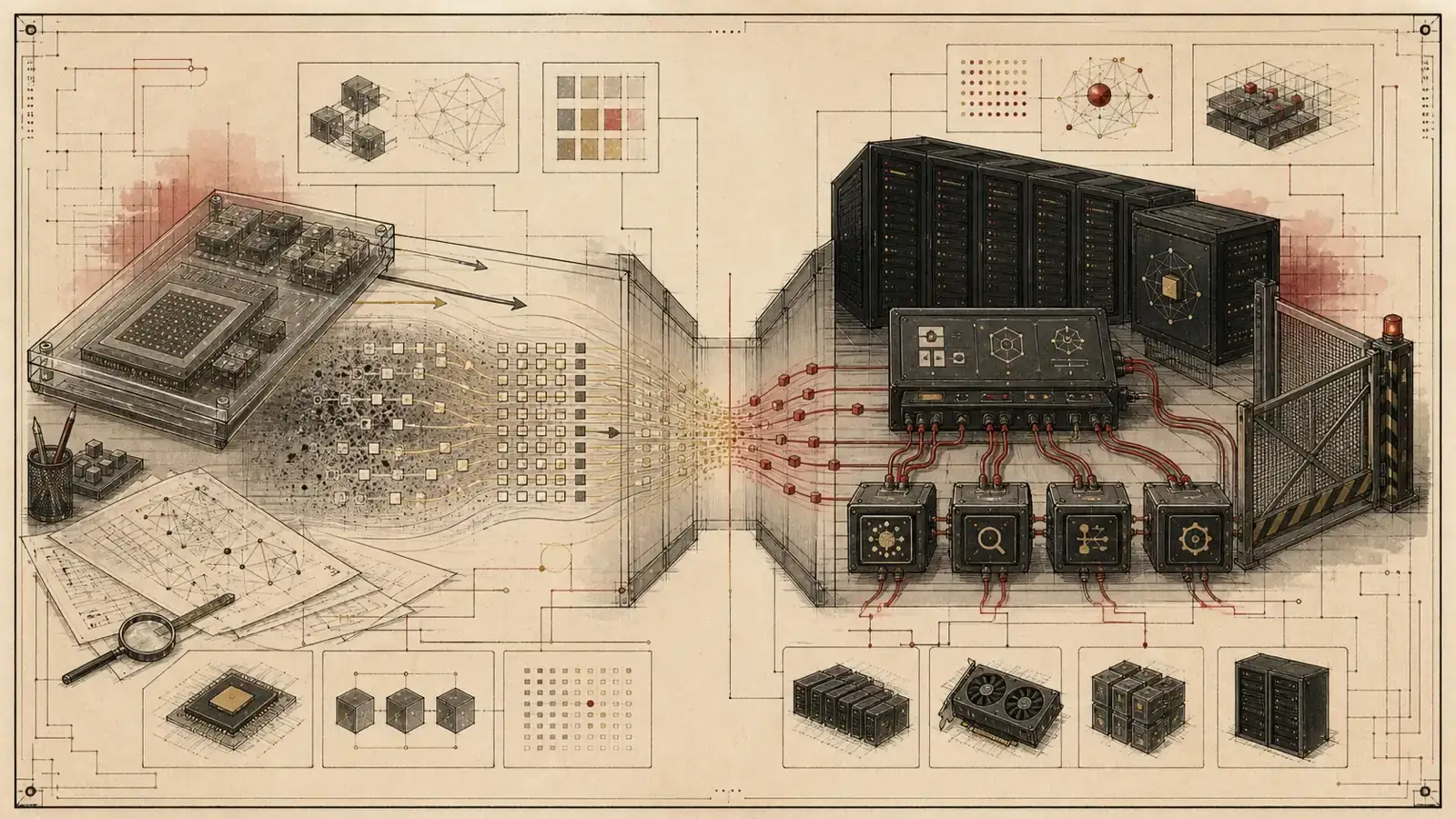
Full-precision weights carry far more numerical detail than a deployment always needs. PrismML’s ternary representation reduces each learned weight to a sign, zero or positive value, then uses group-wise scaling to recover useful magnitude. The result is not a smaller copy made by deleting random parameters. It is a different numerical representation that needs kernels designed to use it efficiently.
That distinction explains why headline memory reduction does not automatically become headline speedup. The runtime must unpack and multiply the compressed representation efficiently, and the hardware must keep the relevant weights fed to the processor. Memory bandwidth, context length, batch size and multimodal preprocessing can dominate the end-to-end result.
Ternary weights also change the optimization problem. The model cannot preserve every full-precision value, so post-training must decide which information survives the projection into three states. Group-wise scaling restores some magnitude information, but the representation remains an approximation. The impressive part of Bonsai 2 is not that compression is free. It is PrismML’s claim that the remaining error is small enough across reasoning, coding, vision and tool use to unlock different hardware.
That claim must be tested for brittle capabilities. Multi-step agents can amplify a small per-step quality loss. A one-point decline in tool selection may look minor in a benchmark average and become substantial across twenty sequential decisions. Local deployment needs end-to-end task success, not only single-turn scores.
The Deployment Math: Capacity Is More Than Model Size
The 5.95 GB language artifact, or 8.60 GB MLX multimodal package, may leave room for an operating system, runtime, KV cache and application on a high-end device. It does not mean every phone can run the model comfortably. Long contexts grow the cache, image inputs add preprocessing cost and background inference competes with battery and thermal limits. The right question is whether a complete workflow fits within a device's memory and power envelope.
For a production test, record cold start, time to first token, sustained tokens per second, peak memory, energy per task and quality on the actual workload. Compare those results with a cloud baseline that includes network latency and data-transfer cost. That is the evidence needed to decide whether local inference is cheaper, faster or simply more private.
The People: Compression Is a Research-to-Product Bet
TechCrunch identifies PrismML as a Caltech-founded company led by professor Babak Hassibi, with Ion Stoica as an adviser, and reports a $22.25 million seed round.[3] PrismML told the publication that its first model reached 11 million downloads and smaller releases added 2.6 million. Those are company figures and downloads are not active deployments, but they show the distribution strategy: publish inspectable artifacts, build developer demand, then sell compression and runtime expertise.
The company also discussed models with several hundred billion parameters. Scaling is not automatic. Larger models increase packing complexity, kernel demands and the cost of measuring regressions. A technique that preserves aggregate quality at 27B can still lose a rare but commercially critical ability at a larger size.
The Hardware Question: Local Does Not Mean Free
Running a model on a device removes a network round trip and can keep data inside a company’s boundary. It also moves the bill into hardware depreciation, thermal management, memory pressure and battery drain. A laptop that handles one coding agent comfortably may struggle when four users share a workstation or when the same model runs beside a video call.
The right comparison is a complete service envelope. Measure cold start and warm throughput, then run a sustained workload until the device reaches its thermal steady state. Record quality after long context accumulation, because a model that is fast for the first prompt may slow down when its cache grows. Privacy is a strong benefit, but it does not excuse weak operational measurement.
Phones present the hardest version of that test. A 5.95 GB language file is already a large resident asset, and the 8.60 GB multimodal MLX package is larger before runtime overhead. Both compete with the operating system, applications, graphics and KV cache. High-end devices may load a suitable build, but loading is not the same as delivering an acceptable interactive experience. Thermal throttling, memory pressure and battery drain can turn a successful demo into a poor daily product.
Workstations are the more forgiving target. A Mac with unified memory or a gaming PC with a modern GPU can keep sensitive code and documents local while avoiding per-token cloud fees. For enterprises, the privacy boundary may justify the hardware even when the raw cost per inference is not lower.
The Open-Source Test: Downloads Are Not Deployments
Apache 2.0 weights make experimentation easier, and the Hugging Face collection gives developers a concrete artifact to inspect.[4] Downloads still measure curiosity more than production adoption. A serious release needs reproducible kernels, clear quantization behavior, model cards that disclose evaluation conditions and tooling that survives an upgrade.
PrismML’s strategic claim is therefore larger than “27B fits on a device.” It is that intelligence density can become a first-class engineering metric. If independent teams can reproduce the speed, energy and quality tradeoffs, compression stops being a clever demo and becomes a new layer of the AI stack.
The Benchmark Breakdown: Aggregate Scores Hide the Trade
PrismML reports an overall score of 83.9 for Ternary Bonsai 2 27B versus 85.4 for full-precision Qwen3.8 27B.[1] The gap is not uniform. The compressed model reports 81.58 across the company’s coding aggregate versus 82.17 for the base model, while knowledge and reasoning fall from 86.66 to 83.95. Instruction following moves in the other direction, from 81.25 to 82.66. Those movements are why “98.2% retained” cannot substitute for workload-level evaluation.
The Hugging Face MLX card separately reports 84.78 across 14 thinking benchmarks. That figure should not be merged with the 83.9 release aggregate because the suites and packaging are not stated as identical.[4] The apparent discrepancy is a methodology warning, not evidence that either number is false. Readers need the exact task list, prompt templates, scoring code and model artifact before interpreting a decimal-point difference.
The deployment numbers also need their full conditions. PrismML reports up to 143 tokens per second on an RTX 5090, 46.8 tokens per second on an M5 Max and 0.714 mWh per token on an RTX 4090.[1] Different chips, kernels and workloads make those separate signals, not a hardware leaderboard. Time to first token, context length, prompt processing and sustained thermals remain essential.
The strongest near-term buyer may not be a phone user. It may be a company that can fit more private agents onto existing workstations or serve more concurrent jobs per GPU. Nine times less weight memory changes capacity planning even when the model never leaves the data center.
The Competitive Landscape: Compression Is Becoming a Product Category
PrismML is not alone. Quantization is already standard across GGUF, MLX and commercial inference stacks, while companies such as Multiverse Computing are pursuing aggressive compression of their own. PrismML’s differentiation is the claim that ternary models can preserve almost all useful capability while delivering purpose-built kernels and a family of downloadable models.
The defensible asset may therefore be the compression process and runtime rather than any single checkpoint. Base models improve quickly. A company that can convert each new open model into a dense local version, verify the loss and ship optimized kernels can ride that improvement without paying to train every foundation model from scratch.
The risk is commoditization. If upstream labs publish equally strong low-bit versions, or open-source runtimes close the kernel gap, PrismML must win through speed of release, device partnerships and domain-specific post-training. The company’s reported conversations with device makers matter only if they become shipping integrations.
The Caveat: “98.2%” Is Not Lossless Intelligence
PrismML’s aggregate score compares a suite of benchmarks, and the company reports uneven results across coding, reasoning, vision and tool use.[1] A two-percent aggregate gap can hide a serious regression in one workflow and no meaningful difference in another. The release also uses custom low-bit kernels and specific hardware, so independent reproduction matters.
What We Have Not Established
What's often overlooked is that model compression changes bargaining power. More intelligence can run on hardware users already own, with less recurring cloud spend and fewer data transfers. That does not kill the data center. It makes the boundary between device and cloud programmable.
Sources & References
Key sources and references used in this article
| # | Source | Outlet | Date | Key Takeaway |
|---|---|---|---|---|
| 1 | PrismML | September 17, 2026 | Architecture, artifact sizes, parameter breakdown, benchmarks and license. | |
| 2 | PrismML | Accessed September 19, 2026 | Vendor-reported CUDA, MLX and energy measurements. | |
| 3 | TechCrunch | September 17, 2026 | Reporting on the founders, $22.25 million seed round, downloads and scaling plans. | |
| 4 | Hugging Face | Accessed September 19, 2026 | MLX package composition, 2.25-bit storage, architecture and 14-benchmark result. | |
| 5 | Hugging Face | Accessed September 19, 2026 | Public GGUF and MLX artifacts. | |
| 6 | Hugging Face | Accessed September 19, 2026 | Upstream model family and public artifacts. | |
| 7 | Apple ML Research | Accessed September 19, 2026 | Array and model runtime used for Apple-silicon deployment. | |
| 8 | Apache Software Foundation | Accessed September 19, 2026 | Terms governing the released weights. | |
| 9 | ggml | Accessed September 19, 2026 | Container format used by the compact language-model releases. |
Last updated: September 19, 2026