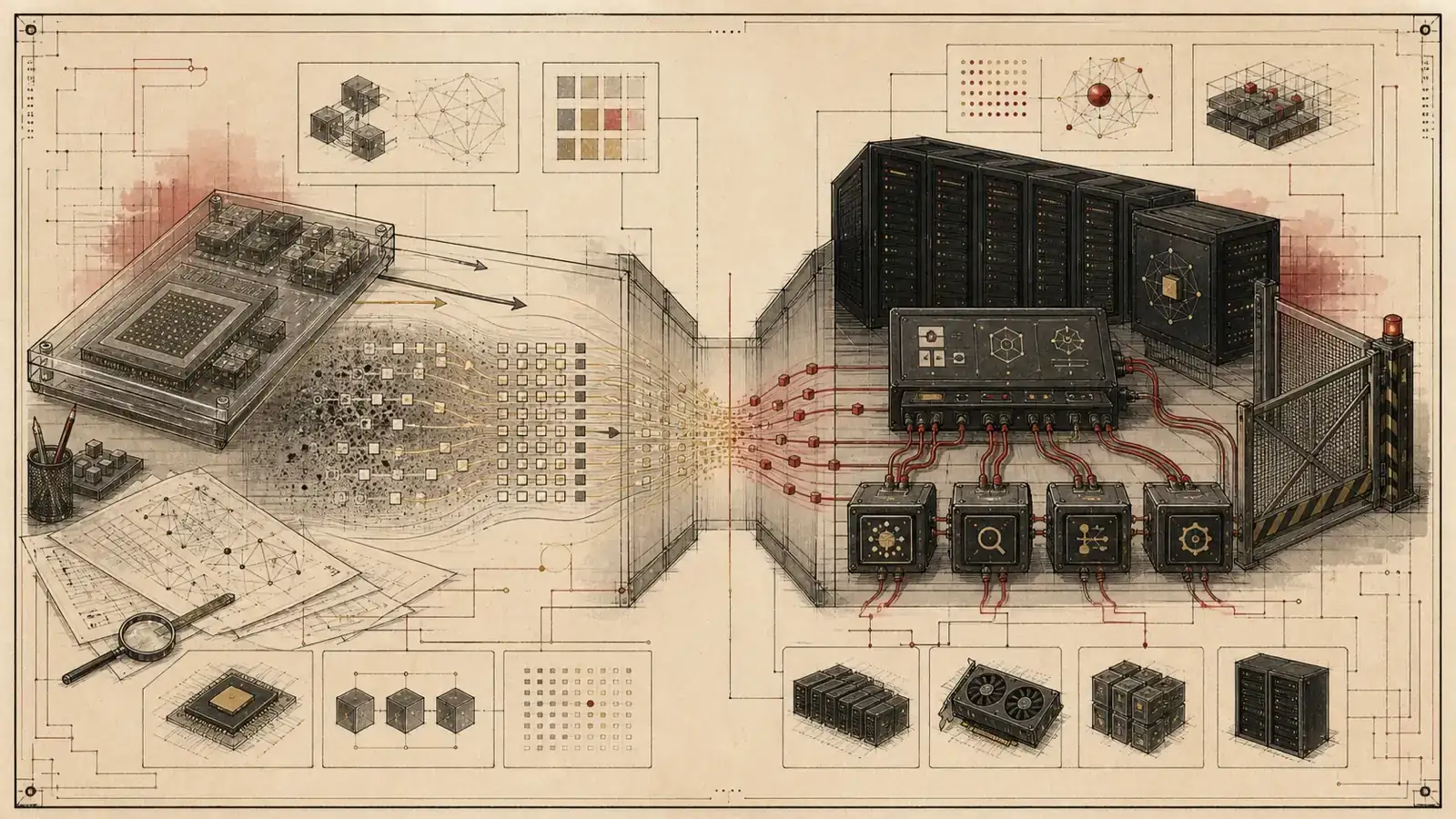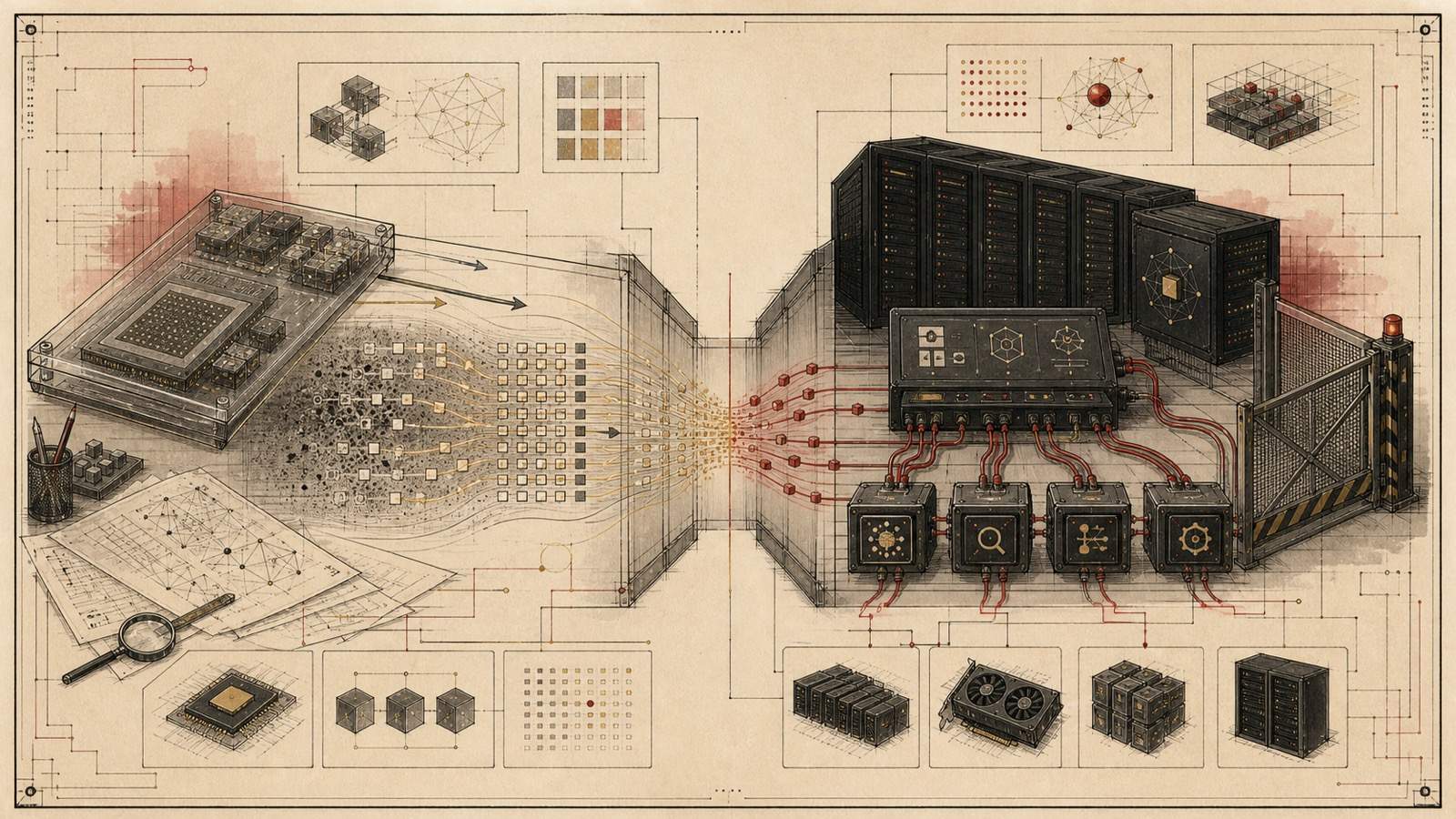
TL;DR: Google released DiffusionGemma on June 10, 2026 as an Apache 2.0 open-weights diffusion language model with 25.2B total parameters, 3.8B active parameters, a 256-token canvas, and Google-claimed 1,000+ tok/s generation on a single H100.[1][2] Inception's Mercury 2 makes the closed-source case for the same architectural shift, with a realtime subagent story built around context compaction, tool search, routing, and customer claims of 82 percent lower summarization latency and 90 percent lower cost.[6] The real story isn't that diffusion beat autoregression everywhere. It is that the fast subagent layer is moving from proprietary API advantage to open infrastructure competition.
DiffusionGemma looks, at first, like a technical footnote. Google took the Gemma 4 26B A4B mixture-of-experts base, added discrete diffusion, made generation happen in 256-token blocks, and published the weights. That is the launch-post version.
That is not the real story.
The real story is that Inception Labs spent the spring making the closed-source case for diffusion LLMs, then Google answered with a model that developers can download, quantize, serve, inspect, and fine-tune. Mercury 2 says diffusion belongs inside a managed realtime subagent platform. DiffusionGemma says the primitive is too important to stay locked behind an API.
Why This Matters Now
Agent systems are no longer one expensive model call. They are chains of planners, codebase explorers, summarizers, retrievers, routers, tool callers, and verification loops. The model that wins those repeated utility calls does not need to be the smartest model in the world. It needs to be fast, cheap, controllable, and available everywhere. That is why DiffusionGemma matters.
This is also why the open-source argument is back. The question is not whether closed labs can ship excellent APIs. They can. The question is whether the infrastructure layer underneath AI agents will become a metered proprietary service or a developer-owned substrate. History keeps giving the same answer. Linux won servers. Kubernetes won orchestration. Open model serving is trying to do the same thing to AI inference.
The Diffusion Subagent Race
DiffusionGemma and Mercury 2 attack the same latency problem from opposite distribution models.
Google's model card lists 25.2B total parameters on a Gemma 4 26B A4B MoE base.
Only 3.8B parameters are active during inference, which is the hardware story behind the local deployment pitch.
DiffusionGemma denoises a 256-token canvas in parallel before committing the block.
vLLM reported 1,288 generation tokens per second on H200 with FP8 DiffusionGemma at batch size 1.
Inception lists $0.25 per million input tokens and $0.75 per million output tokens for Mercury 2.
Inception says Augment cut summarization latency by 82 percent after moving compaction to Mercury 2.
The Real Story: Diffusion Became A Distribution Fight
Let's be clear: diffusion language models are not new because someone discovered parallelism last week. The research thread has been around for years. What changed is product timing. Inception packaged diffusion as a paid low-latency API for production agent loops. Google packaged diffusion as an open model that can sit inside the developer stack.
That is a very different power structure.
Inception's argument is operational. Production AI systems now use many small specialists, not one monolithic model. Its realtime subagents post points to context compaction, task routing, tool search, handoffs, output checks, and structured summaries as the repeated calls that make agents slow when every step uses a heavyweight autoregressive frontier model.[6] Mercury 2 is built to make those loops feel instant.
Google's argument is infrastructural. DiffusionGemma is released under Apache 2.0, available on Hugging Face, and supported across vLLM, Hugging Face Transformers, MLX, SGLang, Unsloth, NVIDIA NeMo, and more.[1][3][5] That means developers do not just rent the latency improvement. They can own it, change it, compress it, and route around it.
Here is the genius. Inception proved the job to be done. Google made the job portable.
Two Diffusion Strategies
| Feature | DiffusionGemma | Mercury 2 |
|---|---|---|
| Distribution | Apache 2.0 open weights on Hugging Face | Closed API and enterprise deployment path |
| Core pitch | Own the fast local subagent layer | Rent a managed realtime reasoning model |
| Architecture | Gemma 4 MoE with 256-token block diffusion | Diffusion LLM with parallel refinement |
| Developer control | Fine-tune, quantize, self-host, inspect serving stack | Use API-compatible endpoint and vendor platform |
| Best workload | Local and low-to-medium batch inference | Production loops where managed latency matters |
| Strategic risk | Quality gap versus Gemma 4, hardware burden shifts to user | Vendor dependency, opaque weights, pricing and policy control |
The conclusion is sharper than the normal "open versus closed" debate. Closed models can lead the market. Open models commoditize the layer once the market understands what the layer is for.
The Architecture: Diffusion Turns Waiting Into Parallel Work
Traditional language models generate like a typewriter. One token appears, then the next token can be computed, then the next. That is efficient at high cloud scale because providers batch many users together. It is less efficient when one developer, one local agent, or one interactive tool is waiting on a single response.
DiffusionGemma changes the shape of the workload. It starts with a canvas of random tokens, refines the whole canvas over multiple denoising steps, locks in confident positions, renoises uncertain ones, and then commits the finished 256-token block back into the sequence.[2][4] Within the block, tokens can attend bidirectionally. Across blocks, generation remains sequential enough to preserve long-form coherence.
How DiffusionGemma Generates Text
The model is still language-model infrastructure, but its inner loop is built around block refinement instead of one-token decoding.
Prefill the prompt
The encoder processes the prompt context and writes it into the KV cache using causal attention.
Create a noisy canvas
The decoder initializes a fixed 256-token canvas and starts from uncertain placeholder tokens.
Refine in parallel
Every canvas position attends to the other positions, confident tokens lock in, uncertain tokens are renoised, and the block snaps into focus.
Commit the block
Once predictions stabilize, the block is committed to the sequence and the next 256-token canvas begins.
The hardware story is the business story. Google says DiffusionGemma shifts the bottleneck from memory bandwidth to compute, reaching 1,000+ tokens per second on a single H100 and 700+ tokens per second on an RTX 5090 in the intended regime.[1] vLLM's FP8 benchmark was even more specific: 1,008 tok/s on H100 and 1,288 tok/s on H200 at batch size 1.[4]
Reported at batch size 1, about 6x a standard autoregressive baseline in vLLM's benchmark.
That number should not be abused. DiffusionGemma is strongest in local, single-user, and low-to-medium batch workloads. Google explicitly warns that high-QPS cloud serving can reduce the advantage because autoregressive systems can already saturate compute through batching.[1] It also warns that Apple Silicon systems may not see the same acceleration because unified memory can stay memory-bandwidth bound.[1]
That caveat makes the model more interesting, not less. DiffusionGemma is not trying to replace every frontier serving cluster. It is trying to own the moment when a local agent, editor, notebook, desktop assistant, or workflow subagent needs a fast block of useful text right now.
The Closed-Source Proof: Inception Found The Subagent Market
Inception's realtime subagents post is the missing context for DiffusionGemma. The post argues that future AI systems are multi-agent systems with planners, explorers, compactors, routers, checkers, and specialized task workers.[6] That is not marketing fluff. Anyone using coding agents already sees it. The visible assistant is only the front desk. Behind it are repeated, boring, latency-sensitive model calls.
Context compaction is the cleanest example. A coding agent burns through a long trajectory of tool calls, diffs, shell logs, user edits, failures, and decisions. Eventually it needs a compact summary that preserves the state of the work without dragging the full history forward. If that summary takes minutes, the agent feels broken. If it takes seconds, the system can keep moving.
Inception says it tested this with 250 multi-turn trajectories from SWE-chat and 250 from SWE-smith, generated 4 probe questions per trace, then scored whether model summaries preserved the information needed to answer those probes.[6] The company positions Mercury 2 as the only model in the "Fast & Good" quadrant and says it is roughly 5x faster than Sonnet 4.6 while matching quality.[6]
The customer proof point is stronger. Inception says Augment Code moved compaction from a primary model like Opus 4.7 to Mercury 2, cutting summarization latency by 82 percent from roughly 150 seconds and reducing cost by 90 percent while preserving quality.[6] It also says Mercury 2 powers Augment's Prism router, reducing total LLM spend by 30 percent, and returns MCP tool-search summaries in under a second.[6]
Where Real-Time Subagents Show Up
The subagent thesis is not about replacing the main model. It is about removing latency from the repeated utility calls around it.
Compress
Long traces are summarized so agents can continue without dragging every prior token forward.
Context compaction
Summarize decisions, relevant files, unresolved work, and next steps from a long trajectory.
Challenges:
- +Losing critical facts
- +Slow summarization
- +High token cost
Route
Requests are classified and sent to the cheapest model that can handle the work.
Model routing
Select specialized models for search, coding, extraction, or final synthesis.
Challenges:
- +Quality cliffs
- +Opaque vendor decisions
- +Routing drift
Verify
Fast models check outputs, summarize tools, and keep the main loop moving.
Utility checks
Run summaries, validations, retrieval distillation, and structured outputs beside the primary agent.
Challenges:
- +Reliability
- +Schema adherence
- +Hidden policy behavior
Here is the uncomfortable truth for closed labs. Inception did the market a favor by naming the workload. Once a workload is named, it can be replicated. Once it can be replicated, open infrastructure starts eating the margin.
The Open-Weights Counterpunch: DiffusionGemma Makes The Primitive Portable
DiffusionGemma's biggest feature is not the speed number. It is the permission model.
The model is Apache 2.0 open weights. It is on Hugging Face. It has a Google model card. It has a developer guide. It has vLLM support. It has quantized checkpoints. It has NVIDIA optimization. By our June 21 check, the Hugging Face page showed 601,208 downloads in the previous month, 26 quantizations, 10 fine-tunes, and 10 Spaces.[5] That is how open infrastructure spreads. Not by winning every benchmark on day one, but by creating a surface area where everyone else can build.
NVIDIA's angle is predictable but important. DiffusionGemma runs on RTX, RTX PRO, DGX Spark, and DGX Station, with NVIDIA citing 1,000 tok/s on H100, 150 tok/s on DGX Spark, and up to 2,000 tok/s on DGX Station in the single-user regime.[8] Google says quantized deployment can fit within 18GB VRAM limits on high-end dedicated consumer GPUs.[1]
That changes the political economy of subagents. A closed Mercury 2 call is convenient. An open DiffusionGemma deployment is a bargaining chip. It gives startups, researchers, and enterprise teams a credible alternative when the API price changes, the model behavior shifts, the data policy tightens, or the vendor decides a research topic is too sensitive.
Open source does not win every application. It wins the layer everyone else needs to compose, debug, fork, secure, and price against.
This is the same lesson we argued in the Claude Fable coverage. When a closed provider silently shapes model capability, researchers lose the ability to know whether a failed result came from their idea, their implementation, or an invisible intervention by the model company. Read that context here: Claude Fable 5: Anthropic's Frontier Model Is A Capability Rationing Test.
DiffusionGemma is not perfect openness. Google did not publish the training data. The model card lists web documents, code, images, audio, and a January 2025 training cutoff, but the dataset itself remains a large-lab artifact.[2] Still, compared with a closed API, open weights change what users can verify. They can test refusal behavior. They can inspect serving code. They can run local evals. They can fine-tune for Sudoku, code infill, document parsing, or internal routing tasks. They can disagree with the provider and still keep building.
That is the point.
The Quality Gap: Google Did Not Pretend This Was Free
The strongest version of the DiffusionGemma argument admits the weakness directly. Google says standard autoregressive Gemma 4 remains the better choice when maximum quality matters.[1] The model card backs that up.
DiffusionGemma trails Gemma 4 26B A4B on MMLU Pro, 77.6 percent versus 82.6 percent. It trails on AIME 2026 without tools, 69.1 percent versus 88.3 percent. It trails on LiveCodeBench v6, 69.1 percent versus 77.1 percent. It trails on GPQA Diamond, 73.2 percent versus 82.3 percent. It trails on Codeforces, 1429 ELO versus 1718.[2]
DiffusionGemma vs Gemma 4: The Tradeoff
| Feature | DiffusionGemma 26B A4B | Gemma 4 26B A4B |
|---|---|---|
| MMLU Pro | 77.6 percent | 82.6 percent |
| AIME 2026 no tools | 69.1 percent | 88.3 percent |
| LiveCodeBench v6 | 69.1 percent | 77.1 percent |
| GPQA Diamond | 73.2 percent | 82.3 percent |
| Codeforces | 1429 ELO | 1718 ELO |
| HLE no tools | 11.0 percent | 8.7 percent |
That looks damning only if you think every model has to be the best general model. It does not. Utility subagents are judged differently. A compactor that is 90 percent cheaper and fast enough to keep an agent loop alive can be valuable even if it is not the best research mathematician. A code-infilling helper that updates a local editor instantly can be valuable even if a larger model would write a slightly better final solution. A router that cuts spend by 30 percent can reshape product economics even if it never appears in a chatbot leaderboard.
What's often overlooked is that Google also demonstrated task adaptation. Its developer guide says a base DiffusionGemma setup had roughly 0 percent success on Sudoku, while a JAX SFT recipe raised correctness to 80 percent and reduced inference steps, with the fine-tuned model solving after 12 steps where the base failed after 48.[3]
That is the open-source win condition. Not "best model out of the box." Better phrasing is "best model that a community can bend toward a narrow, profitable, local problem."
The Strategy: Open Source Wins The Infrastructure Layer
Open source has always had an unfair advantage once a technology becomes infrastructure. It lets competitors cooperate below the product line. It lets buyers avoid lock-in. It lets developers learn the system instead of merely consuming it. It lets every vendor sell differentiation above a shared base rather than forcing every team to reimplement the base.
The 2026 State of Open Source report makes this less ideological than it sounds. OSI, Perforce OpenLogic, and the Eclipse Foundation found that 55 percent of respondents cited avoiding vendor lock-in as a driver of open-source adoption, a 68 percent year-over-year increase. It also found that less than 2 percent of organizations decreased open-source consumption, meaning 98 percent increased or maintained usage.[9]
The Linux Foundation's ROI report is even more blunt. It says active contribution produces 2-5x returns on investment, and that the top 100 open-source contributors gained $23.2 billion in benefits from $3.9 billion invested between 2018 and 2025, roughly a 6x increase.[10] Kubernetes gives the adoption proof. CNCF says Kubernetes became the primary container orchestration tool for 71 percent of Fortune 100 companies after starting as a Google project and moving under CNCF.[11]
That is the pattern. A major lab creates a primitive. The primitive becomes too valuable to stay inside one company's product boundary. Developers demand neutrality. Vendors build around the shared layer. The market moves from invention to ecosystem.
Who Wins If Diffusion Becomes Open Infrastructure
The open-source advantage is uneven, but the upside concentrates where control matters most.
Independent researchers
They can study diffusion decoding behavior without asking a model provider for permission.
Startups
They can price against closed APIs and keep fast utility calls in their own stack.
Enterprises
They get an exit path from black-box subagent infrastructure.
Closed labs
They still win managed reliability, frontier quality, and enterprise support, but the primitive gets harder to monopolize.
The uncomfortable truth is that open source does not need to defeat Mercury 2 on every metric to pressure Inception. It only needs to make the buyer ask a dangerous question: "Why are we renting this utility layer forever?"
The Developer Reality: Use Both, But Do Not Confuse Convenience With Control
There is a practical answer here. Most serious teams will use both.
Mercury 2 is attractive if you want a fast managed model, OpenAI API compatibility, schema-aligned JSON, native tool use, 128K context, and pricing at $0.25 per million input tokens and $0.75 per million output tokens.[7] It is especially attractive if your product already depends on managed inference, tight latency budgets, and vendor support.
DiffusionGemma is attractive if the workload is local, private, high-volume, experimental, or narrow enough to fine-tune. It is also attractive if your organization worries about vendor lock-in, hidden model changes, per-token margins, data retention, or research controls. The model is not free because hardware is not free. But the control surface is different.
When To Use Which
| Feature | Use DiffusionGemma | Use Mercury 2 |
|---|---|---|
| Local editor assistance | Strong fit because low-batch local speed matters | Useful if managed latency beats local hardware |
| Context compaction | Strong if traces are private or workloads are repeatable | Strong if you value managed performance and vendor tuning |
| Tool search summaries | Good for internal catalogs and custom MCP workflows | Good when sub-second managed output matters |
| Sensitive enterprise data | Better control if self-hosted | Possible with enterprise terms, but trust shifts to vendor |
| Best general reasoning | Not the default choice versus stronger AR models | Not necessarily the default versus larger frontier models |
| Platform strategy | Own the primitive and route around vendors | Buy speed and focus on product integration |
Let's be clear: "open" is not magic. Open weights can still be trained on opaque data. Open models still need governance. Open-source users can still underinvest in maintenance, security, and upstream contribution. OSI's report warns that open source at scale creates operational responsibility, not a free lunch.[9]
But closed-source convenience has its own cost. You get the latency. You also inherit the vendor's pricing, policy, retention, routing behavior, availability, and strategic incentives. The more agent systems depend on repeated background model calls, the more that dependency matters.
The Key Strategic Point
DiffusionGemma does not have to be the best model to matter. It has to make fast diffusion decoding reproducible, portable, and cheap enough that every serious agent platform can build its own subagent layer. That is how an API moat turns into an infrastructure commodity.
The Open Source Verdict: The Primitive Is Escaping
The conclusion is not that Google is suddenly the hero of open AI. Google is still a giant lab with its own platform incentives. DiffusionGemma is an open-weights release, not a fully transparent research pipeline. The training data is not public. The safety system is not community-governed. The model is still shaped by a corporate roadmap.
The conclusion is sharper than that. Inception showed that diffusion LLMs are useful where latency compounds: compaction, routing, tool search, and subagent orchestration. Google showed that the primitive can be released into the open ecosystem with enough performance to make developers take it seriously. vLLM showed that the serving stack can absorb a non-autoregressive model without rewriting the entire world. NVIDIA showed that local hardware vendors will happily turn it into a workstation story.
That is how open source wins. First it looks behind. Then it becomes good enough. Then it becomes everywhere. Then the closed product has to justify why the default layer should still be rented.
Mercury 2 may be faster in a managed stack. DiffusionGemma may be rougher, more experimental, and lower quality than Gemma 4. But the direction is obvious. The realtime subagent layer is too strategic, too repeated, and too close to the developer workflow to remain purely proprietary.
Open source wins when the primitive matters more than the product wrapper. DiffusionGemma is the first serious sign that diffusion LLMs have entered that phase.
What To Watch Next
DiffusionGemma should be judged as utility-agent infrastructure, not as a universal frontier replacement. The right comparison is compaction, routing, code infill, and fast local loops.
Mercury 2 proves that realtime subagents are commercially valuable. DiffusionGemma proves that the underlying latency primitive is no longer confined to a closed API.
The decisive question is whether open serving stacks such as vLLM, MLX, SGLang, llama.cpp, and vendor quantizations can make diffusion decoding operationally boring.
The quality gap against Gemma 4 matters, but it does not kill the thesis. Open infrastructure wins by becoming modifiable, cheap, and ubiquitous before it becomes perfect.
The deeper open-source argument is about power. If subagents become the hidden engine of AI products, developers will want to own that engine, not rent it forever.
Sources & References
Key sources and references used in this article
| # | Source | Outlet | Date | Key Takeaway |
|---|---|---|---|---|
| 1 | Google Blog Brendan O'Donoghue and Sebastian Flennerhag | Jun 10, 2026 | Google announced DiffusionGemma as an Apache 2.0 experimental open model with up to 4x faster generation, 1,000+ tok/s on H100, and a 3.8B active-parameter MoE footprint. | |
| 2 | Google AI for Developers Google DeepMind | Jun 2026 | The model card lists the architecture, 25.2B total parameters, 256K context, 256-token canvas, benchmark gaps versus Gemma 4, and training data cutoff. | |
| 3 | Google Developers Blog Ian Ballantyne and Omar Sanseviero | Jun 10, 2026 | Google explains serving, 256-token block autoregressive denoising, vLLM deployment, and the Sudoku SFT example that lifted success to 80 percent. | |
| 4 | vLLM Blog vLLM Team | Jun 10, 2026 | vLLM reports FP8 DiffusionGemma at 1,288 tok/s on H200 and 1,008 tok/s on H100 at batch size 1, while explaining the serving changes needed for diffusion decoding. | |
| 5 | Hugging Face Google | Jun 2026 | The Hugging Face model page provides the downloadable open weights, Apache 2.0 license, usage examples, download count, Spaces, fine-tunes, and quantizations. | |
| 6 | Inception Labs Inception Labs | May 12, 2026 | Inception frames Mercury 2 as a fast diffusion model for subagents, citing context compaction, routing, tool search, Augment latency and cost reductions, and Prism routing savings. | |
| 7 | Inception Labs Stefano Ermon | Feb 24, 2026 | The Mercury 2 launch post lists 1,009 tok/s on Blackwell GPUs, $0.25 per million input tokens, $0.75 per million output tokens, 128K context, tool use, and JSON output. | |
| 8 | NVIDIA Blog Michael Fukuyama | Jun 10, 2026 | NVIDIA positions DiffusionGemma as local AI infrastructure across RTX, RTX PRO, DGX Spark, and DGX Station, including claims of up to 2,000 tok/s on DGX Station. | |
| 9 | Open Source Initiative Open Source Initiative | Apr 28, 2026 | The report shows vendor lock-in as a major driver of open-source adoption, with 55 percent of respondents citing it and 98 percent increasing or maintaining usage. | |
| 10 | Linux Foundation Linux Foundation | Feb 24, 2026 | Linux Foundation Research says active open-source contribution produces 2-5x ROI, with top contributors gaining $23.2B from $3.9B invested between 2018 and 2025. | |
| 11 | CNCF Cloud Native Computing Foundation | Jun 8, 2023 | CNCF documents Kubernetes as the second largest open-source project after Linux and the primary container orchestration tool for 71 percent of Fortune 100 companies. | |
| 12 | LLM Rumors Plutonous | Jun 12, 2026 | Prior LLM Rumors analysis argued that invisible model capability shaping breaks trust for researchers and competitors evaluating frontier systems. |
Last updated: June 21, 2026